Don’t give your dog pork bones. Raw or cooked, the FDA says it makes no difference, and it says the same about the size of the bone.
Pork bones splinter into sharp pieces. Those cut the mouth, can lodge in the esophagus or the intestine, and can puncture the stomach wall. Raw pork also brings Salmonella and Trichinella spiralis, on top of the injury risk.
Between November 2010 and September 2017, the FDA received about 68 reports covering about 90 dogs that ate processed bone treats. Some were sold as “Ham Bones” or “Rib Bones”, and others as “Pork Femur Bones” (FDA, 2017). About 15 dogs died.
Are pork bones safe for dogs?
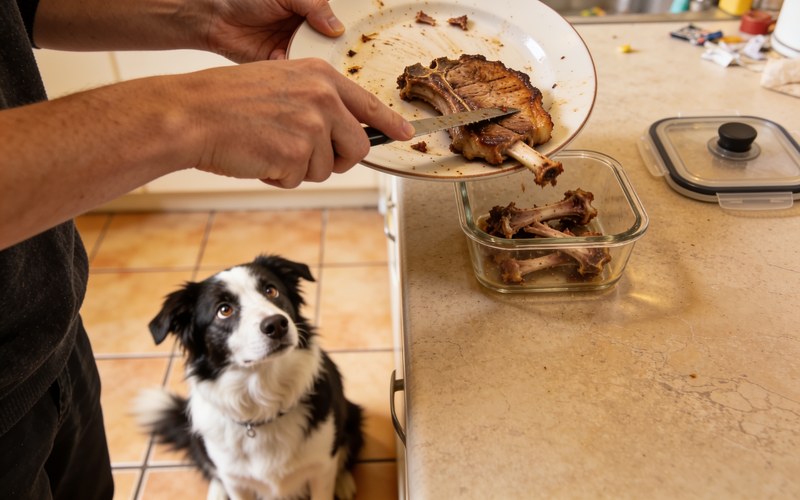
No, and cooking doesn’t change that. Hard fragments hurt the mouth and gut, and raw pork carries pathogens besides. The FDA’s position is that bone size doesn’t matter either.
Cooked pork bones
According to the AKC, cooked pork bones splinter and crack under chewing. The fragments can cause choking and intestinal blockage, or damage the esophagus and intestines.
Smoking or baking doesn’t help. The FDA notes that processed bone treats may be dried by smoking or baking, and some contain preservatives, plus seasonings or smoke flavorings. A dog-treat label on a ham or knuckle bone does not make it any safer than the one from your dinner plate.
Raw pork bones
The AKC puts raw pork bones in the same unsafe category as cooked ones. Raw does not mean gentle.
Hard chewing can break teeth. Pieces swallowed whole can lodge in the throat or gut, and raw pork brings bacteria and parasites along with it.
One caveat on the numbers. The FDA’s bone-treat tally covers processed treats, not uncooked butcher-type bones, so it can’t isolate raw pork bones. The warning against them rests on the same injury mechanisms.

What the FDA, AVMA and AKC advise
The FDA’s Consumer Update says bones are unsafe for dogs regardless of size. It was first published in 2015, on a topic the agency has covered since 2010, and the report counts were updated in 2017.
The AKC says pork bones are unsafe raw or cooked, because they splinter and large dogs swallow small ones whole. Purina doesn’t think pork bones make a good treat, cooked or raw, and points to specially formulated dental chews instead.
The AVMA comes at it from the pathogen side. It discourages feeding dogs and cats any raw or undercooked animal-sourced protein, pork included.
They don’t agree on everything. The AKC accepts large raw cow or bison bones that a dog cannot swallow, under supervision. The FDA carves out no such exception.
Which pork bones are the riskiest?
None of them is safe, but each cut fails in its own way. Thin bones get swallowed in pieces, and dense ones break teeth.
| Bone type | Usual source | Main hazard |
|---|---|---|
| Rib bones | Leftovers, packaged treats | Splinters, swallowed in pieces |
| Pork chop bones | Dinner leftovers | Small enough to swallow whole |
| Neck and knuckle bones | Butcher cuts, smoked treats | Dense, cracks teeth |
| Ham bones | Holiday ham, packaged treats | Large and hard, named in FDA reports |
| Femur bones | Pet-store treats | Processed, blockage and choking reports |
Packaged does not mean tested. The FDA’s reports of illness and death name products such as “Ham Bones” and “Smokey Knuckle Bones”, along with “Pork Femur Bones” and “Rib Bones”.
Pig ears sit outside this table because they are processed pork chews rather than bone, and whether pig ears are any safer has its own answer.
What injuries can pork bones cause in dogs?
The FDA’s consumer update goes through the damage location by location, starting at the front.
- Teeth can break, and the mouth or tongue can end up cut and bleeding. Sometimes a bone gets looped around the lower jaw.
- A bone stuck in the esophagus makes the dog gag. One in the windpipe is a breathing emergency.
- In the stomach, a bone too large to pass into the intestines needs endoscopic removal or surgery.
- Lower down, blockage may need surgery. Sharp fragments cause constipation and heavy rectal bleeding.
Peritonitis is the worst outcome. Fragments puncture the stomach or intestine, and the FDA calls the resulting abdominal infection hard to treat and potentially fatal.
The numbers behind this are blunt. The FDA received about 68 reports of illness linked to bone treats between November 1, 2010 and September 12, 2017. They involved about 90 dogs, since some reports covered more than one dog, and about 15 dogs died after eating a bone treat. Separately, bone accounts for 30% to 80% of reported esophageal foreign bodies in dogs (Barash et al., Journal of Veterinary Internal Medicine, 2022).
Neither tally gives an injury rate per bone fed. Owners report to the FDA and dogs reach clinics after something has gone wrong, so both skew toward the worst cases.
Do pork bones carry health risks beyond injury?
Yes. Raw pork bones add pathogen risk, and fatty, seasoned cooked bones add a pancreatitis risk.
Pathogens in raw pork
The AVMA’s policy names pork among the animal proteins that can carry Salmonella and Campylobacter, and it discourages feeding any of it raw or undercooked to dogs.
Trichinella is a parasite the CDC describes as a risk in raw or undercooked pork and wild game. Its guidance is written for human exposure, and published case data for dogs is thin.
Then there’s Aujeszky’s disease (pseudorabies). USDA APHIS says infections in species other than swine are usually fatal. It says commercial US swine herds have historically been free of pseudorabies since 2004, with feral swine as the remaining reservoir. A detection in a small Iowa commercial herd on April 30, 2026, traced to boars from an outdoor Texas facility, was the first in commercial swine since 2004. APHIS closed it out in June 2026 and says the US is again free of pseudorabies in commercial swine.
That framing narrows the picture. Many owner-advice pages warn that all raw pork carries the virus, but the USDA ties the ongoing US risk to feral swine and to herds that contact them, so a store-bought bone is a low risk and a bone or carcass from a feral hog is a real one.
Freezing does not make a raw bone safe, since it does nothing about splintering. The CDC says pork under 6 inches thick frozen for 20 days at 5 degrees F (-15 degrees C) kills Trichinella worms, but curing, drying, smoking or microwaving does not do so consistently. It adds that freezing may not kill all worms in wild game, because some species are freeze-resistant.
Smoke flavor is not a safety step.
Fat, seasoning and pancreatitis
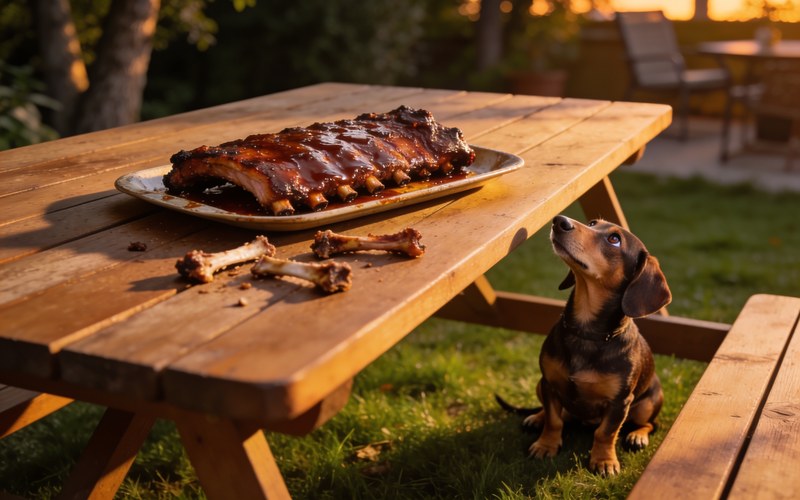
Cooked pork bones with scraps attached bring fat and skin along, plus whatever seasoning was on them. A 2022 review in the Journal of Veterinary Internal Medicine (Cridge et al.) lists table scraps and raiding the trash among suspected pancreatitis risk factors in dogs, along with high-fat diets.
The same review notes that no consensus definition of a high-fat diet exists. No study isolates pork bones as the trigger, so the link is well supported for fatty scraps in general and unproven for bones specifically.
Purina says pork should be served plain, with no seasoning and no sauces or condiments. That rules out rubs and marinades, barbecue sauce included, on a rib bone.
Will stomach acid dissolve a swallowed pork bone?
Often, once the bone is in the stomach. In a 2022 study of 129 dogs, 62 of 84 gastric bone foreign bodies were left in place to dissolve, with no reported complications (Barash et al., Journal of Veterinary Internal Medicine).
Where vets did step in, endoscopic removal worked in 20 of 22 attempts, or 91%.
Esophageal bones played by different rules. The abstract says they warrant removal, and all 45 were dislodged, either pushed into the stomach or retrieved endoscopically, or taken out through an esophagotomy. Erosions were more likely when the bone sat low in the esophagus or stayed longer.
Size cuts both ways. Esophageal bones in the study were larger relative to body weight than gastric ones, so a big piece is more likely to stick in a small dog. The AKC warns that big dogs, on the other hand, may swallow small pork bones whole.
The data has limits. It is a retrospective review of dogs that reached veterinary clinics, and the abstract reports bone foreign bodies as a group rather than pork specifically.
The FDA’s blanket advice and the dissolution data do not actually conflict. A bone that stays in the stomach often dissolves, but nobody can tell at the dinner table whether it will stay there, pass, or lodge.
How do you tell a pork bone is causing trouble, and when do signs appear?
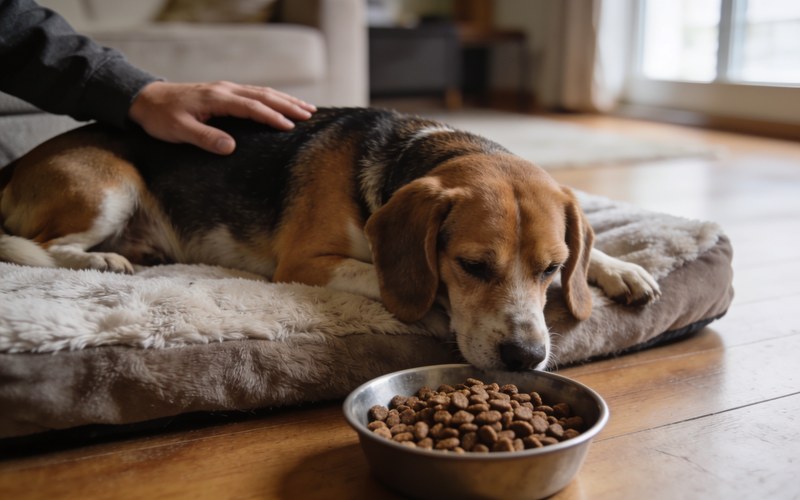
Drooling, gagging, vomiting and refusing food are the early signs, and they can start within hours or show up days later. A dog that looks fine after swallowing a bone is not cleared.
Cornell’s Riney Canine Health Center notes that signs depend on how severe the blockage is, where it sits, and how long the object has been there.
The early ones are easy to write off as an upset stomach. Vomiting is the most common sign of a lodged object, per the AKC. Loss of appetite, drooling and lethargy often come with it, and some dogs have diarrhea or strain to go.
Other signs mean a same-day vet visit.
- Gagging or retching that brings up nothing, which the AKC calls more worrisome than vomiting itself
- Repeated heavy vomiting, or vomit with blood or a fecal smell
- Bloody or tarry stool
- A painful belly, or the prayer position (front legs down, rear up)
- Rapid breathing and pale gums
Two or more of these together is reason enough to go the same day, according to the AKC.
No fixed passing time exists for a bone. Vets work from imaging, and the Merck Veterinary Manual says a swallowed object in a clinically stable animal can be tracked with serial radiographs, but an object that has not passed within about 36 to 48 hours, has stopped moving on repeat films, or comes with worsening signs needs surgical removal.
A quiet first day proves nothing.
What should you do right after a dog eats a pork bone?
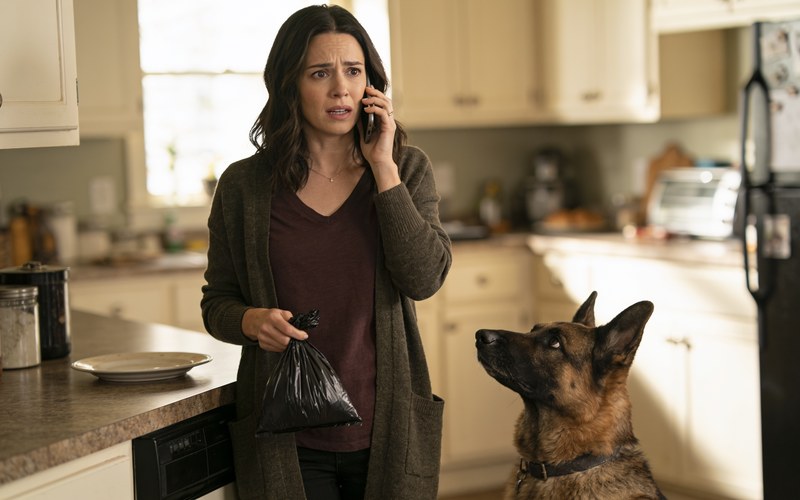
Call a veterinarian right away, even if the dog seems fine, and don’t try to make it vomit. The rest of the list below is just preparation for that call.
- Take away any remaining bone and move the trash out of reach.
- Check that the dog is breathing normally. Choking or labored breathing means an emergency clinic, not a phone call first.
- Call your veterinarian or an emergency clinic. PetMD points out that many dangerous swallowed objects cause no symptoms at first but still lead to internal damage or blockage.
- Have the details ready. That means the type of bone, cooked or raw, any seasoning, how much was eaten, the dog’s weight, and when it happened.
- Skip inducing vomiting unless the vet tells you to. The AKC advises against it after a bone, and sharp fragments can cut the esophagus on the way back up.
- If the clinic is closed, call Pet Poison Helpline (855-764-7661) or ASPCA Animal Poison Control (888-426-4435). Both run around the clock and charge a fee.
- Watch the dog closely afterward, as the AKC recommends, and report any of the later signs above at once.
The common mistake is waiting for symptoms. Cornell says the best outcomes come when a blockage is diagnosed and removed promptly.
How does a vet treat a swallowed pork bone?
A vet locates the bone with imaging, then decides whether to watch it, retrieve it with an endoscope, or operate. The AKC lists the same options.
For diagnosis, Cornell lists history, a physical exam, and abdominal radiographs or ultrasound. Bone is dense enough to show on a plain radiograph, which is why X-rays are usually the first image.
Watching is a real option. The Merck Veterinary Manual describes repeat radiographs to track an object in a clinically stable animal. If the bone is in the esophagus, Merck says it is most often retrieved through the mouth with a flexible endoscope and forceps.
Cornell states that most gastrointestinal foreign body obstructions require surgery. Merck adds that esophageal surgery is reserved for perforation or failed endoscopy, because the esophagus heals poorly and can narrow afterward.
In a 72-dog Italian multicentre study (Di Palma et al., Animals, 2022), 56% of foreign bodies were retrieved by endoscopy and 44% of dogs went to surgery. The objects were not all bone, and the authors linked enterectomy and multiple incisions to poor outcomes.
Two datasets seem to disagree about the intestine. FDA reports lean toward blockage, yet a 208-case review of foreign body surgeries (Hayes, 2009, cited by Barash et al.) found only 5 bones.
The gap has a plausible explanation. FDA reports are voluntary and describe processed treats, while a surgical series counts only dogs who were operated on, and bone is often retrieved or dissolved before it reaches the intestine.
Recovery after intestinal surgery is mostly about food. Cornell recommends small, frequent, low-fat, highly digestible meals for several days, and the suture line is most at risk of failing in the first 3 to 5 days.
What should dogs chew instead of pork bones?
Pick something with some give, like a vet-approved dental chew or a durable rubber toy, sized to the dog and used under supervision.
| Option | Main risk | Verdict |
|---|---|---|
| VOHC-accepted dental chew | Gulped in chunks | Good default |
| Durable rubber toy | Too hard if it fails the fingernail test | Good for heavy chewers |
| Large raw beef or bison bone | Tooth fractures, splinters | Contested, skip |
| Antlers, nylon bones, hooves | Tooth fractures | Skip |
The Veterinary Oral Health Council seal covers plaque and tartar control. The council says it does not test products itself, and its own advice is to match chew size to the dog’s weight and offer chews only when you can watch.
For a broader shortlist, this rundown of safe dog chews covers more options by material.
The fingernail test is easy. Press a nail into the chew, and if it leaves no dent, the chew is harder than a tooth should meet.
The obvious swap for a pork bone is another bone or an antler, and the evidence runs against it. Veterinary dentist John Lewis (Veterinary Practice News) names antlers among the most common causes of carnassial tooth fractures, and Veterinary Times puts the reported prevalence of tooth fracture in dogs at 20% to 27%.
If an antler is already in the cart, settle whether antlers are safe for dogs before it reaches the dog.
Pork Bones for Dogs FAQ
How much does treatment for a swallowed pork bone cost?
It depends on the route, and no single figure holds across clinics. Imaging and monitoring cost less than endoscopy, and surgery with hospitalization costs the most.
Ask the clinic for an estimate after the radiographs, since the plan is set by where the bone sits.
Can dogs eat cooked pork meat or pork bone broth?
Plain, thoroughly cooked pork meat is fine in small amounts, as long as it carries no seasoning, sauce or added fat. Rover’s veterinary content gives the same condition.
The AKC suggests bone broth as a flavor topper but advises checking with a vet first, especially for dogs with intestinal or dietary problems. Strain out every bone fragment before serving.
What if my dog ate raw pork with no bone?
Call your vet for advice, because the AVMA discourages feeding any raw or undercooked pork to dogs.
Watch for vomiting and diarrhea over the next few days. The CDC lists diarrhea among the first signs of trichinellosis, though its data covers people, not dogs.
Do pork bones clean a dog’s teeth or give it calcium?
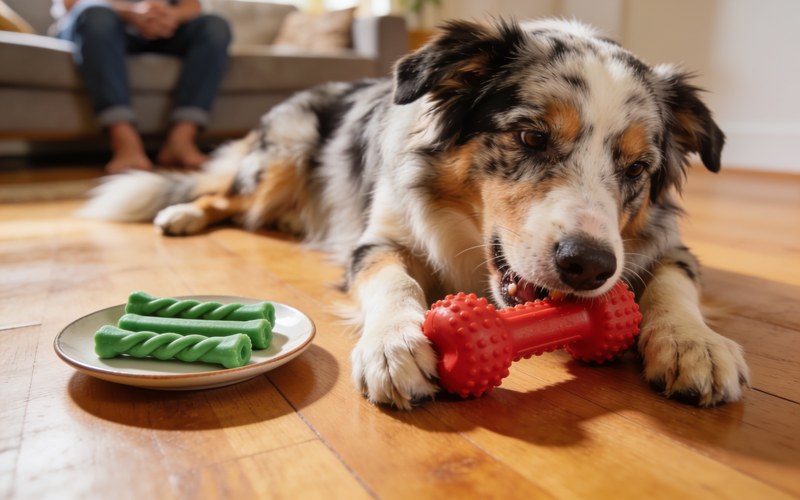
No. The FDA lists broken teeth first among the hazards of giving bones, and the plaque-control claim belongs to products carrying the VOHC seal, not to bones.
Mineral needs are a diet question. A vet can advise on that before any supplement goes in the bowl.
My dog has eaten pork bones before with no problem. Why is it a risk now?
Because each bone is a separate draw. A dog that passed one rib bone has told you nothing about the next chop bone, which differs in size, hardness and how it was chewed.
Past luck lowers the owner’s guard, not the risk of one bad bone.
Keeping Pork Bones Out of Your Dog’s Reach
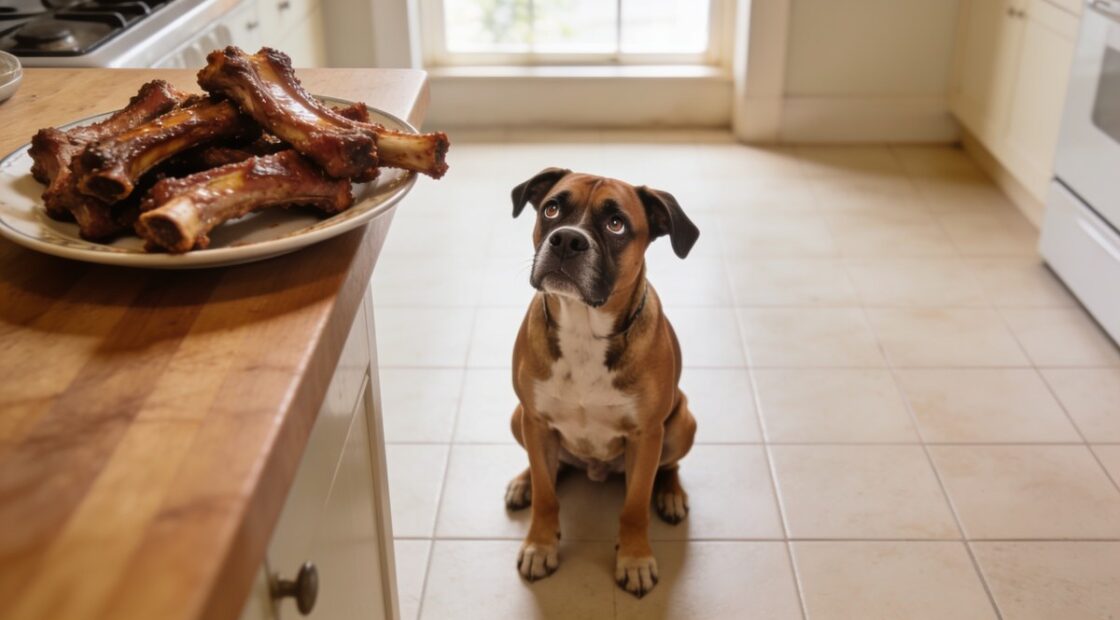
The trash can comes first. The FDA warns that dogs can get into the kitchen trash and eat bones thrown away, and a pancreatitis review lists trash access at an odds ratio of 13.2, against 4.3 for unusual food items and 2.2 for table scraps (Cridge et al., Journal of Veterinary Internal Medicine, 2022).
That ranking sets the order of work. Get a bin the dog cannot open, clear platters before the dog is loose, and keep your eyes on the ground on walks. The FDA advises keeping platters out of reach while cooking and eating.
Trash goes first because it keeps happening when nobody is watching.