Not many Entlebuchers get bred, even in Switzerland. In 2008 the country had 65 breeding dogs, 19 males and 46 females, according to a 2011 study in the Schweizer Archiv fuer Tierheilkunde.
And a lot of those puppies left. The same study reports that roughly two thirds of Swiss-bred Entlebuchers were sold to the Netherlands and Germany.
That small population is worth keeping in mind for the rest of this page, because it explains the wait for a puppy and why the parents’ health records matter so much.
The dog itself is a Swiss cattle drover that works from behind the herd. At 44 to 50 cm for males under the FCI standard, it’s the smallest of the four Sennenhund breeds. The AKC admitted it to the Herding Group on January 1, 2011, as one of three new breeds that brought the AKC’s total to 170.
What Is the Entlebucher Mountain Dog?
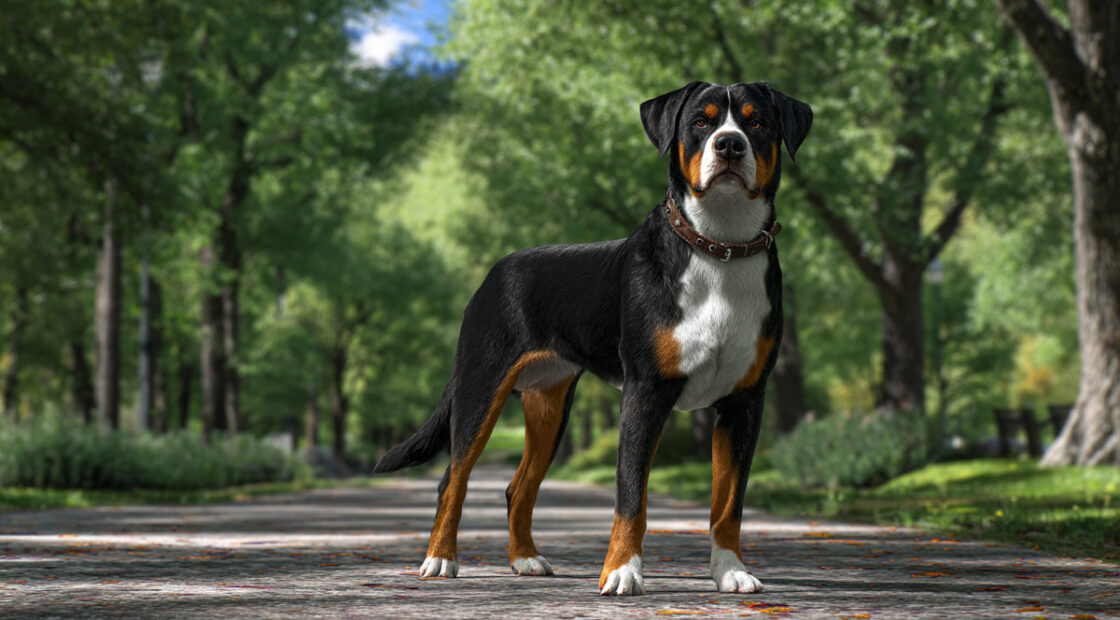
On paper, a medium-sized Swiss herding breed. In person you notice the build first. The body runs slightly longer than tall, on short sturdy legs, under a black, rust and white coat.
The AKC calls it the Laughing Dog of the Swiss Alps. It goes by a few other names too, depending on who’s talking:
- Entlebucher Sennenhund, the FCI registration name
- Entlebuch Cattle Dog, the English title in the FCI standard
- Entles, the short form in the AKC’s recognition announcement
Swiss farmers used it to move cows from pasture to pasture, according to the AKC breed standard. The FCI standard lists driving, watch, guard and farm work, and adds that the breed is now also a versatile working dog and a family dog.
Registries don’t agree on where to file it:
- AKC: Herding Group, full recognition from January 1, 2011
- UKC: Guardian Dog Group, recognized January 1, 1993
- Canadian Kennel Club: Group III, Working Dogs, recognized 1993
- Royal Kennel Club (UK): Working group
- FCI: Group 2, Section 3, Swiss Mountain and Cattle Dogs, standard no. 47
Honestly, the group label mostly decides which show ring the dog walks into. It tells you very little about how the dog behaves on your couch.

How Does the Entlebucher Differ From the Other Sennenhund Breeds?
Look at height first. The Entlebucher is the shortest of the four, and the gap to the two big ones is large.
| Breed | Male height | Coat | Tail |
|---|---|---|---|
| Entlebucher | 17 to 21 in | Short, hard, double | Natural length to bobtail, never over the back |
| Appenzeller | 20.5 to 22 in | Short, smooth, double | Curled tightly over the back |
| Bernese Mountain Dog | 25 to 27.5 in | Thick, full coat | Bushy, carried low, never over the back |
| Greater Swiss Mountain Dog | 25.5 to 28.5 in | Double, medium-length outer coat | Pendulous, never over the back |
Heights are UKC breed-standard ranges for males, measured at the withers. Coat and tail entries come from the same four standards.
Next to a Bernese, the coat gives it away. The Bernese Mountain Dog is the only Sennenhund with a full coat, per the UKC standard, and it’s self-assured and accepting with strangers. Entlebuchers are short-coated, and their standards call for reserve.
The Greater Swiss Mountain Dog was primarily a draft breed (the UKC describes it as good with strangers). Entlebuchers were used mainly to drive cattle.
The Appenzeller is the one people actually mix up with it. Size and watchful temperament are close, so check the tail. The UKC disqualifies an Appenzeller whose tail does not curl tightly when the dog is moving, and an Entlebucher’s tail is never carried over the back.
The resemblance has one source. The UKC standards trace all four breeds to Roman mastiffs crossed with local Swiss working dogs, with the Greater Swiss generally accepted as the first and the other three descending from it. The Appenzeller standard suspects some Spitz influence in that breed, which would explain the curled tail.
Where Does the Entlebucher Come From, and When Was It Recognized?
The name is literal. The breed comes from the Entlebuch valley, which lies in the region of the Swiss cantons of Lucerne and Bern, and it entered the Swiss stud book as the fourth Sennenhund breed after a 1913 dog show.
The 1913 show in Langenthal
The FCI standard dates the first written description, under the name Entlibucherhund, to 1889. For a long time after that, nobody bothered to separate the Appenzeller from the Entlebucher.
Then in 1913, four short-tailed dogs were presented to Professor Albert Heim at the Langenthal show. Heim was the great promoter of the Swiss mountain breeds. Based on the judges’ reports, the dogs were entered as the fourth Sennenhund breed.
Near loss and the first breed club
Growth was slow after that. Petfinder’s breed profile says crosses with German Shepherd Dogs in the early 1900s threatened the breed, and Chewy’s history adds that World War I pushed it close to extinction.
Dr. B. Kobler got the Swiss Club for Entlebuch Cattle Dogs started in 1926. The first breed standard came in 1927. The current FCI standard, no. 47, dates from 2001.
Recognition outside Switzerland
- UKC: January 1, 1993
- Canadian Kennel Club: 1993
- AKC: January 1, 2011, one of three breeds that brought the AKC’s total to 170
The AKC date is a bit messy. Petfinder’s profile lists herding event eligibility in 2007 and Herding Group placement in 2009, while the AKC’s announcement puts full recognition on January 1, 2011.
That announcement describes a staged route for new breeds that begins in the Foundation Stock Service, so the earlier dates are probably steps along the way.
The National Entlebucher Mountain Dog Association (NEMDA) acts as the AKC parent club.
Size, Coat and Tail
Under the FCI standard a male stands 44 to 50 cm at the withers. The coat is short and double in black, rust and white, and the tail can be a natural bobtail or full length.
Height and weight
The body is slightly longer than tall, at a height to length ratio of 8 to 10 in both the FCI and UKC standards.
- 44 to 50 cm for males, up to 52 cm tolerated (FCI standard no. 47)
- 42 to 48 cm for females, up to 50 cm tolerated (FCI standard no. 47)
- 17 to 21 inches for males and 16 to 20 inches for bitches in the UKC standard
- 23 to 30 kg in weight, according to the Entlebucher Mountain Dog Club of Great Britain
The two systems overlap but don’t match. A 21 inch male, the top of the UKC range, is about 53 cm. That’s past the FCI tolerance of 52 cm, and the FCI standard disqualifies dogs outside its tolerances.
The AKC standard gives a working reason for the limits: a dog that is too small lacks power, and one that is too large loses agility.
Coat and color
The outer coat is short, close-fitting and harsh with a natural sheen, sitting over a dense undercoat. Slightly wavy hair on the withers or back is tolerated but not preferred.
Black is the ground color, with a dark grey to brownish undercoat (FCI). Tan shows up above the eyes, on the cheeks, muzzle and throat, on both sides of the chest and on all four legs.
The white goes on the blaze, from chin to chest, and on all four feet. The UKC notes the chest patch typically forms an inverted cross.
Faults are where the registries split. In the FCI standard, a coat that is too long or soft (no double coat) is a disqualifying fault. The UKC treats too long or too soft hair as an ordinary fault and disqualifies only an absent undercoat. Both standards disqualify any ground color other than black.
Shedding and grooming
The Westminster Kennel Club scores shedding at 3 out of 5 and grooming needs at 1 out of 5.
The UK breed club says the dogs moult twice a year and shed comparatively little at other times. They keep themselves clean and need little grooming, according to the club. Low effort, basically, apart from those two moults.
Natural bobtail or full tail
Both are fine by the standards. The FCI standard says a congenital bobtail and a natural long tail are equally acceptable, and the UKC accepts anything from natural length to a natural bob. A kinked tail or one carried over the back is a fault, and the FCI disqualifies a ring tail.
In practice you’ll mostly see long tails now. The UK breed club says the breed was historically bobtailed, but the long black tail tipped with white is now typical. The UKC adds that docking is legal in the US and a personal choice, yet no dog in a UKC event is penalized for a full tail.
Temperament and Herding Instinct
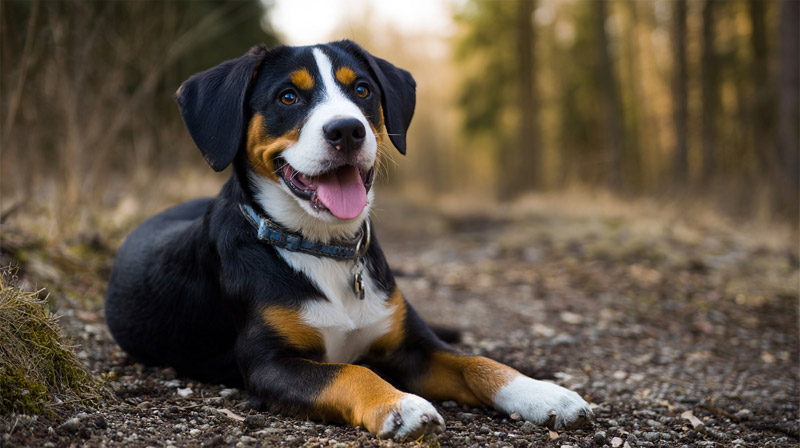
The AKC standard says outright that this is not a breed for the casual owner. I think that’s a fair warning. Entlebuchers are confident and energetic, bond hard with their people, and stay reserved with everyone else.
Bond with family, reserve with strangers
The AKC standard credits the breed’s purpose and heritage for an unusually intense bond between dog and handler. The UK breed club adds that Entlebuchers attach strongly to a main carer, and that their affectionate enthusiasm can leave bruises.
Wording on strangers varies by registry. The FCI and the Royal Kennel Club say slightly suspicious, the AKC says indifferent or somewhat aloof, and the UKC says reserved but not shy.
None of the four describes the breed as outgoing with strangers.
The Westminster Kennel Club scores protectiveness at 5 out of 5, good with other dogs at 5, good with strangers at 3 and barking at 3.
Herding drive in daily life
- The AKC standard describes a compact, muscular drover that moves stock from pasture to pasture
- Petfinder’s profile calls the working style driving, which means getting behind the animals and nudging them along
- Give it a job and the playful companion turns into a serious, tireless worker (AKC standard)
- As a watch dog, the FCI standard says, it won’t be swayed by bribes
The AKC standard ties the guardian traits to one requirement, which is thorough socialization during puppyhood. Skip it and the guard instinct and the reserve with strangers have nothing to temper them.
The AKC breed page calls Entles independent problem solvers who are happiest with a job to do.
How Much Exercise Does an Entlebucher Need?
More than average, every day. The sources only disagree on how much more.
Where the sources land
The AKC’s recognition announcement sits at the top end. It describes an active, high-energy, physical breed with above-average exercise requirements, and Wisdom Panel’s breed profile says extensive exercise every day.
The UK breed club is calmer about it and calls the dogs moderately demanding. Then it adds that most owners tire before the dog does (which kind of undercuts “moderately”). It also notes that they like free running.
I’d plan for the higher end. Chewy’s profile warns that an Entlebucher with unmet needs will find its own work, and owners rarely like what it picks.
Running, hiking and biking beside the owner all count, according to Wisdom Panel.
Herding tests and trials
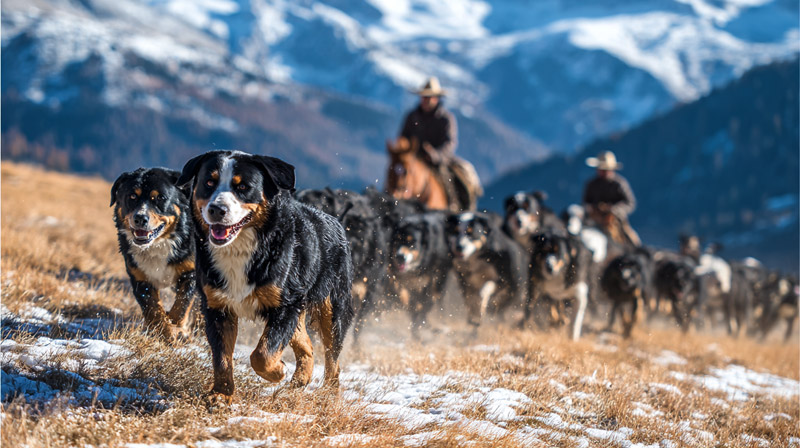
- The AKC lists the Entlebucher among breeds eligible for herding events from 9 months of age
- Instinct tests open at 6 months, and the AKC says a dog needs no training for that first test
- Tests are pass or fail (Herding Instinct Certificate, Herding Tested, Pre-Trial Tested)
- Trials are scored at started, intermediate and advanced levels
The AKC’s getting-started page adds that dogs need training and prior livestock exposure before tests or trials, so the instinct test is the only no-prep entry. It points newcomers to the national breed club (NEMDA) or a local herding club.
Chewy’s profile lists agility, conformation and therapy work as other outlets for the drive.
Limits for puppies and in the heat
The UK breed club names over-exercise or inappropriate exercise at a young age as one cause of hip dysplasia, next to injury and diet.
Dogster’s breed guide describes puppies as suited to playtime and light exercise.
Wamiz and Dogsey both flag heat and humidity as a limit. Neither cites a study, so treat it as a precaution and not a measured risk.
How to Train an Entlebucher Mountain Dog
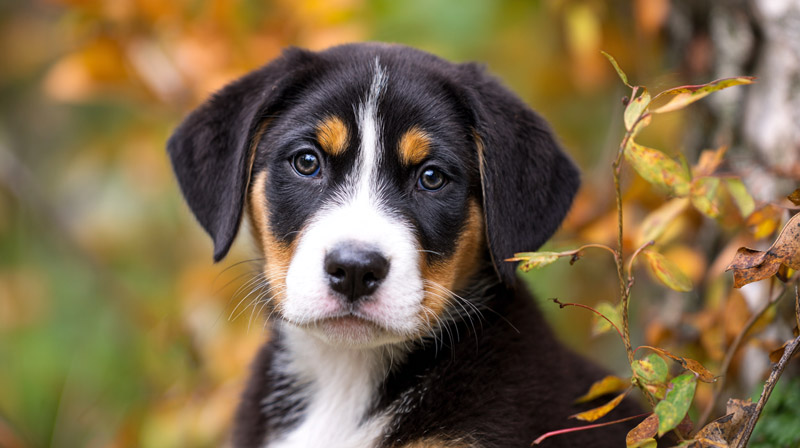
Training starts the day the puppy comes home, and it should be reward-based from the first session. The first three months matter most for socialization.
Easy or stubborn?
Depends who you ask. The AKC announcement prizes the breed for trainability, the FCI standard calls it cheerful and capable of learning, and Wisdom Panel says training can be relatively easy with an early start and a positive approach.
Others are less sure. Vetstreet’s profile calls the dog smart and willful and says it tests its owner, Dogsey says its strength of character challenges all but experienced owners, and Hepper’s guide just calls it stubborn.
The split tracks the owner more than the dog. Every source that calls the breed easy attaches the same conditions, an early start and a reward-based approach.
The training sequence
- Begin at home the day the puppy arrives. Vetstreet warns that waiting until 6 months produces a more headstrong dog.
- Enrol in a puppy class from 7 to 8 weeks. The AVSAB calls the first three months of life the primary and most important socialization period and says it should be standard of care for puppies to get that exposure before full vaccination.
- Use reward-based methods only. The AVSAB’s 2021 statement recommends them for all dog training, including behavior problems.
- Keep sessions short and varied, because Wisdom Panel says this smart breed gets bored easily.
- Add a job once the basics hold, such as an instinct test, agility or tracking.
Treats do most of the rewarding, so portions matter, and Chewy’s profile says to watch the weight. Breaking healthy dog treats into small pieces keeps the calories down.
Problems to expect
- Body slams. A drover bred to move stock with its shoulders may run into people and knock them flat (Chewy)
- An under-exercised dog invents its own jobs
- Repetition loses a clever dog fast, and boredom follows (Wisdom Panel)
Health Problems, Testing and Lifespan
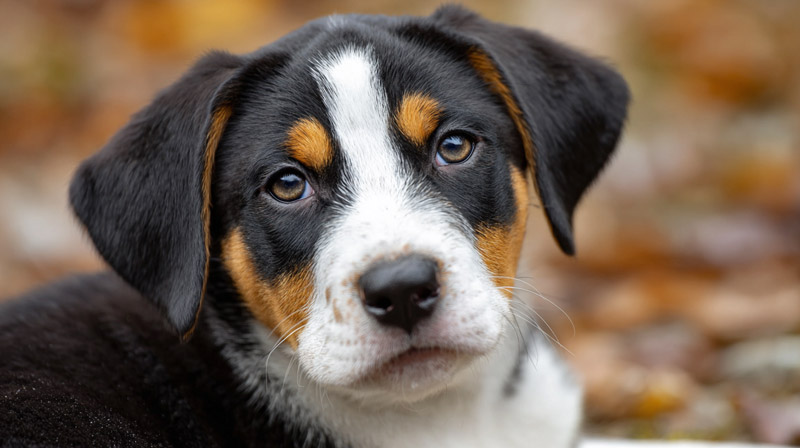
Eye disease and hip dysplasia head every breed club’s list of inherited problems in the Entlebucher. The US and UK clubs don’t test for the same things, though.
Inherited conditions
A University of Zurich study of 798 eye examinations on 285 Swiss Entlebuchers found cataract in 20.4% of dogs and progressive retinal atrophy (PRA) in 6.3%, usually diagnosed around age five (Kuster and colleagues, 2011).
That timing is the problem. Dogs are often bred before the disease shows. The authors trace the breed to four founding dogs, and they note that some cataracts first appeared after age seven, which is why they back annual eye exams for older dogs too.
They also describe two bottlenecks. For years after the 1913 show no new Entlebuchers were entered in the stud book and the breed seemed likely to die out, and during the Second World War the population fell to 12 animals. Breed profiles usually mention only the First World War period, but the two accounts don’t contradict each other.
Other conditions on the club lists:
- Hip dysplasia, named by both NEMDA and the UK breed club
- Patellar luxation, on NEMDA’s list but not the UK club’s
- Glaucoma, on the UK club’s list, with no definitive gene test, so clubs use a gonioscopy exam
- Ectopic ureter, on the UK club’s list, where female puppies born with it are unlikely to survive early puppyhood
Commercial breed pages add degenerative myelopathy, chondrodysplasia and IVDD risk (Basepaws) and hemolytic anemia (Omlet). Neither the NEMDA list nor the UK club list includes them.
Health tests breeders use
NEMDA’s health statement strongly recommends four screens for US breeding dogs and asks for results to go into the OFA database. The UK breed club follows the Swiss Breed Club’s list instead.
| Condition | NEMDA (US) | UK breed club (Swiss list) |
|---|---|---|
| Hips | OFA or FCI certification at 24 months or older | X-ray at about 15 months, scored A to E |
| Eyes | Annual ACVO ophthalmologist exam, within 12 months before each breeding | Cataract check, plus gonioscopy for glaucoma |
| PRA | prcd-PRA DNA test | prcd-PRA DNA test, dogs graded A, B or C |
| Patella | OFA exam from 12 months | Not on the list |
| Heart and urinary tract | Not on the list | Heart murmur check, ectopic ureter ultrasound |
Hips are the better news. NEMDA’s hip page reports that 80% of Entlebuchers evaluated by the OFA over the past 20 years passed, and no dog scored by the UK club has been graded worse than B2.
PRA in the breed is the prcd type and is autosomal recessive, so a dog needs two defective copies to develop it. The UK club mates carriers only with clear dogs, which means no puppy can be affected.
Affected dogs are handled differently. The UK club never breeds them, while the 2011 Swiss paper says affected dogs could still be admitted to breeding if they improved the population.
Ask for OFA records on both parents. A CHIC number records that tests were done and made public, not that every result was normal. A lot of buyers miss that.
Lifespan
I couldn’t find an Entlebucher-specific longevity study, so every lifespan figure out there is an estimate.
- 11 to 13 years: Chewy, WebMD, PetMD and Wisdom Panel
- 9 to 12 years: Rocadog, which adds that some dogs pass 13
- 8 to 12 years: Hundeo’s breed article
For scale, the UK Kennel Club’s 2014 mortality survey found an overall median age at death of 10.33 years across breeds.
None of the Entlebucher ranges states a method. Plan around 9 to 13 years and count the top of the range as a good outcome.
Is an Entlebucher Right for Your Household?
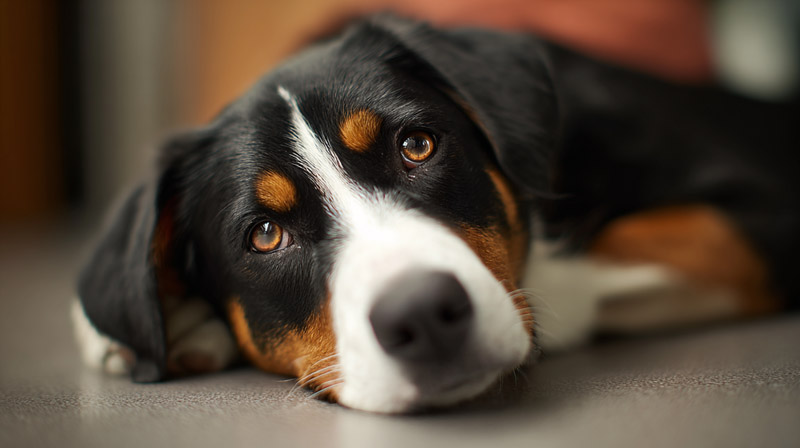
If someone in the house trains daily and gets the puppy out socializing early, it can work well. If nobody can give the dog a job every day, it usually won’t.
Children and other pets
The Westminster Kennel Club rates the breed 3 out of 5 for children. WebMD calls it only moderately good with young children.
Vetstreet is blunter. Its advice is to wait until the kids are big enough to hold their ground against a dog that hurls its body at them. Wisdom Panel says the dogs are usually fine around children but can get rambunctious.
Chewy says Entlebuchers get along with animals from their own household, and Dogster adds that they need plenty of socialization to accept other dogs and cats.
Apartments and time alone
Hours matter more than square footage. The UK breed club says the dogs bond to a main carer and suit long spells alone poorly, and Dogsey says the breed should not be left in a yard for hours.
Wamiz disagrees and says the dog tolerates some solitude. No source gives a number of hours, so a full workday alone is untested territory.
A flat works only if the exercise plan above actually happens.
Pros and cons
In its favor
- Strong attachment to the family
- Trainable with an early, reward-based start
- A natural partner for herding tests, agility and tracking
- Gets along with animals it grows up with
Against it
- Above-average exercise needs, every day
- Shoulder-first enthusiasm that can flatten small children
- A long list of eye and hip screening to check on parents
- Poor tolerance for long hours alone, according to the UK breed club
- Restless and inventive when bored
When the breed does not fit
If nobody can supply active time and a structured outlet every day, pick another breed.
Same goes for a home with toddlers and no way to separate dog and child. Or a dog that would spend most weekdays alone.
The dog doesn’t scale down to fit a quieter life. It finds its own work, which is why the AKC steers the breed toward active families.
Entlebucher Mountain Dog FAQ
How do you pronounce Entlebucher?
Most people say ENT-lee-boo-ker. Petfinder’s breed profile also accepts ENTEL-boo-ker.
The AKC’s own pronunciation guide spells it ENT-leh-boo-cur.
Why is the breed so hard to find?
Small breeding population, so not many puppies. Dogster says buyers in the United States often have better luck with international breeders or with the breeder lists that breed clubs keep.
Waiting for a litter with health-tested parents beats taking the first available puppy.
Is the Entlebucher hypoallergenic?
No source classes it as hypoallergenic. The standards call for a double coat with a dense undercoat, and the UK breed club says the dogs moult twice a year.
If allergies matter, spend time with adult dogs before committing.
How should you feed an Entlebucher?
PetMD recommends feeding twice a day on a regular schedule, using a complete food that meets AAFCO standards.
Vetstreet names obesity as one of the most common health problems, so measure portions and check any supplement with a vet first.
Can you adopt a rescue Entlebucher?
Yes, but rarely. Chewy says the breed is not commonly found in shelters and rescues.
The UK breed club runs a rescue page on its site, so a breed club is the practical first contact.
Finding a Health-Tested Entlebucher Puppy
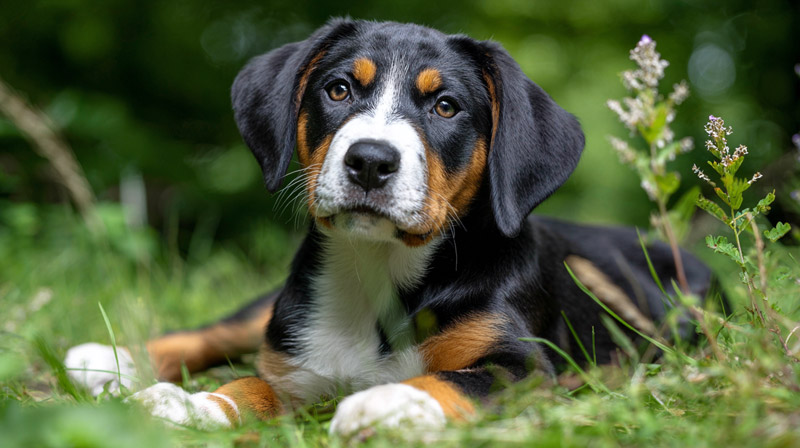
Before you meet a litter, the breeder should be able to show OFA records for both parents. If they can’t, the rest of the visit doesn’t matter much.
Once you have the records, check the date on each eye exam. Swiss breeding approval accepts an eye test no more than 6 months old, and NEMDA asks for one within 12 months of each breeding.
The date carries more weight than people expect. Cataract and PRA are diagnosed around age five on average, so a clean exam at age two says little about a parent at five.
If everything checks out, book a puppy class before pickup day.
The cost of doing it this way is time. A rare breed means waiting for a litter that passes, and buyers who skip the wait usually skip the records too.