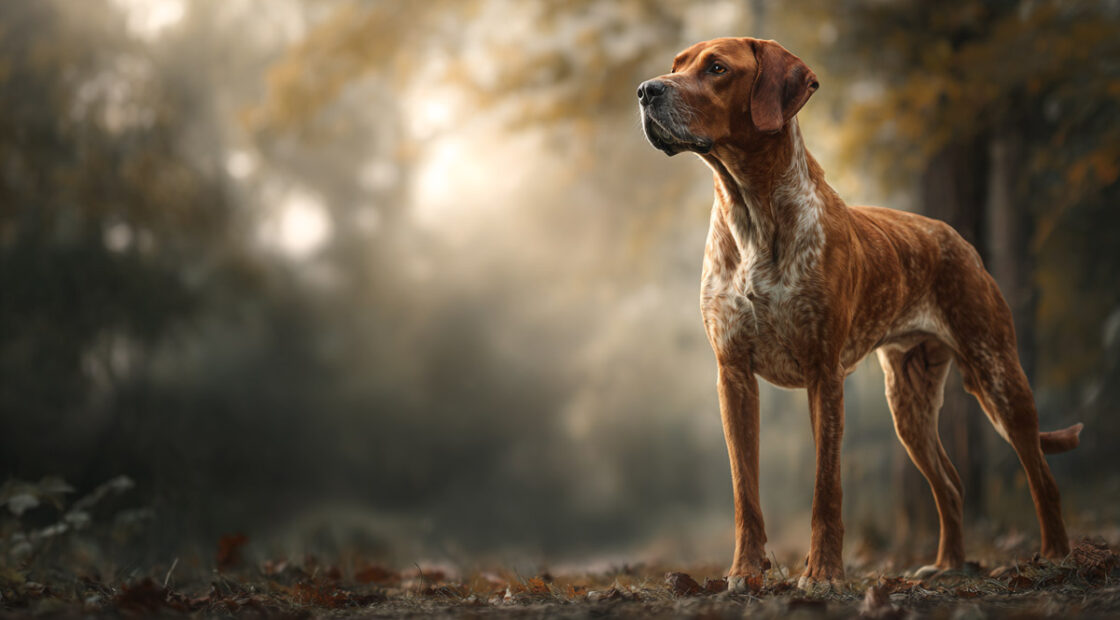
Harrier dogs fill the gap between the Beagle and the English Foxhound. They were bred in England to follow hare by scent as part of a pack, and most standards put them at 19 to 21 inches at the shoulder.
The breed is old, but its paperwork is not. The AKC recognized it in 1885, while The Kennel Club in its home country only listed it in the Hound Group from 1 January 2020 (The Kennel Club, 2019).
Nobody entered a Harrier in an English show after 1915 (AKC, 2016). Hunts kept the hounds, and the show ring dropped them.
What is a Harrier dog?
England bred it to trail hare in a pack, at a pace a person on foot can follow.
Size puts it between the Beagle and the English Foxhound, and the AKC standard calls it a smaller version of the English Foxhound.
Most Harriers still belong to the hunting world rather than the show ring. That’s the main reason the breed stays so uncommon as a pet.
Kennel club recognition
| Registry | Classification | Recognition |
|---|---|---|
| American Kennel Club (AKC) | Hound Group | 1885, the 18th breed recognized |
| Federation Cynologique Internationale (FCI) | Group 6, section 1.2, standard 295 | Original standard published 27 November 1974 (current text dated 5 March 1998) |
| The Kennel Club (UK) | Hound Group | 1 January 2020, interim standard from 1 October 2021 |
The FCI files the Harrier with the medium-sized scent hounds and asks for a working trial, so its standard assumes a dog that actually hunts.
The UK gap was a long one. From that 1915 show entry to the 2020 listing, the breed stayed with the hunts.
In England, many Harriers are registered with the Association of Masters of Harriers and Beagles instead of a kennel club. It was formed in 1891.

The US side is much younger. The Harrier Club of America was founded in 1992 and became the AKC parent club in 1996 (Canine Chronicle, 2025).
Where does the Harrier come from?
England, and the story usually starts with Sir Elias de Midhope, who is credited with founding the Penistone pack in 1260. The AKC says that line lasted about 500 years.
The first written description of the type appears in William Somervile’s 1735 poem “The Chace.”
Where the name comes from
“Harrier” probably derives from the Norman word harier, meaning hound. The competing explanation ties it to the hare, which fits the older term hare hound.
Theories about ancestry
| Theory | Proposed ancestors | Reported by |
|---|---|---|
| Bred-down foxhound | Smaller English Foxhounds selected for size | AKC |
| Old hound stock | Talbot Hound, Bloodhound, Basset Hound | Dogs Australia |
| Foxhound crosses | English Foxhound with Fox Terrier and Greyhound | Dogs Australia |
The second idea leans on medieval scent-hound stock, with Talbot Hounds and Bloodhound crosses supplying the nose.
The last one starts from a Foxhound base and adds a Fox Terrier and a Greyhound.
None of these is documented well enough to settle the question. The AKC points out that hounds were interbred freely for stag, boar, deer and hare, so the paper trail is blurry by design.
How the breed lost ground
In the 19th century, breeders crossed Harriers with foxhounds to get a faster hound that mounted riders could follow, according to Horse & Hound. By the 1800s, the AKC notes, Harrier packs were hard to tell from foxhound packs unless you bred them.
Registration numbers are tiny. Between 1884 and 1994 the AKC registered 949 Harriers (AKC), and the breed sits 4th rarest on its 2025 list, out of 202 counted.
England is even thinner. One Harrier puppy was registered with The Kennel Club in 2024, as reported by Countryfile, which links the low count partly to packs staying inside the hunting world.
Harrier dog size, coat and colors
Kennel club standards agree closely on height. The FCI is a little looser, allowing 48 to 55 cm (about 19 to 21.7 inches) with 48 to 50 cm preferred.
Height and weight
The CKC, the UKC and the English Kennel Club all give 19 to 21 inches (48 to 53 cm), per the Harrier Club of America. FCI standard 295 allows 48 to 55 cm, preferably 48 to 50 cm.
None of those standards states a weight. Breed guides fill the gap with 45 to 65 pounds (WebMD) and 45 to 60 pounds (Hepper).
Weight is the number I’d handle with care. The standards quoted by the Harrier Club of America give no weight, so the pound ranges on pet sites are descriptive, not breed-defining.
An older height of 21 to 24 inches still circulates on some guides (Doggies). No standard cited here backs it.
Coat and colors
The UKC standard describes a short, dense, hard, glossy coat that is finer on the ears, with a brush of hair under the tail.
Color is flexible. The UKC accepts any good hound color, and the FCI describes a mostly white base with shades from black to orange.
In France the breed is often tricolour with a black mantle across the upper back, according to the FCI standard.
Somervile’s 1735 poem already mentions a round cat foot, which the Harrier Club of America says still matches the breed.
How does the Harrier differ from the Beagle and the English Foxhound?
It sits in the middle. At 19 to 21 inches it stands taller than any Beagle (15 inches maximum) and shorter than the English Foxhound (23 to 25 inches).
| Breed | Height | Traditional role | Working character |
|---|---|---|---|
| Beagle | 13 or 15 inch varieties, 15 maximum | Hare and rabbit, followed on foot | Slower, superb nose |
| Harrier | 19 to 21 inches | Hare, followed on foot | Mid-pace, between the two |
| English Foxhound | 23 to 25 inches | Fox, followed on horseback | Hard-running, often overran its nose |
Beagle heights come from the AKC standard. The Foxhound height comes from The Kennel Club standard, last updated in April 2025.
Harrier vs English Foxhound
The AKC standard calls the Harrier a smaller version of the English Foxhound. On the published ranges it stands about 4 inches shorter (19 to 21 inches against 23 to 25).
Faces differ a bit. The Harrier looks bold thanks to prominent eyebrows, while the Foxhound’s expression is keen (Dogs NSW). The Harrier’s tail is set slightly lower and carried between 12 and 3 o’clock (Dogs NSW).
On personality they’re close, since both are sociable pack hounds. PetMD describes the Harrier as playful and outgoing, and the English Foxhound standard asks for a friendly, non-aggressive temperament.
Harrier vs Beagle
Size gives it away. Next to a Beagle, the Harrier is a big dog.
The AKC adds that the Beagle standard puts its weight on bone and nose, and the Harrier standard cares more about build.
Temperament lands closer to the Beagle than to the Foxhound, a view EasyPetMD shares. The Harrier is more active than the Beagle, though, according to PanGoVet, so it needs more exercise.
Harrier dog temperament
Friendly and pack-minded, mostly. The AKC describes the Harrier as outgoing and friendly, and that comes straight from generations of working in packs.
With people and children
PetFinder describes the breed as amiable and tolerant, and good with children.
WebMD says it is not shy and craves human company. The UKC standard adds a wrinkle, noting that the Harrier usually prefers pack company to people.
With other dogs
Pack work leaves little room for a dog that picks fights. The UKC standard does not tolerate aggression toward other dogs, per the Harrier Club of America.
WebMD notes that Harriers get along well with other dogs. A second dog often suits them better than a lone-pet home.
Alone time and prey drive
Separation anxiety shows up in this breed, per Dogster, and PanGoVet calls Harriers not very comfortable being left alone.
Prey drive is high too, with a strong hunting instinct (Horse & Hound).
A Harrier that follows a scent will not stop for a call. That comes with the nose and does not respond well to scolding.
How much exercise and training does a Harrier need?
Plan on two hours of real activity a day and treat one hour as the floor. Sources disagree on the exact figure, but none describe a dog that settles for a walk around the block.
| Source | Daily exercise stated |
|---|---|
| PanGoVet | 1 to 2 hours of vigorous exercise |
| DogZone | At least 2 hours |
| Horse & Hound | More than 2 hours |
The lower figure only holds if the time is hard running. A slow stroll on a lead does not count toward it.
What the exercise looks like
Jogging on a lead and long trail hikes both work. WebMD lists bike rides alongside jogging, and a fenced yard covers games, including tracking games and scent work.
PetMD says daily exercise should happen in an enclosed area. Petful goes further and calls a fenced yard a must.
Owners get creative about it. Petful describes one in upstate New York who followed his Harrier in a golf cart while she ran on a lead.
Skip the exercise and, according to Perfect Pets, you get a hyperactive, destructive dog that also gains weight.
Training a hound that follows its nose
Dogs NZ rates exercise needs as high and trainability as low. That pairing tells you where the work goes.
Bow Wow Insurance describes training as patient and reward-based, with consistency doing most of the lifting, and says recall and lead manners need practice all through the dog’s life. Keep sessions short and pay with small, healthy dog treats that will not add weight to a dog already prone to it.
Build recall in enclosed spaces first. Open ground comes last.
Harrier dog lifespan and health problems
The Harrier Club of America puts the lifespan at 12 to 15 years and calls the breed very healthy, with few known genetic issues. Canine hip dysplasia is the problem it names most often.
| Source | Lifespan | Conditions named |
|---|---|---|
| Harrier Club of America | 12 to 15 years | Hip dysplasia (most common) |
| Adopt-a-Pet | 12 to 15 years | Hip and elbow dysplasia, epilepsy, perianal fistula, ear infections |
| PetMD (profile dated 2009) | 12 to 14 years | Hip dysplasia, epilepsy, perianal fistula |
Dogs NZ is the low outlier at 10 to 12 years.
No source reviewed here publishes a Harrier-specific hip dysplasia rate. “Most common” is a breed-club judgment, not a measured percentage.
The conditions, briefly
Hip dysplasia means the hip joint develops abnormally, which leads to pain, lameness and secondary osteoarthritis, per Adopt-a-Pet.
Epilepsy is a seizure disorder.
Perianal fistula is progressive inflammation around the rectum that causes discomfort and changes in stool.
Screening that matters when you buy
The Harrier Club of America recommends OFA certification for all breeding stock and annual eye certification, as quoted by Canada’s Guide to Dogs.
The OFA hip evaluation has a built-in limit. The dog must be at least 24 months old, and the grade comes from three independent board-certified radiologists, according to OFA material published through VIN.
So a puppy whose parents are younger than two years cannot have a final OFA hip result behind it.
Ear care
Hanging ears trap moisture, and ear infections show up on Adopt-a-Pet’s list of the breed’s problems.
Check them weekly. A gentle dog ear wipe covers routine cleaning, and a vet should look at anything red or smelly.
How much does a Harrier dog cost, and where do you find one?
A Harrier from a breeder usually costs $1,500 to $2,500, and adoption runs about $300, according to Adopt-a-Pet. The harder part is finding a litter, because breeders are few and waitlists are normal.
Breeder or rescue
A breeder means a higher price, pedigree papers, health clearances you can check, and a wait.
Rescue costs far less, since the fee of about $300 covers the dog’s care before adoption. The health history is thinner, though, and Adopt-a-Pet advises a vet check for dysplasia on any rescued Harrier.
Add food, vet care and training on top of either number, because a dog is an expensive commitment long after the puppy price is paid.
How to find a reputable breeder
- Start with the Harrier Club of America’s guidance on finding a reputable breeder.
- Ask for OFA hip results on both parents, who must be at least 24 months old to hold one.
- Ask for eye certification dated within the last 12 months, the standard the club’s guidance sets.
- Join the waitlist instead of buying the first available puppy.
- Watch for scams. Paction warns that puppy scams are common, and a rare breed with long waits is an easy target.
Paction describes the Harrier as rare in North America, so expect to wait, not shop.
When is a Harrier the wrong dog?
Anyone who wants a lap dog or a quiet house should look elsewhere. So should anyone whose dog would spend most of the day alone. Time decides it, and if you cannot give a Harrier hard daily exercise and company, pick another breed.
Poor fits
- Lap-dog seekers (Petful says this is not your breed)
- Owners with no fenced yard
- Apartment dwellers who won’t commit to daily jogging or hiking, since Petful does not recommend apartment life otherwise
- People who want a quiet dog, because PetMD notes Harriers bark or bay when alone or bored
- Households that leave a dog outdoors all day, since Petful says the breed is not outside-only
Pros and cons
The upsides are real. A Harrier is friendly with children and other dogs, needs little grooming beyond occasional brushing (PetMD), and lives 12 to 15 years by the breed club’s account. It also makes an excellent running partner for jogging and hiking.
The downsides carry more weight.
- High daily exercise needs
- Scarce puppies and long waitlists
- A habit of getting vocal when bored
- Hip dysplasia risk that needs screening
A simple decision rule
It comes down to whether you can run or hike with the dog every day, and whether someone is home for most of it.
If both answers are yes, a Harrier fits. If you work long days, Petful suggests keeping two Harriers so they keep each other company, though that doubles every cost above.
Harrier dog FAQ
Do Harriers shed, and how much grooming do they need?
Yes, Harriers shed. The short, hard coat needs only occasional brushing to remove dead hair, according to PetMD.
Dogs NZ rates grooming needs as very low.
Are Harriers hypoallergenic?
No. The coat is short, but it still sheds, so the breed does not suit people with dog allergies.
Some guides call it low-shedding. That is not the same as hypoallergenic.
Do Harriers bark or bay a lot?
Expect a hound’s voice. Bow Wow Insurance notes Harriers can turn vocal and restless without enough exercise, so a well-exercised dog is a quieter one.
Training controls the volume. It does not remove the baying instinct.
Are Harriers still used for hunting today?
Yes, mostly through hunts. Harrier packs remain tied to hunts across the UK and Ireland (Countryfile, 2025).
In the US, the Kingsbury Harriers of California are described by their master as the only Harrier pack in competition (Pure Dog Talk). The breed’s moderate speed also suits drag hunting.
Is the Harrier the same as the Beagle-Harrier?
No. The Beagle-Harrier is a separate French breed, FCI standard 290, standing 45 to 50 cm at the withers.
The Harrier comes from Great Britain, falls under FCI standard 295, and runs larger at 48 to 55 cm.
The First Month With a Harrier Dog
Sort the fence out before the dog arrives. A scent hound that slips its boundary is the costliest early mistake, so secure boundaries come before anything else.
A fixed daily running routine comes next, because unspent energy shows up as destruction and noise. Company ranks last only because it takes longest to arrange, so the search for a sitter or a second dog starts on day one.
The plan breaks at the first step for households with no fenced space and no way to run the dog daily. Another breed fits those homes better.
The cost is a schedule built around the dog for the whole of its life, since a Harrier does not settle for a reduced routine.