The American Water Spaniel ranks 176th of 202 in the AKC’s 2025 registration statistics. Rare, in other words.
It’s a medium-sized, curly-coated Sporting Group dog that stands 15 to 18 inches at the withers under the AKC breed standard. It was developed in Wisconsin during the 1800s to flush upland game and to retrieve waterfowl from skiffs and canoes.
Wisconsin later made it the state dog. Sources split between 1985 and 1986 on the year, and the Wisconsin Legislature’s record settles it: 1985 Wisconsin Act 295 was enacted on April 22, 1986.
What is the American Water Spaniel?
A curly brown spaniel from east-central Wisconsin, bred to flush upland game and retrieve waterfowl from small boats.
It’s the Wisconsin state dog, and Gun Dog magazine places it near the bottom of AKC registration rankings.
Some people call it the American Brown Spaniel or the American Brown Water Spaniel. The AKC files it under the Sporting Group. It is said to be one of only five dog breeds native to the United States, and the only one native to Wisconsin (Wisconsin Blue Book).
Merriam-Webster traces the breed name in print to 1927 and defines it by the thick, curly chocolate or liver coat.
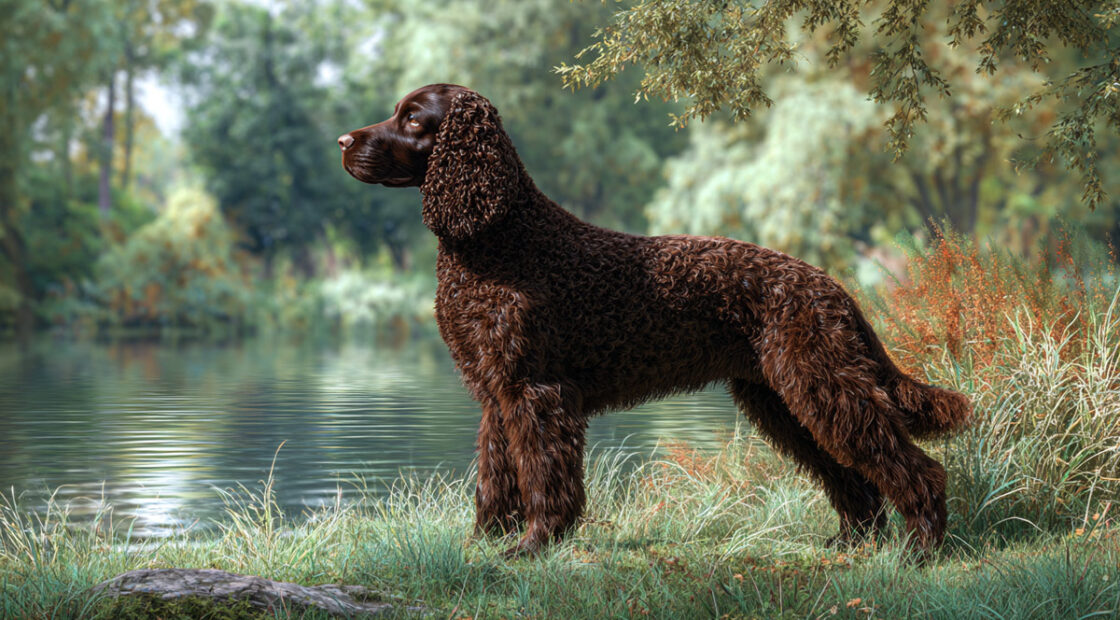
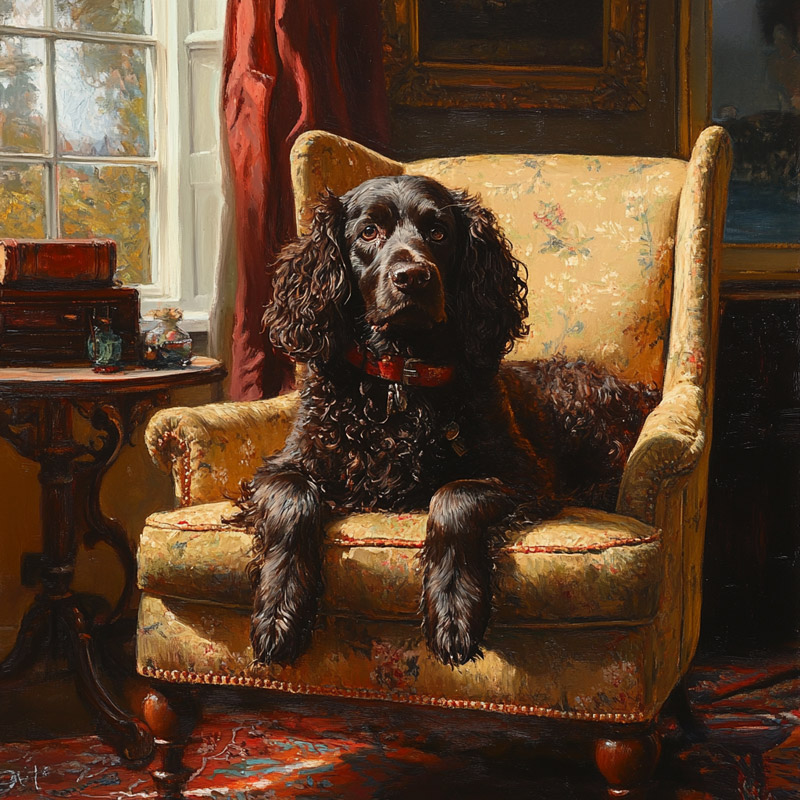
The curls cause confusion. This is not a Poodle, and the coat exists to shed water and protect against cold and brush.
It’s also a different dog from the Irish Water Spaniel, which the Irish Water Spaniel Club of America calls the largest of the spaniels.

Where does the American Water Spaniel come from?
The Wolf and Fox River Valley region of east-central Wisconsin, in the 1800s, according to the UKC breed standard.
Settlers wanted a dog small enough for a skiff and tough enough for cold marsh water. AKC history says they crossed Curly-Coated Retrievers with the old English Water Spaniel, because the retrievers alone were too big for the boats.
Nobody has a paper trail for the exact recipe, and the three best-known accounts disagree.
| Source | Parent breeds named | Detail |
|---|---|---|
| AKC history (updated 2025) | Curly-Coated Retriever, English Water Spaniel | Irish Water Spaniel blood added for coat |
| UKC breed standard (2012) | English Water Spaniel, Irish Water Spaniel, Flat-Coated Retriever | Described as what “some say” |
| Dr. Pfeifer, Dog World (1926) | English curly-coated retriever, field spaniel | Reported by Delta Waterfowl |
AKC history adds that a Field Spaniel cross to sharpen the nose may be only an old rumor.
The same source says the breed has bred true to type since the 1870s. No breeding records exist before 1906, though.
After that the dates are easy to line up.
- Dr. Fred Pfeifer of New London started keeping breeding records in 1906.
- On February 8, 1920, the UKC registered Curly Pfeifer, the first American Water Spaniel.
- The breed went into the Field Dog Stud Book in 1938.
- The AKC recognized it in 1940.
- Wisconsin enacted the state dog law on April 22, 1986.
Pfeifer did not carry the breed into the AKC himself. By 1940 he had turned to Labrador Retrievers, and AKC history credits Karl Hinz of Oshkosh with presenting the studbooks.
About that state dog year. The Wisconsin Legislature’s record shows 1985 Assembly Bill 16 became 1985 Wisconsin Act 295, enacted April 22, 1986 and published May 1, 1986.
Sources that print 1985 most likely cite the act number. An eighth-grade class from New London pushed the bill through, per Delta Waterfowl.
How big is the American Water Spaniel, and what does its coat look like?
Compact, 15 to 18 inches tall, with a curly brown coat made for cold water.
The AKC breed standard gives the same height for both sexes. Males run 30 to 45 pounds and females 25 to 40 pounds. The coat goes from marcel (uniform waves) to closely curled, and the AKC recognized the breed in 1940.
Size and weight
Proportion matters more than a number on the scale.
The standard calls for a body slightly longer than tall, not square or compact, and it states no preference for size anywhere inside the range.
The UKC standard (revised June 1, 2012) states 25 to 45 pounds overall and splits it by sex: males 28 to 45 pounds, females 25 to 40 pounds. That is nearly identical to the AKC figures (males 30 to 45, females 25 to 40); the only difference is the male minimum, 28 versus 30 pounds.
The size is deliberate. The AKC standard describes a dog bred to retrieve from skiffs and canoes.
Coat and color
The texture can be anywhere from marcel (uniform waves) to closely curled. Underneath, the coat is dense enough to protect against weather, water and punishing cover, yet not too coarse or too soft.
Color is liver, chocolate or brown, sometimes with a small white spot on the chest (Wisconsin Blue Book). Eyes are light yellowish brown to brown or hazel, or dark enough to harmonize with the coat.
The UKC lists a coat that is too straight, soft, coarse, fine or tightly kinked as a fault. Tight corkscrew curls are not the goal.
Trimming is allowed. The AKC standard permits a trim for a well groomed look and shaving of the ears, though neither is required.
What is the American Water Spaniel’s temperament like?
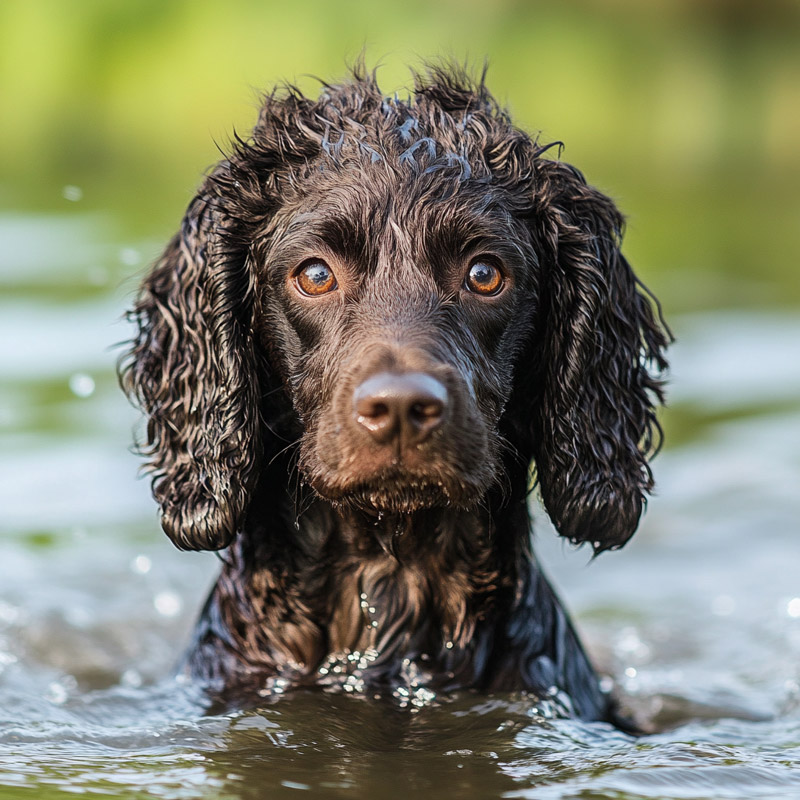
Friendly, intelligent and energetic, with some reserve toward strangers and a stubborn streak, according to the AKC.
The written standard and the AKC’s own breed page do not describe quite the same dog.
The standard asks for intelligence and eagerness to please, plus a friendly demeanor. The breed page adds that the dog can be aloof with strangers and a bit stubborn, while staying happy, eager and charming with its own people.
The Westminster Kennel Club rates the breed 3 out of 5 for children, other dogs and strangers, and 3 out of 5 for barking. Middle scores put the weight on early socialization and supervision around small children.
Hunting drive explains much of the rest. AWSC director Charlie Schlatter told Gun Dog they “absolutely live to hunt.”
That drive is the reason to fence the yard and keep a leash on in open country.
How the American Water Spaniel is trained and worked in the field
Easy to train, flushes upland birds close to the gun, retrieves from boats, and has had access to AKC hunt tests since 2005.
Training approach
Trainability is the breed’s top score.
The Westminster Kennel Club gives it 5 out of 5, the only 5 on its breed page. The AKC’s mention of a stubborn streak argues for brisk, varied sessions over long drills.
- Keep sessions short and change the exercises often.
- Use retrieving games as the reward.
- Get recall reliable before any off-leash work.
Hunting roles
The AKC standard describes an all-around hunting dog that retrieves from skiffs and canoes and works ground with relative ease.
As a flusher it works close to the hunter and puts game up for the gun (Westminster Kennel Club). It handles waterfowl as a retriever, and its size makes it an alternative to larger sporting breeds. It’s also small enough to get in and out of a skiff without upsetting it (AKC history).
Breeders interviewed by the AKC call it a moderate, upbeat worker. A hunter who wants the fast, wide quartering of an English Springer Spaniel will be disappointed, and the water entry is less bold than a Labrador’s.
Hunt tests and club water tests
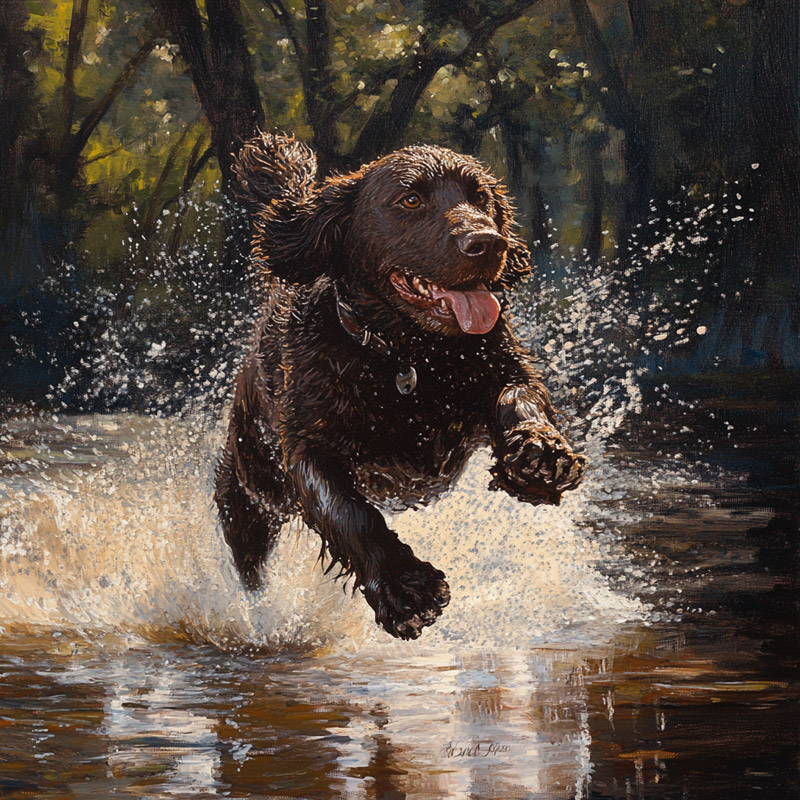
AKC hunt tests were closed to the breed for most of their history.
| Date | Change | Source |
|---|---|---|
| July 13, 1988 | First AKC spaniel hunt test held | AKC |
| June 2005 | Breed classified as a spaniel | Spaniel Journal |
| March 20, 2006 | First AKC Master Hunter title for the breed | Spaniel Journal |
| 2011 | AKC retriever titles open to the breed | Gun Dog |
AKC spaniel hunt tests averaged 171 titles a year from 1996 to 2005 (AKC), yet no American Water Spaniel held one through 2003 (Spaniel Journal). The lockout ran almost 17 years, from the first test in 1988 to classification in 2005. That’s a long wait.
The AKC lets a parent club request only one classification, and the AWSC chose spaniel. Gun Dog reports the AKC added a Retrieving Certification Test to the breed’s title requirements in 2005.
Spaniel titles run Junior Hunter, Senior Hunter and Master Hunter. A Junior Hunter pass needs a flushing test plus a water marked retrieve, per the AWSC.
The current water test rule is unsettled. AKC history (updated October 2025) says the club still requires two club-sponsored water tests before an AKC hunt test pass, while Gun Dog reports the club moved around 2011 to drop the retrieving requirement.
Check the AWSC’s current rules before entering a first test.
How much exercise and grooming does the breed need?
https://youtu.be/803L4vMPhK4?si=rftNzKllx0shCgGu
About an hour of daily activity and a weekly brushing, with the ears checked after every swim.
Daily exercise
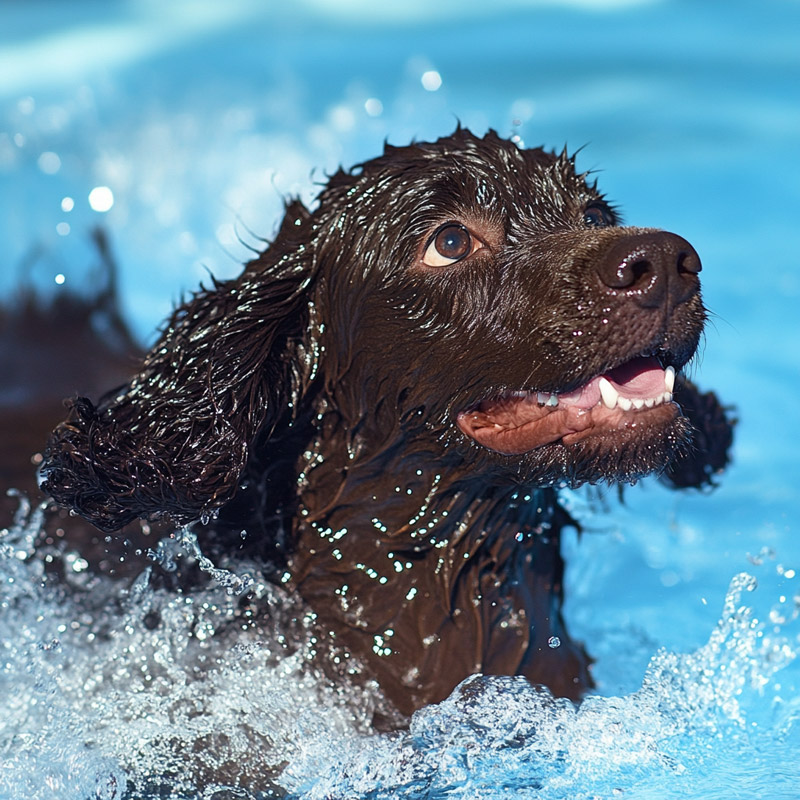
Published exercise figures run from 20 minutes to 2 hours a day.
| Source | Daily exercise | Brushing |
|---|---|---|
| Hill’s Pet Nutrition | 20 to 40 minutes | About twice a week |
| The Kennel Club (UK) | Up to 1 hour | Once a week |
| Purina (New Zealand) | 1 to 2 hours | Once a week |
The gap most likely reflects pet dogs versus working dogs. An hour sits inside two of the three ranges.
Wisdom Panel warns that under-exercised dogs turn to nuisance barking and destructive behavior. Swimming counts toward the total.
Coat and ear care
Brush weekly at minimum (PetMD), and more often during seasonal shedding. Shedding is low, according to Wisdom Panel, so the brush is mostly there to keep the curls from matting.
The ears are long, covered in curls and hanging, which means they need regular checks. Feet get the usual treatment of clean pads and trimmed nails.
Vetstreet advises keeping the ears clean and dry to prevent bacterial or yeast infections. For a water dog, that means drying them after every swim.
A weekly pass with a quality dog ear wipe handles the cleaning in under a minute.
American Water Spaniel health problems and the screening tests that matter
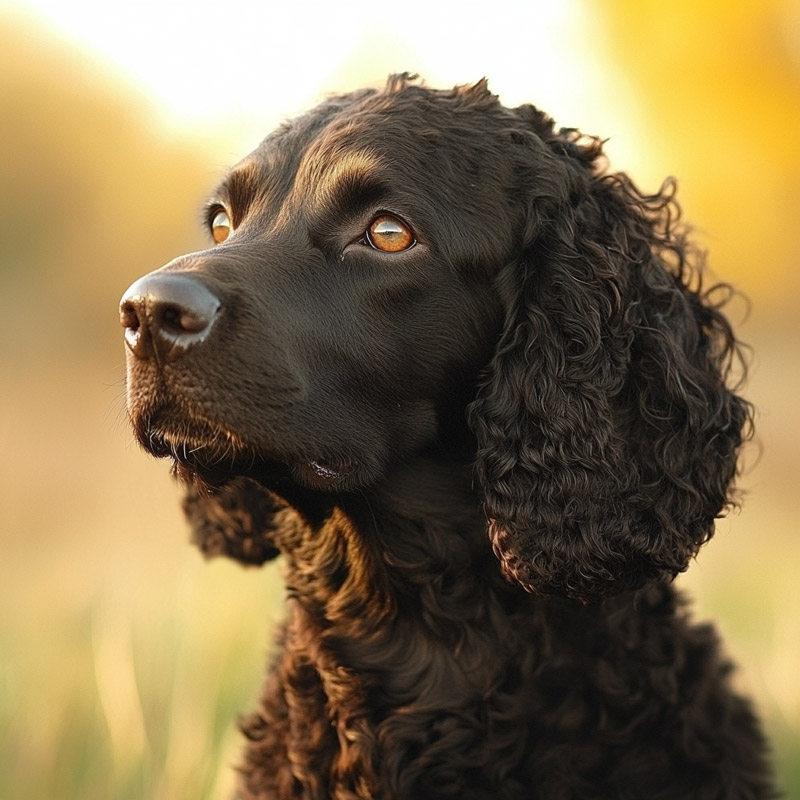
Generally healthy, though the AWSC still wants hips, eyes and heart screened under OFA criteria before breeding.
| Screening | Who certifies | Timing |
|---|---|---|
| Hips | OFA grades veterinarian x-rays | Age 2 or older |
| Eyes | Board-certified ophthalmologist, CAER registry | Within 1 year before breeding, up to age 8 |
| Heart | Cardiologist or OFA-certified veterinarian | Basic exam within 1 year before breeding, or one advanced exam at age 1 or older |
OFA hip grades run Excellent, Good and Fair (all normal), then Borderline, Mild, Moderate and Severe. The last three count as dysplastic, per the AWSC.
A dog that completes all the screenings earns a CHIC number once it is also microchipped or tattooed. The record keeps passes and failures alike.
The number only proves testing happened. The AWSC states it does not show the dog is healthy or free of abnormalities.
PetMD calls mitral valve disease the major heart concern in the breed, with patent ductus arteriosus and pulmonic stenosis as minor ones. It also lists hip dysplasia. The AWSC adds that epilepsy, hypothyroidism, degenerative myelopathy, pattern baldness and diabetes turn up occasionally.
Heart disease appears on both lists, as PetMD’s major concern and as one of the AWSC’s screens. Ask for the heart result first.
Degenerative myelopathy is the one condition here with a DNA test for breeding stock. It is recessive, so a dog needs two copies of the mutated gene to be at risk, and it usually shows up in older dogs.
The AWSC’s position runs against what many buyers assume. It says there is no health benefit to choosing a litter only because both parents test clear, as long as one parent is.
Lifespan depends on who you ask. The AWSC says 12 to 15 years, the Westminster Kennel Club says up to 14, Hill’s Pet Nutrition says 10 to 13 and PetMD says 10 to 12.
The breed club reports the highest figure. Treat 10 to 13 years as the planning range and 15 as the upside.
How does the American Water Spaniel compare with the Irish Water Spaniel and the Boykin Spaniel?
Far smaller than the Irish Water Spaniel, close in size to the Boykin Spaniel, and much rarer than the Boykin.
| Trait | American Water Spaniel | Irish Water Spaniel | Boykin Spaniel |
|---|---|---|---|
| Origin | Wisconsin | Ireland | South Carolina |
| Top height | 18 in | 24 in | 18 in |
| Top weight | 45 lb | 68 lb | 40 lb |
| Field role | Flushing and retrieving | Retrieving, water and land | Flushing and retrieving |
| AKC rank, 2025 (of 202 breeds) | 176 | 169 | 64 |
Sizes come from the Westminster Kennel Club breed pages, which follow the AKC standards. Ranks are AKC 2025 registration statistics.
Versus the Irish Water Spaniel
The Irish Water Spaniel is the heavier, bolder water dog. Hill’s describes bold, daring retrieves in cold North Sea water, and the Irish Water Spaniel Club of America says the breed was developed to retrieve fowl on both water and land.
Coat care sets them apart too. The dense Irish Water Spaniel coat takes real grooming commitment, per Dogs Victoria, while the American Water Spaniel gets by on a weekly brush.
Versus the Boykin Spaniel
The Boykin is easier to find, and easier as a family dog.
Westminster rates the Boykin higher for children and other dogs, two areas where the American Water Spaniel scored lower. It also ranks 64th in AKC registrations against 176th.
The two breeds are related. The UKC’s Boykin Spaniel standard lists the American Water Spaniel among the early ancestors, alongside the Chesapeake Bay Retriever, Springer Spaniel and Cocker Spaniel.
Pick the Boykin if the dog is mostly a family companion. Pick the American Water Spaniel if hunt tests and field work are the point.
Who should and should not own an American Water Spaniel?
Active households with time for daily exercise, and room for a rare, moderately stubborn working spaniel.
The upsides are real. The dog is compact enough for a small house with a small to medium garden (The Kennel Club), it sheds little, it trains easily, and it works as a hunting partner, a hunt test competitor and a companion.
The downsides are just as real. Breeders and litters are very few. It needs an hour or more of daily exercise, it has a stubborn streak and some reserve with strangers, and hip, eye and heart screening is not optional.
Sources disagree on yard size. Petfinder’s profile says the breed needs a large yard in a suburban or rural setting, while The Kennel Club lists a small house and a small to medium garden as enough.
When the breed does not fit
- Homes that sit empty all day are a poor match, since Petfinder says the breed can be left alone only occasionally, and only with training.
- Petfinder calls it suitable for owners with some experience and notes that extra training is required, so first-time owners should think twice.
- Petfinder also advises additional supervision around kids, which rules out leaving it unsupervised with young children.
- Buyers in a hurry will struggle. Breeders are few, so a puppy rarely arrives on short notice.
If two of those four apply to you, pick another breed.
How to find an American Water Spaniel breeder or rescue dog
Start with the AWSC breeders directory, verify OFA results for both parents, and expect the breeder to screen you in return.
- Use the club directory. The AWSC publishes a Breeders Directory, a Code of Ethics and a ten-point list of what a responsible breeder provides.
- Check both parents on OFA. Look up the sire and dam (and the grandparents) by registered name or number at ofa.org. Heart and eye results are tied to a window before breeding, so ask for results from within a year of this litter.
- Ask the club’s questions. The AWSC list covers years of breeding, which tests are done, why the pairing was chosen, when puppies go home and what guarantee comes with them.
- Expect screening. Breeders may ask about the dog’s purpose, where it will sleep, fencing and your experience. Answer honestly.
- Get the paperwork, which means AKC registration, health records, photos of both parents, references from past buyers and a contract.
- Apply early and widely, because a breed this rare may have no litter in your region.
Good Dog’s marketplace listings put American Water Spaniel puppies at $1,500 to $2,000. That is one platform’s range, not a standard price.
Purebred dogs rarely reach shelters, though Dogster notes that mixes with American Water Spaniel ancestry do turn up. Petfinder’s profile says adopting costs far less than buying from a breeder, so search it alongside breed-club contacts.
AKC Marketplace also lists breeders, but it does not replace the health-clearance checks above.
American Water Spaniel FAQ
Is the American Water Spaniel hypoallergenic?
No. Purina lists the breed as non-hypoallergenic, and low shedding does not change that.
PetsRadar adds that no dog breed is truly hypoallergenic.
Can an American Water Spaniel live in an apartment?
Yes, if the dog gets its daily exercise. Purina lists apartment living as suitable for a sufficiently exercised dog, and a trainer quoted in AKC history called the breed a good apartment dog.
The longtime owner interviewed there still said it is not for everyone.
Which dog sports can an American Water Spaniel do besides hunting?
Plenty. The AWSC’s breeder questionnaire lists agility, rally, tracking and dock diving among the activities its dogs do, along with conformation, obedience, therapy work, skijoring and lure coursing.
Do American Water Spaniels drool or snore?
Some drool, yes. Hill’s rates the tendency as high, while Purina and Petfinder say only some.
Hill’s rates snoring as low.
Does the breed need a special diet or joint supplements?

No. Portion control matters more than a special formula, and Wisdom Panel advises measuring food with a standard cup to prevent overfeeding.
Joint supplements are not proven to prevent hip dysplasia: veterinary sources report no direct evidence that they do, so weight control, steady exercise and screened parents matter more.
Caring for an American Water Spaniel Past the Puppy Years
Once adulthood arrives, an American Water Spaniel needs veterinary attention on the heart first and the hind end second, because mitral valve disease and degenerative myelopathy shape the later years.
The AWSC says degenerative myelopathy usually appears between ages 8 and 11, which falls inside the lifespan range most breed profiles give. Senior-year mobility care belongs in the budget from the start.
In practice that means checking the heart at every vet visit, watching the hind paws from age 8, and asking for a rehabilitation referral at the first sign of trouble.
The AWSC states that ground lost to the disease cannot be regained, so early rehabilitation beats waiting for a diagnosis. Its advice is slow leash walks of 5 to 10 minutes, a couple of times a day.
The club still wants the dog running and playing outdoors for as long as it is safe.