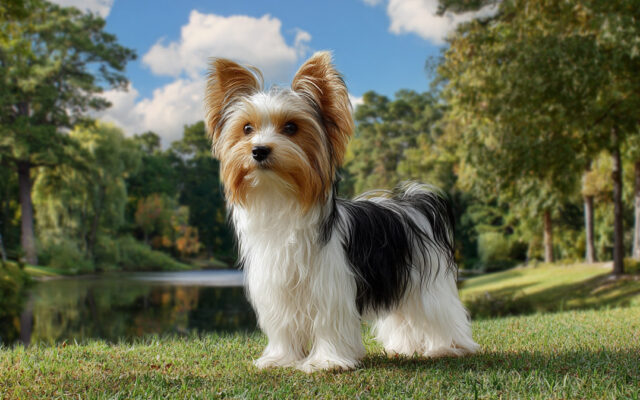
Lhasa Apsos were kept indoors at Tibetan monasteries and palaces, where the job was to sound the alarm when a stranger came near. It’s a small, long-coated Tibetan companion breed now, but the habit stuck.
The coat still needs brushing every day, and the dog still keeps its distance from visitors.
Flat-faced breeds generally lived shorter lives in a 2024 Dogs Trust and Liverpool John Moores University study of 584,734 UK dogs, published in Scientific Reports. The Lhasa Apso was the exception, with a median lifespan of 14 years against 12.5 for all dogs.
What Is a Lhasa Apso?
The AKC calls it a thousand-year-old breed that served as sentinels in palaces and monasteries high in the Himalayas. It worked indoors, while larger Tibetan Mastiffs guarded the outside.
The name has two parts, and only one of them is settled. Lhasa is the capital city of Tibet.
Apso is the disputed half. Proposed roots include Tibetan words for goatee and billy goat, along with a compound meaning bark-guard (Wikipedia), and the AKC says the reason the word was added is unclear.
The Tibetan name is Abso Seng Kye, usually translated as bark lion sentinel dog (VCA Animal Hospitals, Britannica). The AKC spells it Apso Seng Kyi and translates it as bearded lion dog.
On paper it started out as the Lhasa Terrier, though it was never a terrier, and it isn’t a hunting dog either. The AKC describes it as a companion and watchdog.
Where Does the Lhasa Apso Come From?


For roughly a thousand years it guarded monasteries and palaces in Tibet, as an indoor sentinel (AKC). It reached Britain in the early 1900s and the United States in the 1930s.
The first Tibetan dogs to arrive in Britain were lumped together as “Lhasa Terriers” (Wikipedia, VCA Animal Hospitals). The first American pair came in 1933, a gift from the 13th Dalai Lama to C. Suydam Cutting (Wikipedia, citing Wehrmann, 2002).
The AKC recognized the breed in 1935 and put it in the Terrier Group, then moved it to the Non-Sporting Group in 1959. The FCI accepted it on a definitive basis in 1960.
Early imports to Europe and North America were mixed up with the Shih Tzu and possibly the Tibetan Terrier, according to Hill’s. Breeders were separating the types by 1930.
Hill’s traces the Lhasa Apso itself to Tibetan herding-type dogs and the Tibetan Terrier.
Claims about age rest on DNA work. Parker and colleagues examined 85 breeds in a 2004 Science study and separated several ancient-origin breeds from modern European ones.
VCA Animal Hospitals reports that DNA studies place the Lhasa Apso among the 14 most ancient breeds the AKC recognizes, a short list of ancient dog breeds.
How Big Does a Lhasa Apso Get?
The AKC puts an adult at 10 to 11 inches at the shoulder and 12 to 18 pounds.
VCA Animal Hospitals agrees on height but gives 13 to 15 pounds. The Royal Kennel Club (UK, standard updated 1 August 2025) lists an ideal height of 25 cm (10 inches) for dogs, with bitches slightly smaller, and states no weight at all. Hill’s Pet Nutrition says 11 inches for males and 9 inches for females.
The ranges overlap but they don’t match. The UK standard gives height only, which leaves weight to breed guides, and its own note warns that a dog may come out larger or smaller than the figures.
Hill’s lists a wider male and female gap than the “slightly smaller” bitches the standards describe. Expect individual dogs to land outside both.
Lhasa Apso Coat, Colors and Grooming
The coat is long and heavy, with an undercoat beneath it. It sheds little but mats easily, which makes grooming the biggest ongoing demand on an owner’s time. Honestly, this is the part people underestimate most.
Coat colors and texture
The UK standard asks for a long, heavy, straight, hard top coat over a moderate undercoat, neither woolly nor silky (Royal Kennel Club).
Some owner guides call the coat silky. The standard doesn’t.
Golden, sandy, honey, dark grizzle, slate, smoke, parti-colour, black, white and brown are all equally acceptable in the UK standard.
Merle is the one color it rejects. Hill’s owner guide and the AKC standard say every color is accepted.
Shedding and allergies
Low shedding gets mistaken for allergy-friendly pretty often, so the research is worth a look. A 2012 study in the Journal of Allergy and Clinical Immunology (Vredegoor et al.) compared hair and coat samples from 196 dogs of breeds marketed as hypoallergenic with 160 other dogs. The hypoallergenic group carried higher levels of Can f 1, the major dog allergen.
The breeds tested were Labradoodle, Poodle, Spanish Water Dog and Airedale Terrier, not the Lhasa Apso. The authors still concluded that no evidence supports calling any breed hypoallergenic.
The AKC lists the Lhasa Apso among small dogs that shed little. That holds up, but it says nothing about how much allergen the dog carries.
Brushing routine and clips

Daily grooming is required to keep the long coat in condition and prevent matting, according to PDSA.
A full show coat means daily brushing to stop mats, plus careful work to remove debris, and it takes a lot of time (Hill’s). The puppy clip leaves a shorter coat that avoids the daily brushing of long hair (AKC), and many pet owners clip short about twice a year (Hill’s).
Trim length is a lifestyle call more than a style one. If you want options beyond the standard puppy cut, these haircut styles for the breed show what a groomer can do.
Breed Standard and Registry Recognition
Registries don’t agree on one group for the Lhasa Apso. The AKC files it under Non-Sporting, the Royal Kennel Club under Utility, and the FCI under Companion and Toy Dogs.
| Registry | Group | Key dates |
|---|---|---|
| AKC | Non-Sporting | Recognized 1935, Non-Sporting since 1959, standard effective October 1, 2019 |
| Royal Kennel Club (UK) | Utility | Standard last updated 1 August 2025 |
| FCI | Group 9, Companion and Toy Dogs (Tibetan breeds) | Definitive acceptance 19 November 1960 |
| UKC | Companion Dog Group | Recognized 1975, standard revised May 1, 2007 |
The AKC approved its current standard on August 13, 2019, effective October 1, 2019 (as published in Showsight). It replaced a shorter version approved in 1978 (Canine Chronicle).
The American and UK documents describe the same dog in different detail. The UK standard calls for a rectangular body, longer than the height at the withers, and a heavy, straight coat that never restricts movement.
On temperament, the UK text calls the dog “somewhat aloof” with strangers, and the AKC breed summary says “regally aloof.”
The AKC recognizes four Tibetan breeds: the Lhasa Apso, Tibetan Mastiff, Tibetan Spaniel and Tibetan Terrier (Canine Chronicle). It directs prospective owners to the American Lhasa Apso Club.
The standard is useful for judging a breeder’s dogs on structure and temperament. It won’t tell you how big a puppy will end up.
Lhasa Apso Temperament and Behavior

Independent and watchful, with a strong attachment to its own people and little interest in strangers.
The AKC describes an affectionate, comical dog that’s a little mischievous at home and highly aware of its surroundings everywhere else.
With family and children

Sources split on this one.
The AKC is the cautious voice, saying Lhasa Apsos generally prefer adults, though some do well in a household with children. PDSA is more upbeat and says they get along well with children and other pets when they are socialised as puppies.
Don Evans, president of the American Lhasa Apso Club, says they can be great family pets, even with small children, as long as the children give the dog space (Yahoo Lifestyle).
Everyone attaches a condition, though. Children need to learn how to handle a small dog before it arrives, and the AKC advises choosing a confident, outgoing puppy over a shy one.
With strangers and other pets
Strangers get a suspicious, alert reaction. PDSA calls the breed wary, and the AKC says it will bark at intruders.
Other pets are workable with early socialization, although Yahoo Lifestyle notes that a Lhasa Apso likes to be the boss. On time alone, the AKC says separation anxiety is rare, while Yahoo Lifestyle says the dog tolerates reasonable absences but will still sound off at unexpected noises.
The boss streak matters most in a multi-dog household, where it needs a plan from day one.
Barking
Barking comes with the breed, so the real work is managing it.
The AKC says the breed barks at intruders but does not bark indiscriminately. Evans calls it far from yappy, yet its keen hearing means it announces anything unusual.
A rough test: if a delivery or a noise in the hallway would draw a complaint from a neighbor, expect the dog to announce it.
How to Train a Lhasa Apso
Short, reward-based sessions and early socialization work best. The dog will try to negotiate anyway.
- Pick a confident, outgoing puppy, since the AKC says those fare better than shy or “soft” ones.
- Socialize early. PDSA ties the breed’s good manners with children and other pets to puppy socialisation.
- Keep sessions short, with plenty of treats and minimal repetitions (AKC).
- Enroll in AKC STAR Puppy, then Canine Good Citizen.
- Add AKC Virtual Home Manners to set household boundaries.
Obedience rankings and intelligence ratings disagree here. Stanley Coren’s rankings place the Lhasa Apso 68th of 79 groups for working obedience (as summarized by Wikipedia), while the AKC calls it a highly intelligent problem-solver.
What explains the gap is independence. The AKC warns the dog may try to manipulate its owner, and PDSA calls the breed stubborn, so training stalls when owners repeat commands or give in.
House training follows the same reward-based approach as any other cue. In a flat with no quick route to a yard, puppy pads can bridge the gap, so read up on how puppy pads work before relying on them.
Yahoo Lifestyle says Lhasa Apsos can take up to three years to mature emotionally, so adolescent stubbornness isn’t a verdict on the dog.
Lhasa Apso Lifespan and Common Health Problems

Lhasa Apsos live long for a short-muzzled dog, but eye, joint, spine and kidney problems all show up in the breed.
Lifespan
The 2024 Scientific Reports study from Dogs Trust and Liverpool John Moores University covered 584,734 UK dogs and found a median lifespan of 12.5 years across all of them.
The Lhasa Apso reached a median of 14 years. Flat-faced breeds generally fared worse in the same data, so this breed stands out.
PDSA gives an average lifespan of over 12 years. Yahoo Lifestyle says 12 to 15 years on average, with some dogs reported well into their twenties.
Stories of Lhasas in their twenties are reports, not medians. Plan around the population figure.
Eye problems
| Condition | What happens |
|---|---|
| Progressive retinal atrophy | Retina deteriorates, from night blindness to total blindness |
| Dry eye (keratoconjunctivitis sicca) | Reduced tear production damages the cornea |
| Cataracts | Lens turns cloudy |
| Glaucoma | Pressure inside the eye rises |
| Cherry eye | Third eyelid everts, usually in younger dogs, and surgery can correct it |
PDSA lists all five as conditions the breed is prone to.
Joint, spine, kidney and skin conditions
PDSA lists luxating patellas, where the kneecaps slip out of place, plus intervertebral disc disease and atopy, an allergen hypersensitivity that causes itching and skin trauma. Yahoo Lifestyle adds sebaceous adenitis, a genetic skin condition.
Renal dysplasia is the one that strikes young. A veterinary reference hosted by VIN describes it as most extensively reported, and presumed familial, in the Lhasa Apso and Shih Tzu.
The AKC Canine Health Foundation describes affected dogs as drinking and urinating more, vomiting, losing weight and turning lethargic, with kidney failure arriving between 6 weeks and 4 years of age. A newer AKC article gives a wider range, from 7 weeks to 9 years.
Health testing
The AKC’s Non-Sporting Group testing page lists no recommended health tests from the national breed club for the Lhasa Apso.
That leaves a buyer without a breed-club checklist to hold a breeder to. The AKC also says a CHIC number only shows that required tests were done, not that the results were normal.
In the UK, PDSA points to Canine Health Schemes run through the BVA and the Kennel Club, and advises asking about the health of both parents and all four grandparents. The Royal Kennel Club’s Health Test Result Finder lets you look up an RKC-registered dog’s results.
Ask for the vet’s eye and kneecap exam notes on both parents either way.
How Much Does a Lhasa Apso Cost?
A puppy from a reputable breeder costs $1,400 to $1,800, according to Don Evans, president of the American Lhasa Apso Club (Yahoo Lifestyle).
Pet-owner sites publish lower ranges. The gap is itself a reason to ask harder questions about screening and how the litter was raised.
| Item | Cost | Source |
|---|---|---|
| Puppy from a reputable breeder | $1,400 to $1,800 | American Lhasa Apso Club president |
| Adoption from a breed rescue | Set by each rescue group | No standard fee published |
| Monthly upkeep, minimum (UK) | About 70 pounds | PDSA |
PDSA’s monthly minimum for a Lhasa Apso covers food, insurance, grooming, worming, flea treatment, toys and similar items. It excludes vet bills for illness or injury.
PDSA puts the minimum lifetime cost for small breeds at 6,200 to 12,000 pounds, before any illness. Even at the small end, a dog is expensive across a whole life.
Part of what a breeder’s price pays for is the health history of the parents and grandparents (PDSA) and a litter raised with socialization and handling from birth to 8 weeks (Paction). The breeder should also be able to tell you which puppy suits family life (AKC).
Puppy scams are common for popular breeds, Paction warns, so see the litter in person before paying.
The American Lhasa Apso Club coordinates a network of regional rescues. Lhasa Happy Homes Rescue in Santa Monica, founded in 2001, rehomes Lhasa Apsos, Shih Tzus and Maltese, and it does not ship dogs out of state, so rescue often means a local pickup.
Who Should Own a Lhasa Apso, and Who Should Not?
Adults and families with older children tend to do best, provided they’ll brush daily and can live with watchdog barking.
It’s a good fit when the household is mostly adults or calm, older children (AKC), when someone will do the daily brushing or keep a short clip (PDSA, AKC), and when short walks and indoor play cover the exercise.
It’s a poor fit with toddlers and rough play every day. Thin walls and unhappy neighbors are another problem, since Yahoo Lifestyle notes the bark can undercut the apartment-dog reputation. Anyone who wants a dog that welcomes every visitor will be disappointed, and so will a budget that can’t absorb grooming and vet bills.
Exercise advice runs wide. Yahoo Lifestyle suggests a 20-minute walk once or twice a day, plus play. The AKC says no extensive exercise is needed and regular walks suit apartment living. PDSA says around an hour a day.
First-time owners can manage the breed if they stay consistent. The AKC’s warning about manipulation is real.
Lhasa Apso or Shih Tzu
Both are small lion dogs with long coats and a share of the same kidney risk. They diverge on manner with visitors and on lifespan data.
The Shih Tzu is an AKC Toy Group dog bred for companionship, with a trusting, friendly, outgoing temperament in its standard.
| Trait | Lhasa Apso | Shih Tzu |
|---|---|---|
| Median lifespan (UK study) | 14 years | 12.8 years |
| With strangers | Suspicious, barks at intruders | Friendly, outgoing |
| Renal dysplasia | Presumed familial | Presumed familial, same disease |
The Lhasa Apso suits someone who wants a watchful dog and a slightly longer median life. A sociable dog points to the Shih Tzu. Either way, ask about kidney health.
Lhasa Apso FAQ
What should a Lhasa Apso eat?
A balanced adult diet, with calories cut back if weight starts to climb, according to VCA Animal Hospitals.
ManyPets, an insurer, notes that a healthy weight reduces pressure on the knee in dogs with luxating patella. Ask your vet for exact portions.
How do you manage tear staining on a Lhasa Apso?
Keep hair out of the eyes and clean the area frequently. The AKC notes that the long facial furnishings can be banded out of the face for cleanliness.
Staining that persists or comes with discharge calls for a vet eye exam. PDSA lists dry eye, glaucoma and cherry eye among the breed’s eye problems.
Do Lhasa Apsos snore?
Not often. Hill’s rates snoring at the low end of its scale for the breed.
Loud, labored breathing while awake is a different matter and needs a vet visit.
Can a Lhasa Apso swim?
Only under supervision. VCA Animal Hospitals does not recommend swimming unless the dog is constantly watched.
How does a Lhasa Apso handle hot weather?
Not well. VCA Animal Hospitals says the breed does not tend to enjoy hot weather, which fits a coat developed high in the Himalayas.
Schedule walks for the cooler hours of the day.
Should a Lhasa Apso owner buy pet insurance?
Pricing a policy before the puppy arrives is sensible. PDSA, which sells pet insurance, recommends cover for breeds prone to certain conditions, and its monthly cost minimum for the breed excludes vet bills for illness.
Eye, kidney and spine risks are the reason to compare what each policy covers for hereditary conditions.
Planning the First Year With a Lhasa Apso
The first year goes best when the vet visit comes before the training plan. Kidney failure from renal dysplasia typically shows up between 6 weeks and 4 years of age, and the AKC reports cases up to 9 years.
Emotional maturity in the breed takes up to three years, so the stubborn adolescent phase overlaps that same window. Treat behavior changes there as a medical question before a training one.
A workable order starts with a vet exam that includes an eye check. Next comes a daily brushing habit, started before the coat lengthens, with socialization and reward-based classes running alongside.
Health goes first because illness can skew training. The coat comes next, since mats form quickly. The cost is time, either daily brushing or a short clip that gives up the long show coat.
Food comes after that, and a comparison of puppy food brands narrows the choice.