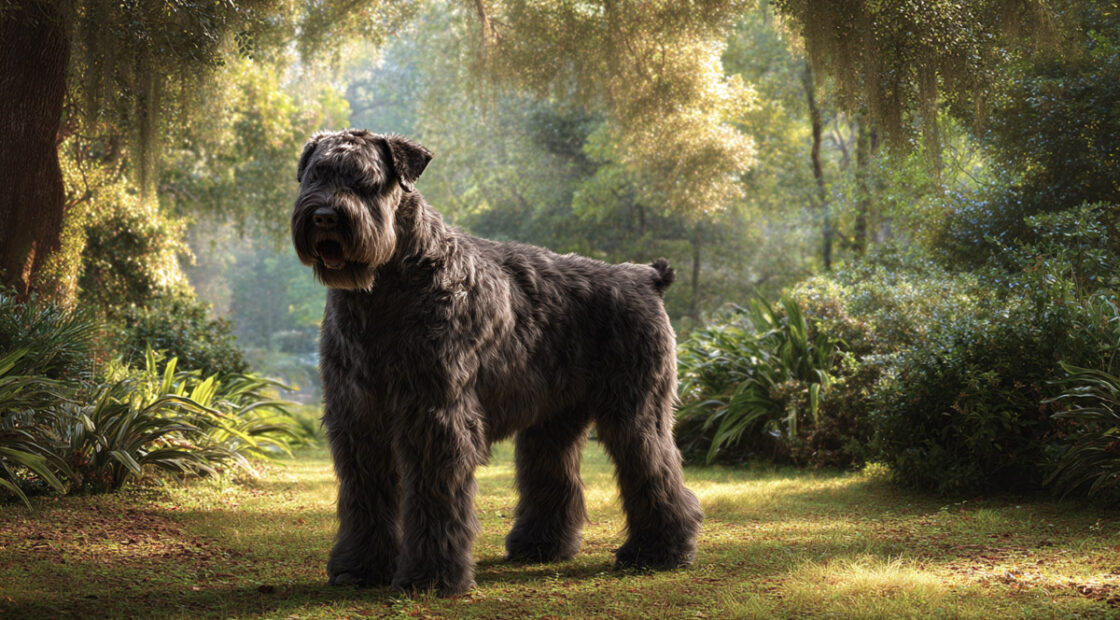
Bouviers des Flandres are big, rough-coated dogs from Flanders, on both sides of the Belgian and French border. They drove cattle and pulled carts, and guarded the farm on the side.
Police and army units use them now, guide-dog programs too, and plenty of families keep one as a guard. The FCI, AKC and UKC all file the breed under herding or cattle dogs.
Median life expectancy for a Bouvier is 11.3 years, 1.4 years below the 12.7-year median for purebred dogs overall (Dogs Trust, Scientific Reports, 2024). The breed figure rests on 151 dogs, so its 95% confidence interval runs from 10.4 to 11.9 years.
What Is the Bouvier des Flandres?
Built to drive cattle, haul carts and watch over farms, this is a large herding dog from Flanders.
The AKC breed standard calls for a powerful, short-coupled, rough-coated dog with a rugged look.
Name and meaning
Bouvier is French for cowherd, and the UKC notes the word once applied to any dog that worked cattle. The des Flandres part means “of Flanders,” the farmland on both sides of the Belgian and French border (FCI standard no. 191).
Flanders Cattle Dog and Vlaamse Koehond are the usual alternates. Toucheur de Boeuf turns up too, and so does Vuilbaard, which means dirty beard. Not the most flattering nickname.
Merriam-Webster gives the pronunciation as boo-vee-AY-duh-FLAN-derz. Owners shorten the name to Bouvier, and the plural is Bouviers des Flandres.
How kennel clubs classify the breed
The group names differ, but every major registry files the breed under herding or cattle-driving dogs.

| Registry | Group | Recognition and notes |
|---|---|---|
| FCI | Group 1, Section 2 (cattle dogs) | Standard no. 191 |
| AKC | Herding Group | Eligible 1929, first imports registered 1931 |
| UKC | Herding Dog Group | Recognized 1948 |
| Canadian Kennel Club | Group 7 (Herding) | Recognized 1955 |
Breed profiles split between 1929 and 1931 for the AKC date, and both are right, according to the AKC’s own breed history (2021). The breed became eligible for registration in 1929. The first two imports, Hardix de Montreuil and Diane de Montreuil, weren’t registered until 1931.
Where Does the Bouvier des Flandres Come From?
Flanders, where the dogs herded cattle and handled general farm work. Nobody documented the ancestry, and the UKC says the exact origin is still speculation.
The FCI standard lists herding, draught work and churning as the original jobs. Farm machinery ended most of that, and the same standard now describes the breed mainly as an estate guard, defence and police dog.
Competing theories about its ancestry
AKC history traces the breed to Berger Picard herders and heavy Matin cart dogs, crossed with British rough-coated gray hounds brought to the Abbey of Duynen as early as the 11th century.
Hill’s Pet’s breed profile goes a different way and suggests a griffon crossed with the Beauceron. The UKC standard hedges, mentioning both a blend of continental herding breeds and direct descent from the Schnauzer.
Local preferences for size and color produced the Bouvier des Ardennes, the Bouvier de Roulers and the Bouvier des Flandres, per AKC history. The Kennel Club adds that most of those types died out in the battles of the First World War.
How two world wars reshaped the breed
Only six active breeders remained after World War I, according to AKC history.
Dogs had hauled wounded soldiers and supplies and carried messages, and many didn’t come back. In 1922 the Club National Belge du Bouvier des Flandres adopted a standard covering type, coat texture and character, but not color.
A Belgian army veterinarian, Captain Barbry, rescued a Bouvier during the war and started a careful breeding programme from it, per The Kennel Club.
World War II hit harder. AKC history reports German soldiers shot Bouviers on sight.
Edmee Bowles, an Antwerp breeder active in the Resistance, fled Belgium with a black male named Belco and later shaped the breed in America. After the war, Justin Chastel’s de la Thudinie kennel sent breeding stock overseas, which seeded the North American lines.
How Big Does a Bouvier des Flandres Get?
A male stands about 62 to 70 cm (24.5 to 27.5 inches) at the withers, and a female a little lower. Weight is where the registries disagree.
The Kennel Club (UK) gives dogs 62 to 68 cm and 35 to 40 kg (77 to 88 lb), and bitches 59 to 65 cm and 27 to 35 kg (59 to 77 lb), per the standard updated 1 January 2025.
The AKC measures in inches: dogs 24.5 to 27.5, bitches 23.5 to 26.5, with ideals of 26 and 25 inches.
The Canadian Kennel Club puts dogs at about 34 to 45.25 kg (77 to 100 lb) and bitches at about 27.25 to 38.5 kg (60 to 85 lb).
The FCI and UK figures agree on 35 to 40 kg for males. The Canadian ceiling sits about 5 kg higher.
The build is square. Length from shoulder point to buttock equals height at the withers, and the AKC standard faults a long-bodied dog.
Show standards penalize dogs outside the height limits. The Kennel Club says its numbers are a guide, and a pet may fall above or below them.
Growth runs slow. Dogs NZ states that Bouviers don’t reach adulthood until 2 to 3 years, so a puppy keeps filling out well after its first birthday.
Coat, Colors and Grooming Needs
Expect a harsh, weatherproof double coat in shades from fawn to black, and plan on combing it weekly at the very least.
Coat structure and colors
The topcoat is rough, dry and tousled, never curly or woolly (UKC standard), over a fine, dense undercoat that gets thicker in winter. Length runs about 6 cm (2.5 inches), per The Kennel Club. The head carries a heavy beard and mustache, and the upright eyebrows should never veil the eyes.
A flat coat means a missing undercoat. The UKC lists it as a serious fault, and The Kennel Club calls it highly undesirable.
Accepted colors run from fawn to black, including brindle. The UKC standard also names salt and pepper and gray, and allows a small white star on the chest.
Chocolate brown and predominantly white dogs are faulted by both registries. Canada adds cream and washed-out shades to its list of undesirable colors.
Stripping, clipping and brushing
Sources disagree on workload. The Kennel Club’s breed page rates grooming as every day, while Orvis recommends a thorough brushing at least weekly.
A practical split is to comb the beard and leg furnishings daily and brush the full coat down to the skin once a week. The beard earns its Vuilbaard nickname by collecting food and water, so wipe it after meals.
Purina’s breed profile says the rough coat needs frequent hand stripping. The UKC standard allows only slight trimming to accent the body line and faults over-trimming.
Orvis notes that many owners trim the beard and coat to make it manageable. Pet owners who clip give up the show-ring finish for an easier routine.
Show dogs stay natural. Pet dogs can be clipped without penalty.
What Is the Bouvier des Flandres Temperament Like?
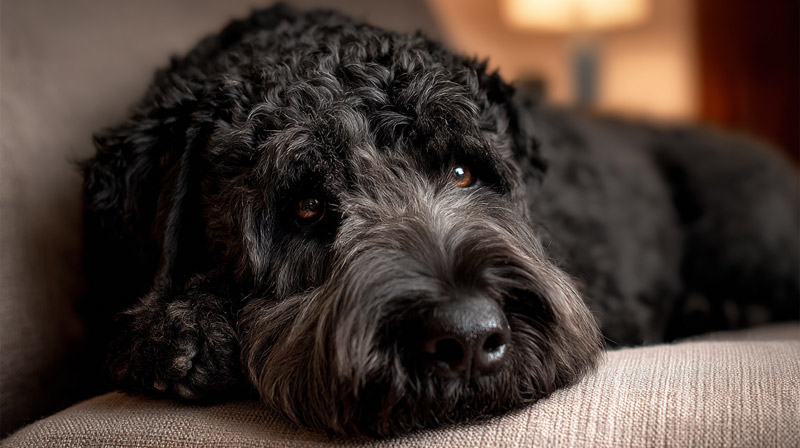
Calm and protective, mostly. The breed was built to work alongside people, and the standards describe a dog that watches before it acts.
The FCI wants a calm, thoughtful, sensible and fearless character that keeps its aptitude for work. The AKC describes an equable dog, steady, resolute and fearless, with a serene and well-behaved disposition. The UKC asks for an even-tempered, agile, steady dog and disqualifies viciousness or extreme shyness.
American Bouvier des Flandres Club president Nancy Eilks, speaking in the AKC’s breed history, describes the protectiveness as selective. The dog may challenge a person but doesn’t bite unless it decides it must.
One documented case: after an earthquake wrecked the California home of breeder Gladys May, her Bouvier Banquo pulled her son to safety and then kept neighborhood children safe under a tree (AKC history). He had no obedience training beyond conformation work.
The same history calls the breed excellent with the very young and the very old. At home, a Bouvier often parks itself in a doorway or on a stair landing to watch the family.
Dogs NZ says the breed needs daily involvement, not occasional attention. It guards by instinct, so strangers at the door get noticed. Socialize it with people, other dogs and handling before adolescence.
A 100 lb guard dog with no early socialization is a liability. That’s the one temperament risk the sources keep coming back to.
How Much Exercise and Training Does a Bouvier des Flandres Need?
An adult needs roughly an hour of exercise a day, and many need more. A bored Bouvier turns destructive, according to the Dogs NSW breed page.
Daily exercise
The Kennel Club’s breed page lists exercise at up to 1 hour per day and recommends a large house with a large garden. Orvis sees it differently, calling the breed tough to tire out and saying it will happily trek with its owner for miles.
Treat the hour as a floor. Anything above it is capacity the dog will use if you offer it.
Puppies are a separate case. Petfinder’s breed profile advises monitoring puppy exercise to protect developing joints.
Jobs and sports that suit the breed
- Herding. The AKC lists Bouviers des Flandres as eligible, and its non-competitive Instinct Test takes dogs from 6 months with no prior training
- Tracking, carting and search and rescue
- Police and army work, plus guide work for the blind (UKC standard)
- Obedience, agility and Schutzhund, per Purina’s breed profile
- Draft Dog and Versatile Bouvier programs from the American Bouvier des Flandres Club
Any of these gives the dog a task. That’s the point of the FCI standard’s rule that the breed must keep its aptitude for work.
Training and maturity
Sources split on how easy the breed is to train. Dogs Victoria describes a quick learner that does well with obedience work, but with a stubborn streak that doesn’t suit first-time or timid owners.
Purina’s New Zealand breed library sets the method. Build the bond first, then stay kind, fair and consistent.
Maturity is the other disagreement. Dogs Victoria says a Bouvier may take 3 to 4 years to mature fully, a year longer than the 2 to 3 years Dogs NZ gives.
Plan on adolescent behavior well past the second birthday, and keep going to classes until the dog settles. The AKC Canine Good Citizen title gives that work a concrete target.
Which Health Problems Affect the Bouvier des Flandres, and How Long Does It Live?
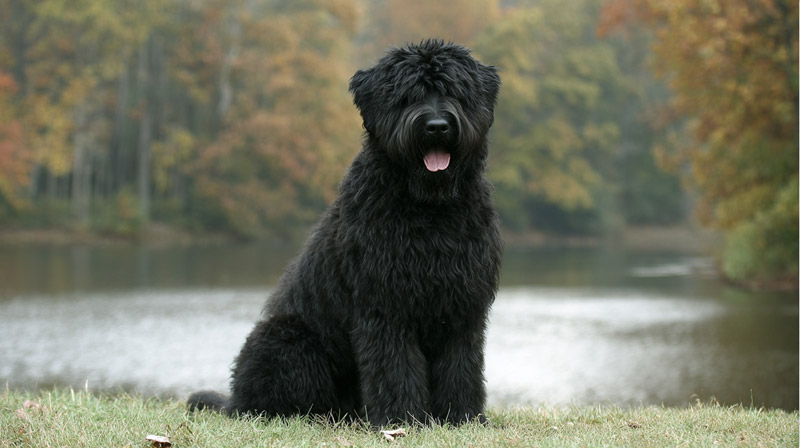
The American Bouvier des Flandres Club calls the breed relatively healthy, but it carries known risks in the hips, elbows, heart, eyes, airway and stomach. Median lifespan sits near 11 years.
Lifespan
The Dogs Trust study in Scientific Reports (2024) puts the median life expectancy of a Bouvier at 11.3 years, against 12.7 years for purebred dogs overall.
The breed sample is small, 151 dogs with 79 deceased, so the 95% confidence interval runs from 10.4 to 11.9 years.
Breed profiles usually quote 10 to 12 years. VetWest, an Australian animal hospital group, lists 12 to 14, which sits above the Dogs Trust interval.
Screening tests breeders should complete
The American Bouvier des Flandres Club’s health statement of 18 June 2026 asks for four exams on both sire and dam. They come from the CHIC requirements, the Canine Health Information Center program run by the Orthopedic Foundation for Animals (OFA).
Hips get an OFA radiographic evaluation or PennHIP, and elbows an OFA radiographic evaluation. The heart needs one cardiac exam (standard congenital with results registered with OFA, advanced, or basic). Eyes are examined by an ACVO ophthalmologist from 18 months and rechecked every two years until age 8.
The cardiac exam looks for subaortic stenosis, an inherited narrowing in the flow out of the heart that can end in heart failure (Purina UK).
Registries don’t agree on the panel. The AKC’s herding-group testing list shows hip, elbow and cardiac exams for the breed and omits the eye exam the parent club adds.
The Kennel Club in the UK lists BVA/KC schemes for hips, elbows and eyes, with no cardiac scheme on its list.
Bloat and how to lower the risk
Every owner of a deep-chested dog should know about bloat before the puppy arrives.
In gastric dilatation-volvulus (GDV) the stomach fills with air, fluid or food and twists on itself, and Cornell’s Riney Canine Health Center names large, deep-chested dogs as the most at risk.
On feeding, Cornell lists one meal a day and large meal volumes as risk factors and advises two or more meals daily. The Veterinary Information Network adds fast eating to the profile of a typical bloat case, so a slow feeder bowl is a cheap precaution.
A prophylactic gastropexy, often done at spay or neuter, tacks the stomach to the body wall. Cornell says it lowers the risk of twisting but doesn’t prevent bloating.
A sudden swollen abdomen with obvious distress is an emergency. Cornell states that prompt surgery is critical once the stomach has twisted.
Other conditions
Cornell notes a congenital form of laryngeal paralysis in Bouviers, which can appear in young puppies. There’s no cure, and surgery often improves quality of life.
Glaucoma, a painful build-up of pressure inside the eye, is on the list too (Purina UK), along with hip and elbow dysplasia, which the club tells buyers to ask breeders about. Embrace Pet Insurance’s breed profile adds autoimmune thyroiditis.
Not every Bouvier meets any of these. The list is still the reason a breeder’s health results count for more than a low price.
How to Buy a Bouvier des Flandres Puppy
Start with the breeder, not the puppy. The American Bouvier des Flandres Club tells buyers to take their time and never buy on impulse.
No registry publishes puppy prices, and commercial breed guides quote ranges that differ widely between the US and UK. Vetstreet’s 2011 profile ties price to location, the puppy’s sex, the parents’ titles and whether the dog suits a show or pet home.
- Read the AKC breed standard so you know what a sound, correctly built Bouvier looks like.
- Visit dog shows and performance events, and talk to owners about their dogs.
- Shortlist breeders who sign the ABdFC Code of Ethics. The club’s referral list charges breeders a small fee, and the club does not recommend any of them.
- Ask for hip, elbow, heart and eye results on both parents, and look them up on the OFA website, where the club says records are available. UK buyers can use the Kennel Club’s Health Test Results Finder.
- Check that the parents are mature. The club says sound physique and stable temperament are rarely, if ever, settled before age two.
- Expect an interview. The breeder matches each puppy’s personality to a family and wants proof of shelter and care.
- Collect the paperwork: a vet exam, age-appropriate vaccinations and worming before placement, plus a spay/neuter contract or limited registration for a companion puppy.
Walk away from any puppy sold through a pet shop or dealer. Walk away too if only one parent has results, or if the breeder won’t take a puppy back.
Who Should Not Get a Bouvier des Flandres?
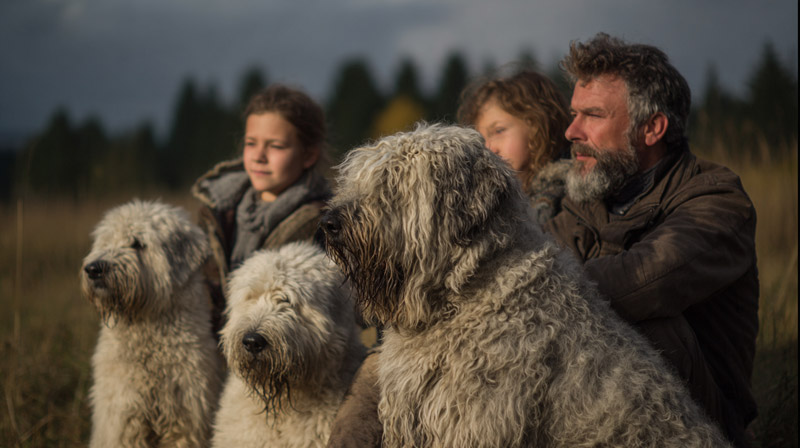
First-time owners, empty households and anyone unwilling to groom regularly should look at other breeds. Country Living, quoted in Merriam-Webster’s usage examples, calls the Bouvier a gifted herding dog that needs an experienced owner with plenty of time for training and a job to do.
Where the breed fails
Dogs Victoria says the breed may not suit first-time or timid owners. Purina’s New Zealand library notes that herding breeds can be distressed when their social group splits up, which makes an empty house a poor fit.
Homes with small pets have their own problem. The club’s puppy guide warns of strong prey drive and a love of chasing moving things, and the same guide lists significant coat requirements for owners short on grooming time.
Small, crowded spaces are hard on everyone, since the club says Bouviers don’t understand their own size.
Supervision matters around children too. Dogs Victoria says a Bouvier should never be left unsupervised with them, as with all breeds.
Strength shows up in daily life. Lucky, the Bouvier given to Ronald and Nancy Reagan in December 1984, was photographed tugging the president around the White House grounds on a walk with Margaret Thatcher in February 1985.
Pros and cons of ownership
On the plus side, the dog is loyal and protective with its family and trains well when the bond comes first.
- Works in herding, tracking, carting and search and rescue
- Serene at home once it has had its exercise (Orvis)
The downsides are bigger.
- Coat care takes regular time
- Strong enough to pull an adult off balance
- High prey drive around small animals
- Slow maturity, so adolescence runs long
- Bloat risk and a long list of health screens
If you can commit to about an hour of daily exercise, regular coat care and training classes until the dog matures, the breed fits. If you can’t, pick something lower-maintenance.
Bouvier des Flandres FAQ
Is the Bouvier des Ardennes the same breed as the Bouvier des Flandres?
No. The Ardennes is a separate regional type of bouvier.
AKC history says local preferences for size and color produced the Ardennes, Roulers and Flandres types. The Flandres became the favored variety from the Lys River to the coast.
Which is the better fit, a Giant Schnauzer or a Bouvier des Flandres?
Neither wins outright, because both started as farm drovers and guards and suit similar jobs.
Historian David Hancock calls the Giant Schnauzer Germany’s drover and farm guard. The AKC admits it to herding events even though it files the breed outside the Herding Group (Canine Chronicle, 2023).
Is a Bouvier hypoallergenic?
No. The American Bouvier des Flandres Club says the breed has low dander but isn’t hypoallergenic.
Orvis describes the coat as low-shedding and adds that regular grooming reduces dander further.
Can a Bouvier live in an apartment?
Rarely. Petfinder’s breed profile says Bouviers do best in a larger home in a suburban or rural area with a fenced yard.
A small flat only works if the owner supplies the full daily exercise and a regular job.
Are Bouvier ears cropped and tails docked?
Both are optional in the US and banned in some countries. The UKC says docking and cropping are legal in America as a personal choice, and it penalizes no dog for a full tail or natural ears.
The Kennel Club’s standard calls docking previously customary and accepts a tail that follows the natural line of the spine.
Can you adopt an adult Bouvier?
Yes. The American Bouvier Rescue League, the club’s rescue partner, places misplaced, neglected and unwanted Bouviers.
The club itself suggests an adult dog for homes that find a puppy’s energy and training demands overwhelming.
Preparing Your Home for a Bouvier des Flandres
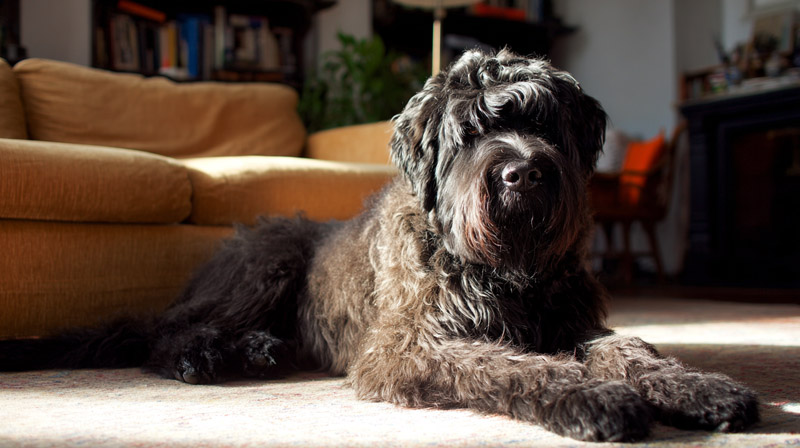
Before pickup day, get parental health results verified, a puppy class booked and the nearest 24-hour emergency vet located. That order follows what can’t be fixed later, so check the results before paying a deposit.
A Bouvier that matures at 3 to 4 years spends 27 to 35 percent of a median 11.3-year life still maturing. Training commitment therefore outlasts puppyhood by years.
The trade-off is a longer wait for a litter with complete results. Health requests follow the American Bouvier des Flandres Club’s 18 June 2026 statement, verified 21 October 2026, and a revised CHIC panel would change them.
With those in place, compare puppy food brands before the first meal.