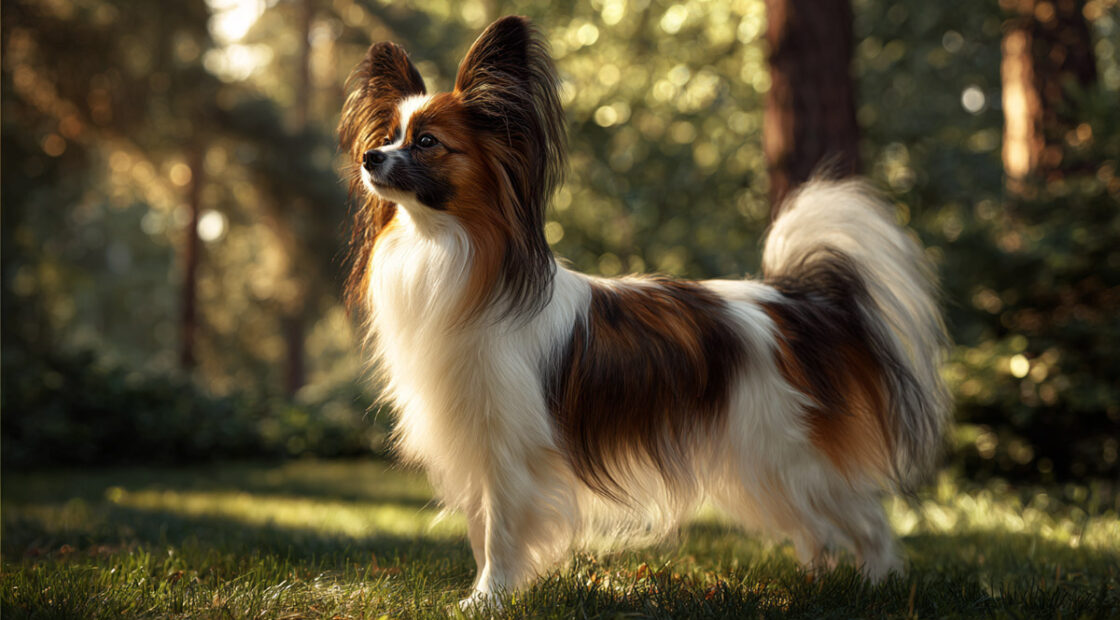
Papillons are small. They stand 8 to 11 inches tall, and the ears do most of the identifying: large, fringed and shaped like butterfly wings. It’s a toy spaniel from France and Belgium.
The AKC places the breed in the Toy Group, but in obedience and agility it competes against much larger dogs.
The ears are the newest part of the look. Renaissance painters from Titian onward showed toy spaniels with drooping ears. The erect type only became fashionable toward the end of the 19th century, according to the breed’s US parent club in a history adapted from its 1957 handbook.
What is the Papillon dog breed?
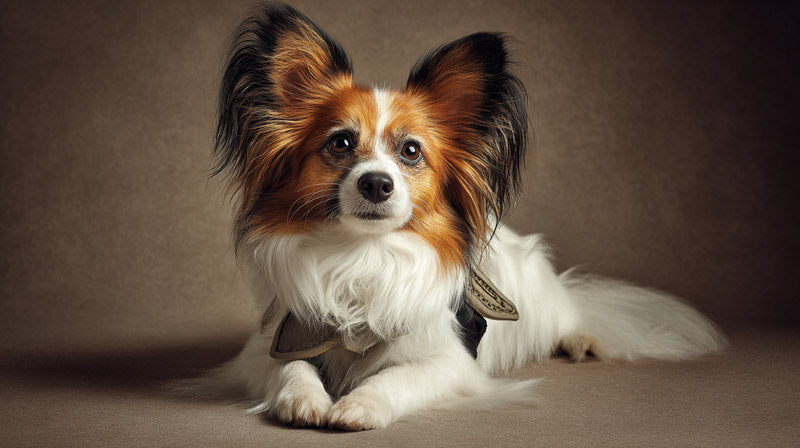
Large, fringed ears carried like the spread wings of a butterfly give the Papillon away. It stands 8 to 11 inches tall and belongs to the toy spaniel family.
Papillon is French for butterfly. The Papillon Club of America (PCA) counts it among the oldest purebred toys.
Other names include Continental Toy Spaniel and Butterfly Dog, while the FCI uses Epagneul Nain Continental. The AKC sorts the breed into the Toy Group, and the FCI files it under Group 9, Companion and Toy Dogs.
The drop-eared variety is called the Phalene, French for moth.
Size isn’t the whole story. The breed competes in obedience and agility against much larger dogs, and tracking too. A breed profile hosted by the PCA (first published in Dog Fancy in 1991) calls it the most popular toy breed in obedience.
Papillon history and breed recognition

Renaissance court portraits keep showing the same little dwarf spaniels, and those dogs are the Papillon’s ancestors. France and Belgium share credit for the modern breed.
Baron Albert Houtart of Belgium, author of the standard work on the subject, concluded that both countries perfected the type equally. The PCA history, adapted from its 1957 handbook, says the same applies to the erect-eared type.
How old is the breed?
Nobody agrees on a starting point, not even the PCA’s own articles:
- Italian frescoes from the 13th to 15th century, per the breed profile on the PCA site
- Italian paintings from the 15th century, according to the PCA’s general-background article
- Titian’s tiny spaniels, around 1500, in the 1957 history
Titian’s dogs were red and white with flat heads and little stop. Every continental toy spaniel from Titian through the court painter Mignard carried its ears down.
Royal favor worked against the breed in the end. Marie Antoinette owned a dwarf spaniel, and the dogs lost popularity during the French Revolution because royalty had liked them so much.
Interest came back in France, Belgium and England in the late 1800s and early 1900s.
Where do the erect ears come from?
Erect ears showed up late. They became fashionable toward the end of the 19th century, and soon after that the name Papillon covered the whole breed.
The PCA FAQ says the upright ear seems to be a mutation from that period.
You’ll still run into the old story that Chihuahuas brought back from Mexico gave the breed its erect ears. The PCA says there’s no historical basis for it. The Titian spaniel was already a pure breed before the conquest of Mexico, and erect ears became fashionable more than three centuries after it.
When did the AKC recognize the Papillon?
- The first known US imports arrived in 1907, brought in by Mrs. William Storr Wells of Massachusetts
- AKC recognition came in 1915 (PCA breed profile, VCA Animal Hospitals)
- England formed its Papillon Club in 1924
- The Papillon Club of America was founded in 1935
- In 1999, Ch. Loteki Supernatural Being won Best in Show at Westminster (PCA FAQ)
Plenty of breed pages give 1935 as the AKC recognition year, but the PCA and VCA date it to 1915. The 1935 date matches the founding of the PCA, which probably explains the mix-up. The breed had been shown in the US for years before the club existed.
AKC registration rankings for 2025, released in 2026, place the Papillon 42nd of 202 breeds.
Papillon size and weight standards
The AKC standard sets a height range of 8 to 11 inches at the withers and gives no weight. In practice a Papillon typically weighs 3 to 9 pounds (PCA).
The AKC and Kennel Club standards both give the height as 8 to 11 inches (20 to 28 cm). Over 11 inches is a fault, and over 12 inches is a disqualification under the AKC. Weight is meant to be proportional to height, and the AKC doesn’t put a number on it.
Weight: where the standards differ
The AKC, UKC and Canadian Kennel Club standards tie weight to height and name no figure. Of the five standards checked here, only FCI Standard No. 77 (published 1990, revised 1998) gives numbers.
- Class 1 dogs weigh under 2.5 kg (about 5.5 lb), males and females alike
- In class 2, males run 2.5 to 4.5 kg (about 5.5 to 9.9 lb) and females 2.5 to 5 kg (about 5.5 to 11 lb)
- The minimum is 1.5 kg (about 3.3 lb)
The FCI ceiling of 5 kg sits above the PCA’s typical 9 pounds (about 4.1 kg). So the international standard tolerates heavier dogs than the average show Papillon.
The AKC standard also describes the body as slightly longer than tall. A Papillon is never a cobby dog.
Oversize dogs
Being outside the standard costs a dog its show career. It doesn’t cost it any value as a pet.
Over 11 inches is a fault in the AKC, UKC and Canadian Kennel Club standards. The AKC goes further and disqualifies dogs over 12 inches, and the UKC treats any dog over 12 inches as an eliminating fault.
Regional taste muddies this. The PCA FAQ reports that larger Papillons near the 12-inch limit do well in some parts of the US show scene and get penalized by judges elsewhere.
The Kennel Club adds a note for puppy buyers (as of its April 2025 update). Its measurements describe the ideal, and an individual dog can be larger or smaller.
Coat and color: what the Papillon standard accepts
A long, fine, silky coat with no undercoat, and white with patches of any color. That’s what the standard requires.
Coat
With no undercoat there’s no heavy seasonal shed, the PCA notes. The AKC standard calls the coat abundant, straight and resilient, lying flat on the back and sides.
The long hair sits on the chest (the frill), the ears, the backs of the forelegs, the hind legs (the breeches) and the tail plume.
The skull, the muzzle, the front of the forelegs and the hind feet up to the hocks carry short, close hair.
Color
No shade is preferred, as long as the nose, eye rims and lips are pigmented black.
Color other than white must cover both ears, front and back, and run unbroken from the ears over both eyes. A clean white blaze and noseband are preferred to a solidly marked head.
Body patches can be any size, shape or placement. The AKC disqualifies an all-white dog or a dog with no white.
The PCA FAQ lists the combinations the AKC registers:
- White and black
- White and lemon
- White and red
- White and sable
- Tricolor (white, black and tan)
The Kennel Club is stricter. Its standard accepts white with patches of any colour except liver, plus tricolours, and calls every other combination unacceptable (April 2025). The AKC standard names no excluded shade, though the PCA says liver is now seldom seen.
The parti-color rule makes sense once you know the history. Titian’s spaniels were red and white. Solid colors were popular from the late 1800s into the early 1900s, and they had disappeared by the time of the PCA’s 1957 handbook.
Papillon vs Phalene: how the two ear types differ
One breed, two ear types. The Papillon carries its ears erect and the Phalene carries them dropped.
| Feature | Papillon | Phalene |
|---|---|---|
| Ear carriage | Erect, carried obliquely like spread wings | Drooping, completely down |
| Name meaning | Butterfly | Moth (night moth) |
| Place in breed history | Fashion of the late 1800s | Original variety |
| Ear set | About 45 degrees to the head | Same angle, with a slight rise at the skull |
| Frequency | Far more common | Rarer, with fanciers working to bring it back |
How registries classify the two
The AKC registers one breed, Papillon, and shows both ear types together. The Kennel Club (UK) also has a single breed standard, with the completely dropped ear type called the Phalene.
The FCI uses one standard too (No. 77), but at FCI shows the two varieties are judged separately.
Sources disagree on one point. The PCA FAQ and VCA Animal Hospitals report that some European countries treat the Phalene as a separate breed, while the FCI standard places both varieties in one.
What stays the same
Apart from the ears, the two varieties are identical, so the same size, coat and color rules apply. Both ear types can appear in one litter, according to the Kennel Union of Southern Africa breed standard effective July 2025.
The Phalene ear sits at the same 45-degree angle as the Papillon’s. It isn’t set low on the head like the low-set ears of a Cocker Spaniel. The PCA’s Phalene article ties the slight rise at the skull to ear health, because it lets air reach the ear canal.
Drop ears also change how a judge reads the dog. A Phalene can look longer in the back and smaller in height than a Papillon with identical measurements (PCA).
Temperament, intelligence and training
Friendly, alert and lively. The AKC standard asks for exactly that, a happy dog that is neither shy nor aggressive.
Most of the behavior traces back to two facts. The breed spent centuries as a court companion, and its ancestry includes hunting spaniels.
Intelligence and trainability
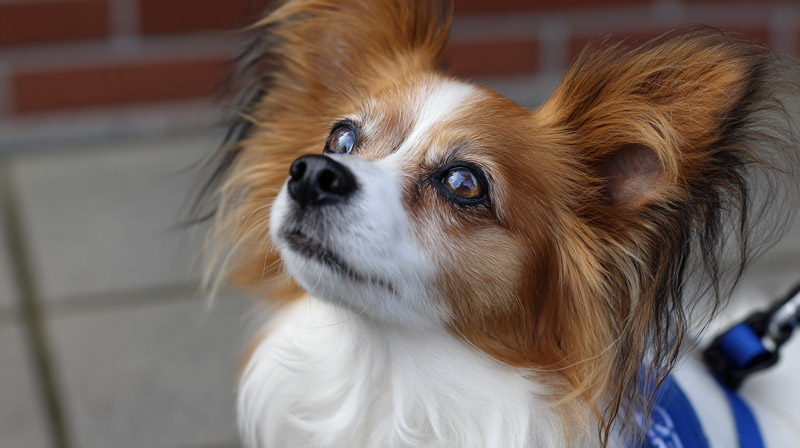
Stanley Coren’s 1994 book The Intelligence of Dogs ranks the Papillon 8th for working and obedience intelligence. The score comes from ratings by North American obedience judges.
The PCA warns against confusing intelligence with trainability. A Papillon learns from every experience, so an inconsistent trainer gets inconsistent results, even with basics like housebreaking.
Forced methods and punishment backfire with this breed, according to the PCA’s 2003 guidance. Coren himself advised against choosing a dog by its trainability score (Tampa Bay Times, 1994).
Barking and alertness
The PCA’s own articles don’t agree on barking.
- The breed profile (1991) says many Papillons bark at nearby noises and make no distinction between casual sounds and real alarms
- The general-background article says the breed is generally not yappy, alerts at the door, then quiets once the visitor is let in
- Wisdom Panel says some Papillons are yappy and that shared-wall apartments may not suit them
It varies by individual, and by how much outside noise reaches the dog.
The 1991 profile adds that the barking is often hard to control even though the dogs train easily.
Other animals and prey drive
Papillons generally do well with other pets, especially small dogs, and can become close friends with cats (PCA). First contact with a cat needs supervision because claws threaten the eyes.
The breed ignores size differences and invites much larger dogs to play, often with bad results.
Plenty of Papillons still flush mice or lizards from cover, and they love working a field.
Dog sports
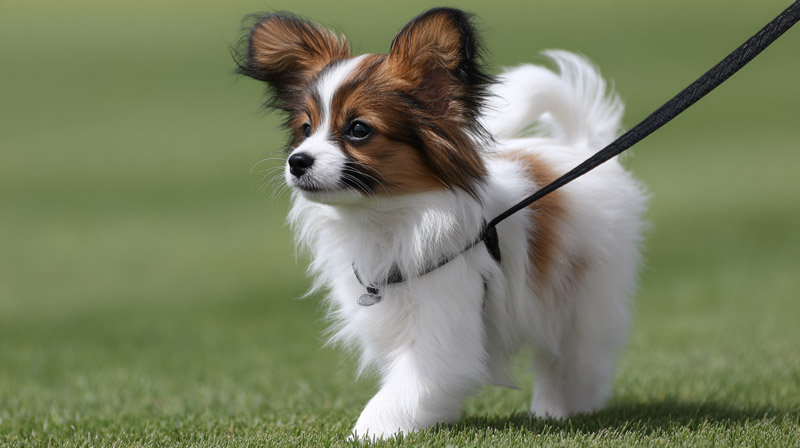
Papillons train well for sports, and the record shows it.
- In obedience, the PCA places the breed among the five top performers in competition once scores and titles are weighed against registrations
- The PCA describes agility and tracking ability as exceptional
- Some dogs do hospital visits as therapy dogs, and others work as hearing-ear dogs
CH and OTCH Loteki Sudden Impulse held the record as the most AKC-titled dog of any breed until 2000 (PCA FAQ).
The drawback is the dog’s own enthusiasm. Many Papillons try jumps that are too high or loads that are too heavy, so agility jumps need to be set low.
Health problems and screening
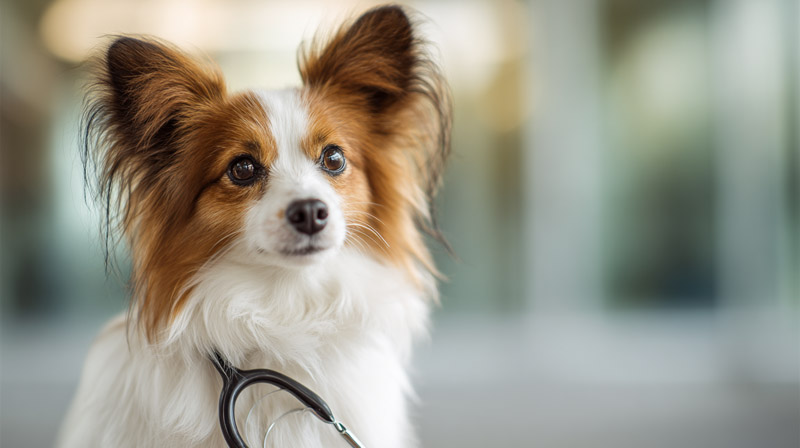
Papillons are hardy, but the usual toy-breed problems do turn up: patellar luxation, periodontal disease, open fontanels and progressive retinal atrophy (PRA).
Patellar luxation
A kneecap that slips out of its groove in the hind leg makes the dog hop or skip until it resets (PCA). That’s patellar luxation.
- In grade 1, the patella luxates by hand at full extension of the stifle and returns when released
- Grade 2 is where luxation turns frequent, and in some cases it becomes more or less permanent
The Orthopedic Foundation for Animals (OFA) form describes grades 1 and 2 this way, and grades 3 and 4 are more severe still.
A veterinarian can sometimes correct the problem surgically, but the PCA says most affected dogs learn to live with it. Dogs with patella problems should not be bred.
Dental disease
Periodontal disease appeared in 29.7% of Papillons against 18.2% of all dogs in a study of more than three million Banfield Pet Hospital records across 60 breeds (Wallis et al., The Veterinary Journal, 2021).
Only the Greyhound and the Shetland Sheepdog scored higher.
Retained puppy teeth add to the risk. When baby teeth don’t fall out, food and hair get trapped between the teeth, and a vet may remove them (WebMD).
A 2026 owner-questionnaire study in the Journal of Small Animal Practice also flagged the Papillon as higher risk, with a much higher overall rate than records-based studies. Records capture what vets diagnose, and mouth disease often goes unlogged until an exam under anesthesia.
Eye and skull conditions
Progressive retinal atrophy is a hereditary eye disease. The PCA reported it as newly found in the breed in the late 1990s, which led the club to push eye testing of breeding stock.
An open fontanel is a soft spot in the top of the skull. Under a quarter inch in a young puppy, it usually closes. If it’s larger, or still felt in an adult, it won’t close, and a blow to that spot can kill the dog (PCA, 1991).
Affected dogs can live a full life with head protection, but they should not be bred.
Which tests do breeders run?
As of this writing (October 2026), the AKC lists these as the tests recommended by the national breed club:
- Patella evaluation
- Cardiac exam
- Ophthalmologist evaluation
OFA’s Canine Health Information Center (CHIC) issues a number when a dog’s results meet the parent club’s testing requirements, per the AKC. A CHIC number on a parent is a quick first check, though the results themselves are what to read.
Lifespan: why sources disagree
| Source | Figure | What it measures |
|---|---|---|
| PCA breed profile (1991) | 14 to 16 years | Breed club expectation for a well-chosen dog |
| VCA Animal Hospitals | 12 to 15 years | Veterinary hospital breed page |
| VetCompass (Teng et al., 2022) | 10.7 years | UK Toy group life expectancy at age 0 |
A 2003 PCA article goes further and says Papillons with good care often live into their late teens.
The VetCompass life tables cover 18 breeds and the Papillon isn’t one of them, so the Toy group figure is the closest primary-data benchmark. Life expectancy at age 0 counts puppy deaths, which pulls any group figure below the lifespan of a dog that reaches adulthood.
Adams et al. (Journal of Small Animal Practice, 2010) found smaller breeds tend to outlive larger ones. Treat 14 to 16 years as a best case, not a promise.
Daily care: grooming, exercise and teeth
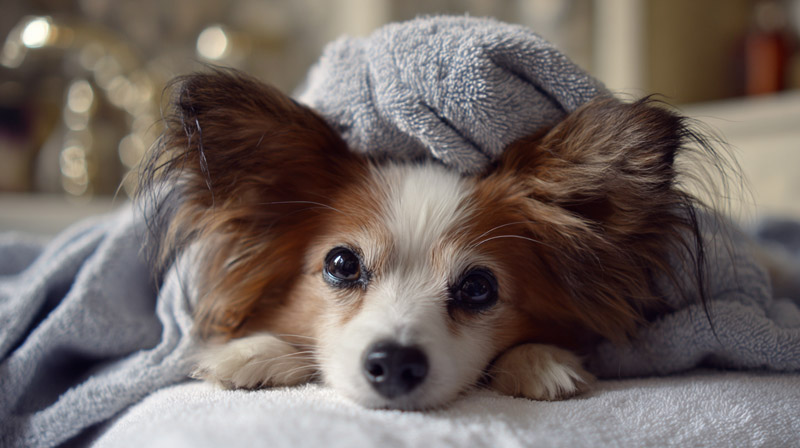
Sources disagree on how much brushing, exercise and tooth care a Papillon needs. The ranges below show how far apart they are.
| Task | Range in sources | Practical read |
|---|---|---|
| Brushing | More than once a week (Omlet UK) to daily (Petsecure) | Several times a week, aimed at mat-prone spots |
| Exercise | No substantial requirement (PCA FAQ) to high energy (Omlet UK) | Daily walk plus play |
| Teeth | Learn to tolerate brushing at a young age (PCA) | Start in puppyhood |
Grooming routine
The PCA calls the Papillon a wash-and-wear breed because the single coat resists matting. The ear fringes still need dedicated care, and frequent bathing promotes hair growth and prevents breakage.
- Dampen the hair slightly before brushing to prevent breakage.
- Work through the mat-prone spots: behind the ears, inside the rear legs and the culottes.
- Break small mats apart with your fingers instead of pulling them out. For a stubborn mat, rub in cornstarch and wait about 10 minutes.
- Keep nails short, and check any dewclaws that were not removed, because they can grow in a circle back into the leg.
- Trim the hair between the pads, and check the anal glands at every bath.
Exercise
Papillons are indoor dogs that still want something to do.
The PCA FAQ says they have no substantial exercise requirement but enjoy the outdoors, and Purina New Zealand puts a daily walk at about half an hour.
Puppies need supervision on stairs and sofas, because a tumble or a jump can break a leg (PCA, 1991). Check fences too, since a curious pup will find small gaps between posts and gates.
Dental care
It starts with a puppy that tolerates a toothbrush.
The PCA says mouth infections can spread through the bloodstream and damage the heart and kidneys, and heavy calculus may need a veterinary cleaning.
Anesthesia needs a plan before that cleaning. The PCA FAQ (written 1996 to 2000) lists the Papillon among the more anesthetic-sensitive breeds and recommends discussing the anesthetic with the vet before dental procedures.
When a Papillon is the wrong fit
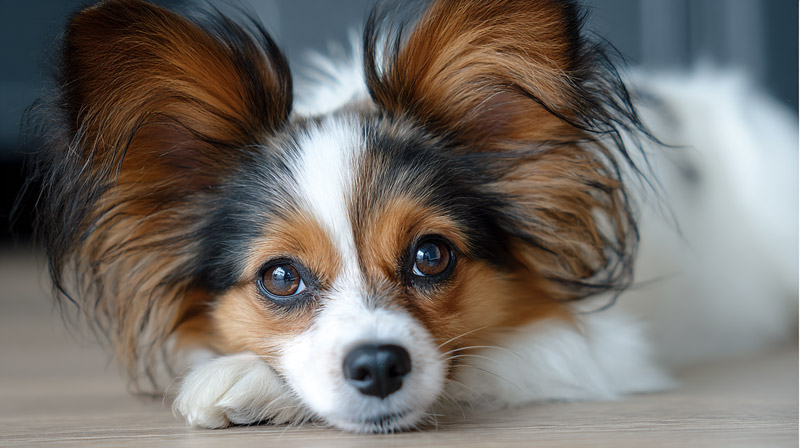
Some homes just don’t suit this dog. Long workdays away, small children or rough play, and a wish for a guard dog or a backyard dog are the big ones.
The PCA says a companion dog left alone for long hours becomes unhappy and develops barking, digging and chewing, sometimes self-mutilation.
PCA breeders advise against placing Papillons with very small children or with older children who want to roughhouse. Buyers who want a guard dog, protection training or a backyard dog are told to pick another breed.
A large, energetic dog that sees a Papillon as prey can injure or kill it, even by accident, so mixed-size households need thought.
And if you’re after a quiet lap ornament, the breed rarely outgrows its playfulness, so it will feel like a chore.
A workable rule: if the home is empty for a full workday on most weekdays, choose a different dog or arrange company. The PCA notes that Papillons form lasting attachments to other pets, which can ease loneliness.
Where the sources disagree
On apartments, the PCA FAQ says Papillons adapt equally well to close quarters and country life, while the PCA’s 1991 profile warns that many bark excessively at nearby noises. Wisdom Panel says shared walls may not suit them.
Noise exposure decides it, not floor space.
On children, VCA Animal Hospitals’ breed page gives the Papillon its top score for children, yet the PCA’s 2003 article calls the breed rarely a good choice for very small children.
Both hold up. The temperament is friendly, and the risk is physical, since a squirming puppy can escape a child’s arms and land badly (PCA FAQ).
Toy breeds to compare
Anyone who wants a small companion but can’t meet a Papillon’s appetite for company can compare other toy breeds on health testing first.
The AKC’s Toy Group list recommends patella, cardiac and eye tests for the Japanese Chin, the same set as the Papillon (as of October 2026).
The list for the Cavalier King Charles Spaniel adds a hip evaluation.
How to choose a Papillon puppy or adult
Buy from a breeder who health-tests both parents and shows you the whole litter. Or contact the PCA rescue committee about a dog that needs a home.
Evaluating a breeder
- Start with the PCA’s breeder listings instead of a classified ad or a pet shop.
- Ask for health test results on both parents before paying a deposit: patella evaluation, cardiac exam and ophthalmologist evaluation.
- Ask to see the dam and all the puppies together, not one at a time.
- Do not take a puppy home before 8 weeks of age (PCA).
- Read the contract. It should name the sire and dam with registration numbers, give the birth date, set a return window after a vet exam, and include a spay or neuter agreement for pet-quality puppies.
- Expect a wait. Litters are small, often two or three puppies, and a wait of a year or more is not unusual (PCA, 1991).
Stay flexible on size, sex and color. The PCA says temperament match matters far more than looks.
Skip pet shops and commercial kennels entirely. The PCA FAQ says their puppies typically come from puppy farms, leave their dams too young and have parents that were never tested for PRA or other problems.
Rescue and adult dogs
Papillons rarely reach shelters, though it has happened, and the PCA runs a rescue committee.
An adult can settle in quickly. The PCA says a Papillon can change homes at any age and adjust happily if suitably placed.
An adult also comes with a known size and temperament, which no puppy can offer.
Papillon FAQ
Are Papillons hypoallergenic?
No. The single coat means no heavy seasonal shed, but the PCA states that Papillons shed and are not hypoallergenic.
Orvis adds that no breed is completely hypoallergenic, though Papillons tend to shed less than many others.
How much does a Papillon puppy cost?
No registry or breed club publishes a standard price, so the figure varies by breeder.
Ask what the price covers. The PCA says the contract should name the sire and dam, set a return window after a vet exam, and include a spay or neuter agreement for pet-quality puppies.
What should a Papillon eat?
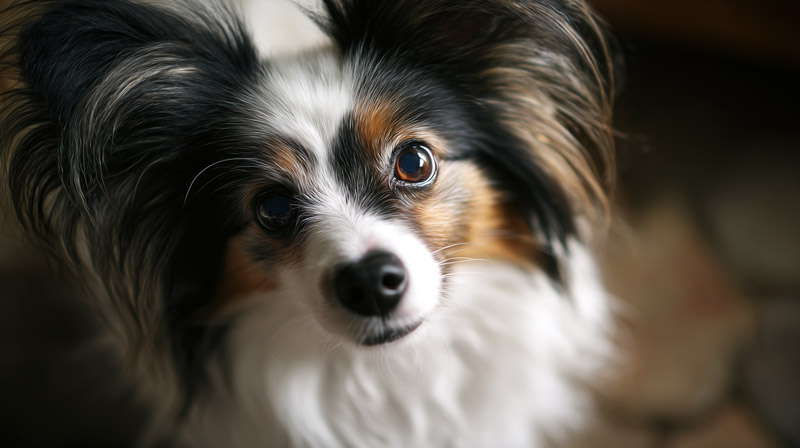
Most adults do fine on a measured portion of a complete commercial food, since the PCA describes Papillons as seldom finicky and not prone to obesity.
Diet also affects coat quality and dental health, per the PCA. For a growing puppy, compare puppy food brands with your vet.
When do a Papillon puppy’s ears stand up?
Puppies are born with their ears down, and the ears may begin to stand within a few weeks and finish by about four months, though some never stand, according to Orvis.
Ears that stay completely down make a Phalene. Under the AKC standard, one ear up or ears partly down is a fault.
Planning the First Year With a Papillon
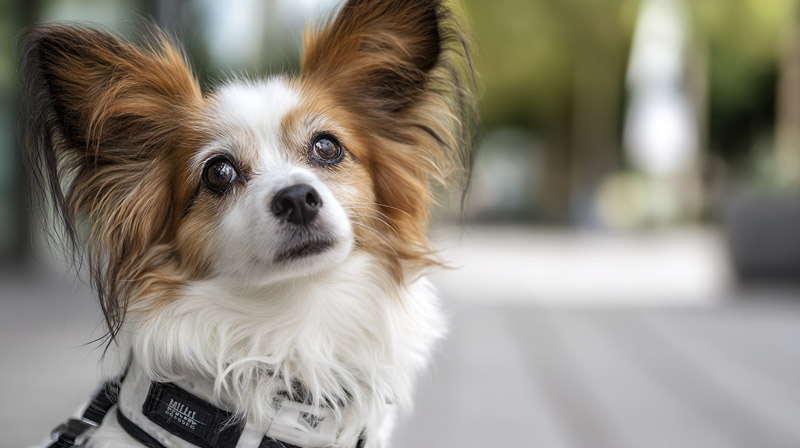
Teeth set the pace in the first year. A 2023 Veterinary Sciences study of Yorkshire terriers, another toy breed, found that the active phase of tooth development runs from about 2 to 7 months, and that baby teeth were lost and adult teeth erupted later in dogs under 3 kg.
Typical Papillons weigh 3 to 9 pounds, so many straddle that 3 kg line (6.6 lb). Their mouths need a check every week through month 7.
- Toothbrush training from week one, plus weekly mouth checks to month 7
- Stair and sofa supervision until adulthood
Dental work comes first because the retained-tooth window closes. Jump supervision can ease once the dog is an adult and, per the PCA, surprisingly resilient.
The trade-off is time. A puppy that gets brushed, inspected and watched every day needs an owner who is home.