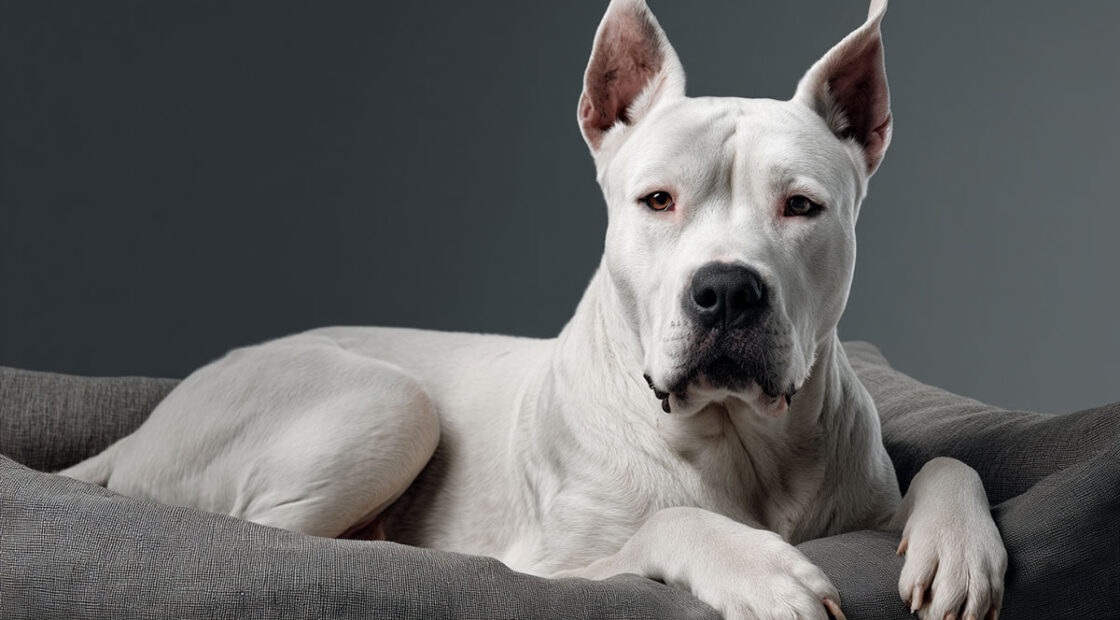
Dr. Antonio Nores Martinez built the Dogo Argentino in Cordoba, Argentina, to hunt wild boar and puma in packs. The result is a large, all-white, mastiff-type dog, and in 1973 the FCI accepted it as the first Argentine breed.
Under the FCI standard, males stand 60 to 68 cm and weigh about 40 to 45 kg. The AKC took the breed into its Working Group in 2020.
The white coat comes with a hearing problem. Of 811 dogs given a BAER hearing test, 25.77% were deaf in one or both ears (Veterinary Record, 2021), yet the FCI standard disqualifies deafness.
What Is the Dogo Argentino?

Britannica calls it the national dog of Argentina. It is a big white mastiff type bred to hunt boar and puma in packs, and the Federation Cynologique Internationale (FCI) lists its use as big-game hunting dog and sets no working trial for it.
The FCI files the breed under Group 2, Section 2.1 (Molossian, Dogue type), standard 292. The AKC puts it in the Working Group, with full recognition since January 1, 2020. You will also see it called the Argentine Dogo or the Argentinian Mastiff, and plenty of owners just say Dogo.
According to the FCI’s own breed history, it was the first Argentine breed the FCI accepted.
The hunting job accounts for the prey drive. The hearing problems come with the white coat.
Where Did the Dogo Argentino Come From?
Nores Martinez was a surgeon from Cordoba province, and he laid the foundations of the breed in central Argentina in 1928, according to the 1999 version of FCI Standard 292.

The type was stable by 1947, when the standard went to the Hunter’s Club in Buenos Aires (FCI, 2012).
He started from the Old Fighting Dog of Cordoba, which was already a mix of bulldogs and Bull Terriers and a favorite with dog-fight crowds.
What he wanted instead was a pack dog that could take on wild boar and peccary, and puma too. The FCI credits its strength, tenacity, scenting ability and courage for its value in the field.
Breeding was strict. Dogs had to be fully white and not undershot, with heavy heads and long muzzles.
Which Breeds Shaped the Dogo Argentino?
The FCI standard says these were crossed into the Old Fighting Dog of Cordoba.
- English Bulldog
- Great Dane
- Pyrenean Mastiff
- Bull Terrier
- Boxer
- Pointer
- Dogue de Bordeaux
- Irish Wolfhound
That’s a wide spread. Bulldog and mastiff types sit alongside a Boxer and a Pointer, with a sighthound, the Irish Wolfhound, thrown in. Shorter summaries on pet sites drop several of them.
The standard lists the breeds but never says what each one added. So any breed-by-breed credit for size, scent and the rest rests on breeder lore, not on the document.
What Does the Dogo Argentino Breed Standard Require?

Males run 60 to 68 cm and about 40 to 45 kg under the FCI standard. Females are 60 to 65 cm and about 40 to 43 kg.
| Sex | Height at withers | Ideal height | Weight |
|---|---|---|---|
| Males | 60 to 68 cm | 64 to 65 cm | 40 to 45 kg |
| Females | 60 to 65 cm | 62 to 64 cm | 40 to 43 kg |
Britannica quotes a wider weight band that starts at 36 kg. Summaries drift from the standard more often than you would expect, so check the FCI text when numbers matter.
The coat is short and smooth, uniform across the body, averaging 1.5 to 2 cm. Density shifts with climate.
The dog has to be entirely white. A single dark patch is allowed on the skull, one ear or around one eye, and it cannot exceed 10% of the head.
Between two dogs of equal quality, the standard prefers the whiter one. The AKC standard also allows a dark patch near the eye, with its own size limit.
A dog is disqualified for more than one head spot, spots on the body coat, blue or mismatched eyes, a brown nose, long hair or deafness.
The build is athletic and rectangular, with the chest reaching the elbows. The muzzle matches the skull in length, and body length exceeds height at the withers by 10% at most.
Which Kennel Clubs Recognize the Breed?
The AKC accepted the Dogo Argentino 47 years after the FCI did.
The Federacion Cinologica Argentina and the Sociedad Rural Argentina opened their studbooks in 1964. In 1973 the FCI accepted the breed on a definitive basis, credited to the founder’s brother, Agustin Nores Martinez, and the national breed club. Full AKC recognition in the Working Group took effect on January 1, 2020.
AKC admission requires a minimum number of dogs spread across the US and an established breed club, per the AKC announcement. The Dogo Argentino Club of America is the parent club.
Dogo Argentino Temperament and Prey Drive
A well-bred Dogo is confident and devoted to its family, and it is cautious with strangers. The prey drive rules out unsupervised time with small animals.
The FCI standard asks for a quiet hunter that never barks on the trail and is never aggressive toward people. Aggressive or overly shy dogs are disqualified.
Hill’s Pet Nutrition says the dog bonds closely with its family and guards the household as part of the pack. It stays wary of strangers until it decides the coast is clear (Hill’s).
Large dogs of the same sex can spark trouble (Spot Pet Insurance). Cats and small pets are a high risk, per both guides.
For young children the guides disagree and cite no behavior data, so supervise.
Hill’s recommends a leash, with off-leash running only in a securely fenced area. Britannica adds that the breed does not belong at dog parks and is not for inexperienced owners.
The sources split on one point. Insurer and pet-food guides treat wariness around strangers as normal, while Kassi McLaughlin, a breeder and hunter writing for Modern Molosser, says a balanced Dogo accepts a friendly stranger and is never wary.
Ask a breeder which of those two temperaments the lines are selected for.
How Common Is Deafness in the Dogo Argentino?
Roughly one in four tested Dogo Argentinos is deaf in at least one ear.
Two studies published twelve years apart land within about 1.2 percentage points of each other.
The Veterinary Record study tested 811 dogs by BAER and found 25.77% deaf in one or both ears (Veterinary Record, 2021). Of those, 20.35% were deaf in one ear only and 5.43% in both ears.
The earlier Anales de Veterinaria de Murcia study found 27% with hearing disorders in 299 dogs (Anales de Veterinaria de Murcia, 2009).
The Veterinary Record sample came from a US population, and the Murcia study predates it. The figure has not visibly dropped between the two reports, though the populations differ.
The Veterinary Record study found no difference between males and females. Dogs without a head patch were significantly more likely to be deaf than patched dogs.
The FCI standard prefers the whiter of two equal dogs and disqualifies deafness outright. That show-ring preference runs against the one phenotype finding in the data, although the study does not prove cause.
The condition is tied to white pigmentation, and the founder bred from fully white dogs only. The MSD Veterinary Manual (reviewed August 2025) names the Dogo Argentino among the piebald-gene breeds with the highest hereditary deafness, next to the Dalmatian.
Without BAER testing, a dog deaf in one ear passes as normal. In the Murcia study, one-eared cases made up most of the affected group, and those are the dogs that slip into breeding programs.
The AKC’s breed health testing list names BAER testing alongside a hip evaluation and a cardiac exam.
Other Health Problems and Lifespan

PetMD lists limping, trouble rising, a bunny-hopping gait and reluctance to run, jump or climb stairs as the warning signs of hip dysplasia. The AKC list includes a hip evaluation for breeding dogs.
PetMD also names laryngeal paralysis among the breed’s concerns. It is a nerve condition of the voice box that restricts breathing.
Chewy’s veterinary-reviewed guide flags sunburn risk for the short white coat, plus food and seasonal allergies.
Pet insurer guides quote a lifespan range as wide as 9 to 15 years. A range that wide signals thin data more than a real spread.
How to Train, Exercise and Socialize a Dogo Argentino

Socialization has to start in the first three months. Training should use rewards from day one, and the dog needs an hour or more of vigorous exercise every day.
The AVSAB position statement (2008) calls the first three months of life the primary socialization window. Puppy classes can start as early as 7 to 8 weeks, after the first vaccine set and a first deworming.
- Handle the puppy from birth so it accepts touch on every body part (the breeder’s job).
- Introduce many people, well-socialized animals, surfaces and places, and take the puppy on car trips.
- Enroll in a puppy class once the vaccine and deworming conditions are met.
- Skip dog parks and other busy, unsanitized spaces until the vaccine series is complete.
- Schedule alone time with a chew toy or a crate nap, which the AVSAB says helps prevent over-attachment.
- Keep widening the circle after three months. The window narrows but never closes.
Per the same statement, incomplete socialization raises the risk of fear and avoidance, and of aggression later in life. For a breed that guides already describe as cautious with strangers, that risk is not small.
Breed guides and behaviorists split on method. Dogster wants an owner who can display dominance, and Lemonade asks for an assertive handler, while the AVSAB links punishment and dominance-based methods to more behavior problems than consistent positive training.
Firm can mean consistent rules instead of confrontation. That reading fits the AVSAB evidence.
Healthy Paws and Lemonade both set the floor at an hour or more of vigorous activity. Hiking, scent work and puzzle toys all count, and Britannica adds that the breed likes a ball or disc but may not bring it back.
The breed matures slowly and grows fast, so Dogster advises holding off on jumping and agility until the dog is fully grown.
Skip the exercise and Lemonade says the dog turns restless and destructive, and potentially dangerous.
Where Is the Dogo Argentino Banned or Restricted?
The UK and Norway ban the breed outright, Australia and New Zealand bar imports, and the United States leaves it to local rules.
| Jurisdiction | Status | Legal basis |
|---|---|---|
| United Kingdom | Owning, selling, giving away and breeding banned; court exemption possible | Dangerous Dogs Act 1991 |
| Norway | Owning, breeding and importing banned, crosses included | Regulation on dogs, section 1 |
| Australia | Import prohibited | Customs (Prohibited Imports) Regulations 1956 |
| New Zealand | Import banned; dogs already inside classed as menacing | Dog Control Act 1996, Schedule 4 |
| United States | No national ban; city and county rules vary | Municipal ordinances |
US rules depend on the address. Some states bar local governments from passing breed-specific ordinances (Animal Legal and Historical Center), and the AVMA opposes breed-specific laws and backs dangerous-dog rules that name no breed.
Check city and county ordinances before buying, because a state-level answer does not settle a city-level rule.
How the UK ban works
GOV.UK says a dog counts as a banned type by what it looks like, not by its breed or name, and the owner must prove the dog is not a banned type.
The Dogo Argentino shares the list with the Pit Bull Terrier, Japanese Tosa, XL Bully and Fila Brasileiro. Police or a council dog warden can seize a banned dog even without a complaint or any dangerous behavior.
Conviction carries an unlimited fine, up to 6 months in prison, or both, and the dog is destroyed.
A court that finds the dog is not a danger to the public can issue a Contingent Destruction Order, which opens the way to a Certificate of Exemption. The dog must then be neutered, microchipped, kept on a lead and muzzled in public, and held in a secure place, and the owner must be over 16.
From 1 November 2026, GOV.UK says no child under 12 may be left in close contact with a banned dog in a private place without adult supervision.
Importing or relocating with a Dogo Argentino
- In Australia, the Department of Agriculture lists the Dogo Argentino among banned pure breeds, while mixed-breed dogs can come in if other conditions are met. Home Affairs may investigate a dog identified as a possible prohibited breed after arrival.
- New Zealand’s Dog Control Act bans importing any dog that is wholly or predominantly a Schedule 4 breed (section 30A). Dogs already inside the country must be muzzled in public, according to the Department of Internal Affairs.
- Mattilsynet in Norway (page reviewed 27 September 2024) says the ban covers crossbreeds with the breed in any proportion, and extends to semen and embryos.
Australian states add their own rules. The City of Greater Bendigo lets owners keep restricted dogs only if the dogs were in Victoria before 1 September 2010 and registered before 30 September 2011.
When Is the Dogo Argentino the Wrong Dog?

Skip this breed if it would be your first dog, if you can’t supply hard exercise every day, or if you live somewhere it is banned. Homes where a deaf dog would be a hazard are a poor match too.
Britannica calls it a breed for neither inexperienced nor casual owners, and Lemonade says training needs a confident, experienced handler.
Lemonade describes a natural fit for experienced owners with space, and warns that a dog without exercise and structure turns destructive.
Deafness matters more in a busy house. The MSD Veterinary Manual (owner edition, updated April 2026) says deaf dogs startle more easily, which can lead to bites, and are less protected from hazards such as cars. A deaf Dogo Argentino in a home with small children or a traffic-facing yard needs more management, not less.
A move to the UK or Norway ends the question. Australia and New Zealand close the border to imports.
A first dog, an irregular schedule, an apartment with no outlet or unmanaged deafness all make for a poor fit. The workable version is an experienced handler with space and a daily exercise routine that survives bad weeks.
The poor-fit situations outnumber the workable ones. That is the honest summary.
What Does a Dogo Argentino Cost and How Do You Choose a Breeder?
Spot Pet Insurance puts a purebred Dogo Argentino puppy from a breeder at $1,500 to $3,500, and says the price depends on the breeder and the health clearances.
What the puppy price includes
Petful warns that breeder price lists cover different dogs and different terms, so two quotes are not comparable by headline number. Ask for an itemized quote that names the puppy, the written terms, the records and the cost of getting the dog home.
Paction, a Canadian puppy marketplace, also warns that puppy scams are common for popular breeds. Pay only after you have spoken with the breeder directly.
What to ask a breeder before paying
- Written BAER results for both parents, plus a BAER test on the puppy
- Hip evaluation and cardiac exam results for both parents
- A visit or video call, which reputable breeders welcome (Paction)
- Which temperament they select for, given the split between wary and accepting lines
Do not rely on watching the litter react to a clap. The MSD Veterinary Manual says deafness is hard to spot in young puppies kept in groups because they copy their littermates, and electronic testing is the reliable route.
The Dogo Argentino Club of America is the parent club, and the AKC Marketplace lists breeders. Healthy Paws also points to the Dogo Argentino Rescue Network (DARN) for adoption and fostering.
Dogo Argentino FAQ
Is a Dogo Argentino a pit bull?
No. They are separate breeds, and GOV.UK lists the Pit Bull Terrier and the Dogo Argentino as separate banned types.
The FCI foundation list for the Dogo names the Bull Terrier, not the American Pit Bull Terrier, so the pit bull sits outside its recorded ancestry.
Do Dogo Argentinos shed, and are they hypoallergenic?

They shed regularly despite the short coat, according to PetMD. Dogster recommends brushing once or twice a week with a soft bristle brush to clear dead hair.
Do not buy one on the assumption that it is hypoallergenic.
What are common Dogo Argentino mixes?
Chewy says the most common crosses pair the breed with pit bull types, Rottweilers, Cane Corsos, Huskies, Labradors and Dobermans.
Legal status follows the dog’s appearance or ancestry under local rules, so check before choosing a cross.
Can a Dogo Argentino work as a police or service dog?

Yes, occasionally. Dogster lists police, military, service and search-and-rescue roles, and Wisdom Panel confirms military and police use.
The FCI still gives big-game hunting as the breed’s official utilization.
Budgeting for a Decade With a Dogo Argentino
Lemonade estimates $65 to $95 a month for food, which works out to $7,800 to $11,400 over ten years. That exceeds the $1,500 to $3,500 puppy price at both ends of the range.
Lemonade presents its figure as an estimate that depends on what you feed, so treat food as a floor. Spot’s own lifetime cost estimate leaves out emergency care, and major illness or accident bills can run into the thousands of dollars.
Confirm local legality first, because a ban cannot be negotiated. Pay for a BAER-tested litter next, since a puppy’s hearing cannot be changed after the sale. An emergency reserve comes after that.
Spot’s puppy price page was last updated in August 2025, so recheck current prices and the monthly food cost before locking in a budget.