A raccoon dog toy doesn’t look like much until it’s dragged, twitched, and flopped across a living room floor, and a dog that’s ignored every ball in the house suddenly won’t leave it alone. That’s the whole design brief. The low body, the dark banding around the eyes and tail, the way it scoots instead of bounces: all of it is built to catch a dog’s prey drive mid-play.
KONG leans on squeaker plush for most of its raccoon line. Outward Hound built its version around a hide-and-seek puzzle shell instead. ZippyPaws splits the difference with a stuffing-free rope core, mostly aimed at dogs that have already proven they can gut a stuffed animal in under ten minutes. Sizing across all three runs from small-breed puppies up to dogs that treat every toy like a demolition job.
Outward Hound’s raccoon puzzle carries the Nina Ottosson name, after the Swedish dog trainer and product designer whose enrichment toys are built around a dog’s hunting and foraging instincts specifically, not just general play.
What Is a Raccoon Dog Toy?
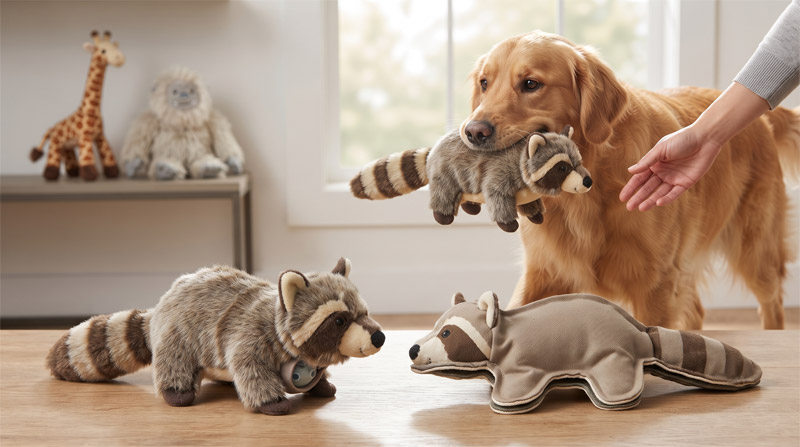
The shape and coloring aren’t decoration. They’re the whole mechanism: the moment that toy gets tossed, dragged, or shaken, a dog’s prey drive kicks in before any training does.
Two build types cover most of what’s on shelves. Squeaker plush is soft-bodied, built around one or more internal squeakers, and reads more like a stuffed animal than a chew toy. Stuffing-free builds go the opposite direction, made for dogs that shred anything with fluff inside within minutes.
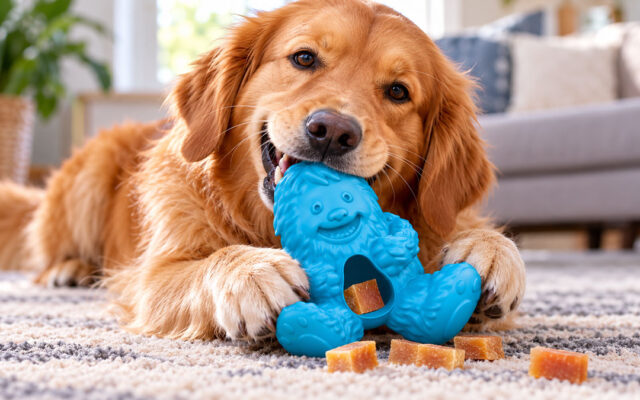
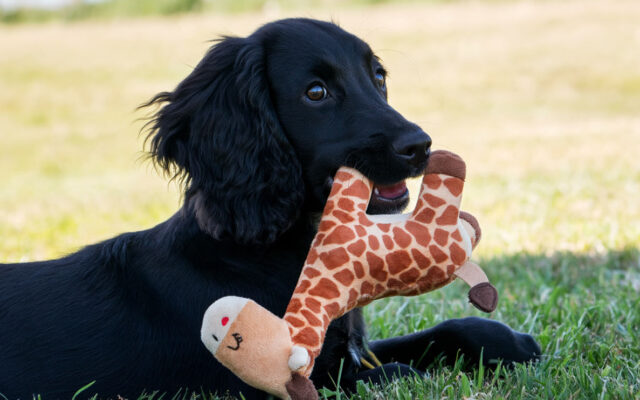
Look one shelf over and there’s usually a long-necked giraffe-shaped chew toy built on the same construction logic, and often a shaggy yeti-shaped design next to that, for owners who rotate shapes to keep a bored dog interested.
None of this has anything to do with the actual raccoon dog, Nyctereutes procyonoides. Same name, unrelated animal.
Raccoon Dog Toy Materials and Construction
Construction sets the ceiling on how long a raccoon dog toy actually survives contact with a real dog.
Plush fabric, usually a polyester or cotton blend, makes up the soft outer shell on most versions and is built more for cuddling than for chewing. Canvas and ballistic nylon show up on toys marketed toward moderate chewers, since the tighter weave holds up better against teeth. A handful of hybrid designs pair a rubber core with a plush raccoon shell over top, and some manufacturers weave rope into the tail or limbs for tug play.

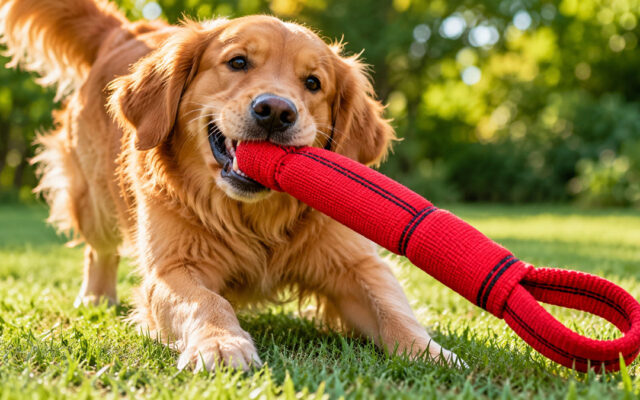
Some heavy-duty lines skip fabric altogether, borrowing the idea behind toys built from repurposed fire hose material and wrapping a raccoon-colored sleeve around a core that’s close to unchewable.
Reinforced stitching along the seams, especially around the tail and ears, is usually the first tell that a toy was built for more than light nibbling.
Stuffing-free versions swap the fluffy interior for a hollow, crinkle-lined body, which cuts down the risk of a dog swallowing loose stuffing mid-play. And machine washable fabric matters more than most owners expect. A raccoon toy spends about as much time on the floor as it does in a dog’s mouth.
How the Squeaker Mechanism Works
A squeak happens when a dog’s bite forces air through a small plastic or vinyl bulb sewn inside the toy. Nothing fancier than that.
Placement changes how the toy actually plays. A single squeaker in the body rewards one solid bite and nothing more. Spread several through the head, body, and tail instead, and a dog ends up working the whole toy rather than clamping down on one spot and calling it done. Some builds skip the sound entirely, using crinkle material or nothing at all, which matters for dogs that get more destructive chasing a sound than they would with something silent.
Tuffy, one of the better-known plush toy makers, sews its squeakers into a separate protective pouch instead of leaving them loose in the stuffing. That single choice is why some toys survive a determined chewer far longer than others built from the same fabric weight.
Why Dogs Are Drawn to Raccoon-Shaped Toys
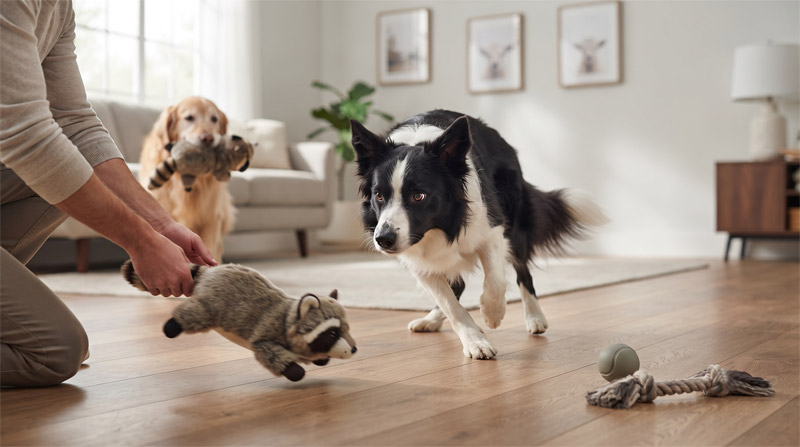
Prey drive is the short answer.
A raccoon’s low, wide body and erratic scurry sit close enough to real prey movement that plenty of dogs react on instinct before any training kicks in. The dark banding around the eyes and tail reads close to natural raccoon markings. The low center of gravity flops and drags differently than a round ball or a flat rope ever could. And the squeaker timing lands more like a distress sound than a steady tone, which seems to be a big part of what sets dogs off.
Breeds with a strong herding or hunting background tend to react hardest. A Border Collie, bred over generations to fixate on movement and chase it down, will often lock onto a raccoon toy faster than a breed picked mainly for companionship.
That doesn’t make the toy wrong for low-drive breeds, though. The play just looks different, more carry-and-cuddle, less chase-and-shake.
Durability for Aggressive Chewers
Not every raccoon dog toy is built for the same bite force, and the ratings show it.
Tuffy scores its own toys on a Tuff Scale that runs from 1 to 10, and some of its Mega Series builds stack up to seven layers of bonded, stitched fabric to get there.
| Chewer Level | Typical Construction | Expected Lifespan |
|---|---|---|
| Light | Single-layer plush, one squeaker | Months of normal play |
| Moderate | Double-layer fabric, reinforced seams | Weeks under regular chewing |
| Aggressive | Multi-layer canvas or fire hose core | Days to weeks, still not indestructible |
Breed and jaw strength matter just as much as the fabric itself. Give an American Pit Bull Terrier enough time and it can put sustained pressure on a seam until a toy rated for moderate chewers just fails, sometimes in one sitting. A Bullmastiff works differently, more slow crush than quick tear, but the end result on a plush raccoon toy tends to look about the same.
No plush raccoon toy, whatever its Tuff Scale rating says, gets marketed as indestructible for a true power chewer. Worth keeping in mind before spending twenty dollars expecting otherwise.
Safety Features and Risks
A raccoon dog toy carries the same risks as any plush or squeaker toy once it starts breaking down, and the numbers back that up more than most owners realize.
Toys and toy parts accounted for 20% of foreign body ingestion claims filed for dogs and cats between 2020 and 2025 (Pumpkin Pet Insurance, 2025). Trupanion’s average foreign body ingestion claim in 2023 came out to $878, with the highest recorded payout hitting $27,403 (Trupanion, 2024). Across Trupanion’s entire insured population, 7% of dogs have filed a claim like this at least once (Trupanion, 2024).
Most of that risk traces back to a short list of failure points: exposed squeakers once the outer fabric tears, loose stuffing pulled out and swallowed in strands, and plastic eyes or nose pieces that work themselves loose under repeated chewing.
Non-toxic dye and fabric are baseline expectations at this point, and some manufacturers voluntarily test against ASTM F963, the toy safety standard originally written for children’s products. None of that replaces actually checking the toy yourself, though. A split seam or a squeaker poking through the fabric means the toy comes off the floor immediately, not after one more play session.
Choosing the Right Size for Your Dog’s Breed
A raccoon dog toy sized for a small breed turns into a choking hazard the moment a large breed gets hold of it.
| Size Category | Approximate Weight Range | Toy Considerations |
|---|---|---|
| Small | Under 25 lbs | Smaller squeaker, lighter fabric, easy to carry |
| Medium | 25 to 60 lbs | Standard plush or hybrid rubber build |
| Large | Over 60 lbs | Reinforced seams, multi-squeaker, larger overall size |
A Chihuahua and a Great Dane aren’t shopping in the same aisle, even when both owners typed the exact same search into Google.
The sizing mistakes tend to run one direction more than the other. Buying too small for a large breed creates a choking hazard once the toy gets chewed down to pieces. Buying too large for a small breed is less dangerous but limits play more than it protects anything.
When in doubt, size up rather than down. A toy a dog can’t fully fit in its mouth beats one it can swallow, every time.
Best Raccoon Dog Toy Brands Compared
KONG, Outward Hound, and ZippyPaws dominate this corner of the pet toy aisle, and each one solves the raccoon shape a little differently.
| Brand | Typical Build | Best For |
|---|---|---|
| KONG | Plush shell over internal knotted rope, no stuffing | Light chewers, tug play |
| Outward Hound | Hide-and-seek trash can puzzle with mini plush raccoons | Enrichment, problem-solving dogs |
| ZippyPaws | Burrow-style den with squeaky raccoon inserts | Small to medium dogs, low to moderate chewers |
KONG’s Scrunch Knots Raccoon runs around $18.99 and skips stuffing entirely for an internal coiled rope, which keeps the mess down on the day a dog finally does manage to open a seam.
Outward Hound flips the format into an actual puzzle with its Hide-A-Raccoon. Six squeaky plush pieces (three raccoons, plus a newspaper, a fish bone, and an apple core) hide inside a trash-can-shaped shell, and the dog has to dig each one out on its own.
ZippyPaws runs a similar concept through its Burrow line, though it tucks the small raccoon characters into a den-style base rather than a can.
All three show up regularly on Chewy, Amazon, Petco, and PetSmart, usually somewhere in the fifteen to twenty five dollar range depending on size.
None of that spending moves the needle much against what owning a dog actually costs over its lifetime. A toy budget is basically a rounding error next to food and vet bills.
Raccoon Dog Toy vs Other Animal-Shaped Enrichment Toys
The same mechanism that makes a raccoon toy work applies to other animal shapes too. Which one wins usually comes down to preference more than actual performance.
The raccoon’s banded coloring reads clearly against grass, carpet, or furniture, and the low profile suits ground-level chase-and-drag play well. It’s also less common on store shelves than squirrel or fox designs, so a dog that’s bored of everything else might still perk up for it.
Squirrel and fox toys go the other way: longer, narrower bodies built more for whip-and-shake play than dragging. The retail selection is wider too, more sizes and price points to pick from. The tradeoff is familiarity. A dog that already owns three squirrel toys probably won’t give a fourth one much of a reaction.
KONG sells both a Scrunch Knots Raccoon and a Scrunch Knots Squirrel on the same internal rope construction, which makes for a fair side-by-side if you’re trying to decide. Dogs that lose interest in one shape after a week or two often re-engage with the other. Something about the change in silhouette and scent seems to reset the novelty.
When a Raccoon Dog Toy Does Not Work
A raccoon dog toy isn’t the right call for every dog or every household, and it’s worth saying that plainly before getting into brands and Tuff Scale ratings.
Resource guarding
Roughly 20.6% of dogs growl or snap when a family member tries to take food or toys away from them (Guy et al., 2001). Introducing a new plush toy to a dog with that kind of history, without guidance from a trainer or a veterinary behaviorist, can make things worse rather than better.
Very young puppies
Puppies under a year old file 322% more foreign body ingestion claims than adult or senior dogs do (Trupanion, 2024). Teething puppies chew harder and longer than most raccoon toys are built to survive. A rubber teether is usually the better starting point, with a plush raccoon toy joining the rotation once chewing habits calm down.
Extreme power chewers
A dog that destroys a rope toy in minutes will likely do the same to a plush raccoon toy, Tuff Scale rating or layer count aside.
Squeaker-sensitive households run into a simpler problem than any of this. If the sound itself is the issue, no amount of durability fixes it, and a silent chew toy solves things faster than any raccoon design will.
How to Introduce a Raccoon Dog Toy for Enrichment Play
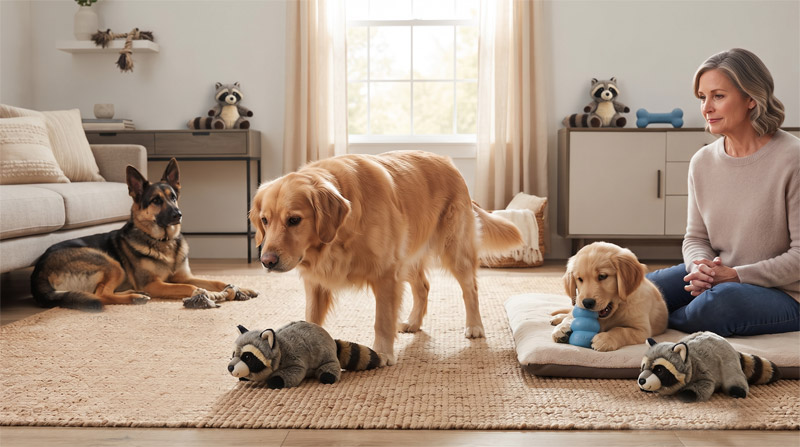
A raccoon dog toy works best as part of a rotation, not something left out on the floor permanently.
- Supervise the first few sessions closely, watching how the dog handles the squeaker and any seams
- Start with fetch or gentle tug before allowing unsupervised chewing
- Introduce hide-and-seek play once the dog is comfortable with the toy’s shape and sound
- Inspect the toy after every session for loose stitching, exposed stuffing, or a squeaker working its way out
- Rotate the toy out of sight for a few days once interest fades, then bring it back
That last step matters more than most owners assume it does.
In a free choice test, dogs picked an unfamiliar toy over two familiar ones in 38 of 50 trials (Kaulfuß and Mills, 2008, Animal Cognition). Kongs, chews, and activity toys remain the most common enrichment options dog owners reach for, according to a 2024 survey published in Veterinary Record (Heys, Lloyd, and Westgarth).
A raccoon-shaped toy slots into that same rotation fine. Its real value comes from standing out against whatever else is already sitting at the bottom of the toy basket.
FAQ on Raccoon Dog Toys
Is a raccoon dog toy made for the actual raccoon dog species?
No. It only borrows the color pattern and low-slung shape of Nyctereutes procyonoides, the real raccoon dog. That wild canid lives across East Asia and Europe and has nothing to do with the plush or stuffing-free toy sold for dogs.
How do you clean a raccoon dog toy?
Most plush raccoon toys are machine washable on a cold, gentle cycle, then air dried to protect the squeaker and stitching. Rubber or hybrid builds just wipe clean with mild soap and water. Check the care label before the first wash regardless.
Are raccoon dog toys safe for puppies?
Yes, for supervised play once teething eases up. Puppies under a year chew harder and swallow more foreign objects than adult dogs do, so a rubber teether usually comes first, with a plush raccoon toy joining the rotation once chewing habits settle down.
What happens if a raccoon dog toy gets destroyed in one sitting?
Most brands don’t offer a formal warranty against chewing damage, since destruction tends to void the standard return policy. KONG’s satisfaction guarantee is an exception and covers some of its plush lines. Otherwise, a toy that gets torn open fast usually just means it was rated below that dog’s actual chewer level.
Where can you buy raccoon dog toys?
Chewy, Amazon, Petco, and PetSmart carry the widest raccoon dog toy selection, typically priced between fifteen and twenty five dollars. Specialty pet boutiques and brand sites like KONG or Outward Hound stock the same designs, sometimes in exclusive colorways.
What Should You Do First When a Raccoon Dog Toy Starts to Fail?
A raccoon dog toy that a dog manages to tear open needs to come out of rotation immediately. A compromised seam turns a durability problem into a swallowing risk within minutes, not hours.
- Inspect the dog’s mouth and stool for missing fragments
- Compare the failure point against the original chewer rating
- Move up a durability tier instead of buying the same build again
Toys made up one in five foreign body ingestion claims across dogs and cats, and Trupanion’s average payout of $878 alone outweighs whatever the toy itself cost.
Sizing up in durability tier does trade something away, though: the flop and drag movement that triggers a dog’s prey drive in the first place, since heavier canvas or fire hose cores move nothing like lightweight plush does.
For dogs that settle better with a calmer chew object than an active chase toy, a dedicated dog pacifier design is worth a look next.