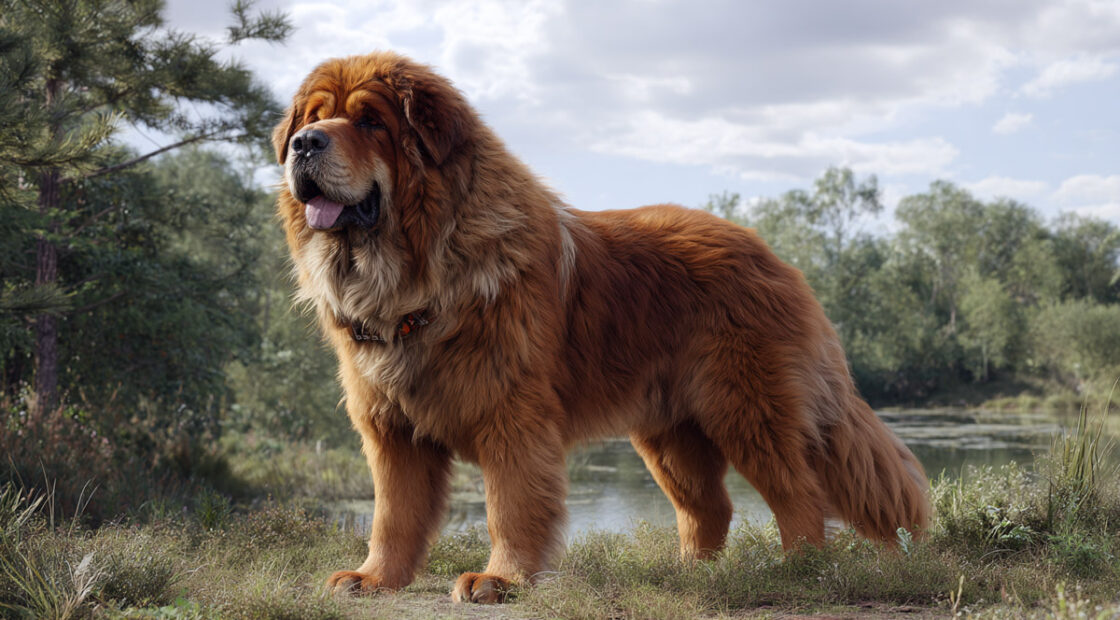
The Tibetan Mastiff comes from the Tibetan Plateau, where it guarded herds and homesteads, and monasteries too. It’s a large dog with a dense double coat, and it makes its own calls.
Himalayan herders tethered these dogs at property entrances to deter intruders (The Kennel Club). Registries now class the breed as a working or guardian dog.
Altitude shows up in its DNA as well. Researchers ran whole-genome sequencing on 60 dogs from elevations of 800 to 5,100 meters and found four mutations at EPAS1 specific to high-altitude dogs like this breed. Tibetan people show selection on the same gene (Genome Research, 2014).
What Is the Tibetan Mastiff?
Size, coat and attitude all trace back to one job, which was protecting livestock and property on the plateau without waiting for instructions.
The AKC sums up the temperament as watchful and aloof. Calm around the house, devoted to family, territorial with strangers.
Names and What They Mean
Do-khyi is the native Tibetan name, and it’s the heading the FCI uses for the breed in its nomenclature. The Chinese name is Zang Ao.
The English name came in 1873, when The Kennel Club first classified the breed (AKC history). It describes size, not family tree. Breed clubs call it a misnomer, since the dog is not a true Mastiff like the English breed.
What the Breed Was Built to Do

Himalayan herders kept these dogs at camps and homesteads, and monasteries kept them at the gate. The Kennel Club notes they were often tethered at a property entrance to deter intruders.
That job description explains most of the behavior owners see today. Livestock guardian dogs elsewhere, like the Anatolian Shepherd Dog of Turkey, work much the same way. They stay put and watch, and they decide alone.

Where Does the Tibetan Mastiff Come From?
Himalayan herders and monasteries kept the dog as a guardian on the Tibetan Plateau. How far back that goes, nobody has documented.
How Old Is the Breed?
WebMD places the earliest accounts in 12th century B.C. China. The FCI breed standard traces written mentions from Aristotle (384 to 322 B.C.) to Marco Polo, who traveled to Asia in 1271.
The breed shows up on every list of ancient dog breeds, but the paper trail is thin. The AKC’s own history page concedes that no accurate genetic records exist, and Modern Molosser points out that Polo may have heard about the dogs secondhand.
What the Genetics Show
A 2014 study in Molecular Biology and Evolution compared 32 Tibetan Mastiffs with 20 Chinese native dogs and 14 grey wolves. It found that the breed derives from Chinese native dogs, with selection on genes tied to life at altitude.
A separate 2014 whole-genome study in Genome Research flagged EPAS1 in highland dogs, the same gene under selection in Tibetan people.
Neither paper tests the claim that the breed fathered other mastiffs. The FCI breed standard repeats that idea as something some authorities held, so it stays a tradition and not a finding.
Arrival in the West
Sources disagree on the first dog to reach Britain. The Kennel Club says King George IV presented one to London Zoo in 1828, while the FCI standard and the AKC point to a dog Lord Hardinge sent to Queen Victoria in 1847.
The AKC names that 1847 dog Siring. The Royal Collection Trust catalogs a Tibetan Mastiff called Bout, given by Lord Hardinge the same year and kept at Windsor until his death in 1856, so the naming stays unsettled. Later imports by the Prince of Wales are dated 1874 by the AKC and to the 1880s by the FCI standard.
The breed nearly vanished at home. The Kennel Club reports compulsory slaughter of dogs after the Chinese invasion of Tibet in 1950, and the few dogs from remote areas became the base of the modern breed.
In 1958, Nepal’s foreign ministry sent a pair to President Eisenhower, the first documented US import (AKC). The AKC dates the start of modern US breeding to 1966, when Ann Rohrer acquired Kalu while posted in Kathmandu, though Modern Molosser puts Kalu’s birth in 1967, so treat the exact year as unsettled. The American Tibetan Mastiff Association formed in the US in 1974 (Petful).
Breed Recognition and Registry Standards
The Kennel Club (UK) puts the breed in its Working group. Its first official standard was adopted in 1931, after Mrs. Bailey formed the Tibetan Breeds Association (AKC history).
The FCI lists it in Group 2, Molossian type, mountain type, and accepted it on a definitive basis on 22 August 1961, with Tibet (China) as country of origin. The UKC recognized it in 1998 and files it under the Guardian Dog Group (Royal Canin). The AKC has had it in the Working Group since 2006.
The AKC itself calls the breed relatively new to its registry, even though the FCI accepted it 45 years earlier.
How Big Does a Tibetan Mastiff Get?
Registry standards put males at 26 to 30 inches at the withers and females at 24 to 28 inches, with adult weights from about 75 to over 160 pounds (UKC standard, revised 2017).
| Source | Height | Weight |
|---|---|---|
| UKC standard | Dogs 26-30 in, bitches 24-28 in | Dogs 100-160+ lb, bitches 75-120+ lb |
| Orvis breed profile | 24-26 in average | Males 90-150 lb, females 70-120 lb |
| PDSA (UK) | 61-66 cm average | 35-70 kg |
| Purina | Males 26+ in, females 24+ in | 140-180 lb |
Orvis and PDSA publish 24 to 26 inches (61 to 66 cm) as the average, which is simply the span between the female and male minimums in the standards. Purina’s 140 to 180 pounds is the highest range in the table.
Read any single profile as a floor for height, not a typical adult.
The UKC calls the breed slow to mature, and WebMD puts full maturity at 4 to 5 years for males and 3 to 4 for females.
The Kennel Club adds that its standard describes an ideal, not a promise that every dog measures up.
Tibetan Mastiff Coat, Colors and Grooming
The coat is a heavy double layer. A woolly undercoat sits beneath a long, coarse outer coat, and a thick mane around the neck and shoulders gives the lion-head look.
Males carry more coat than females (Wisdom Panel). The UKC standard puts coat quality ahead of quantity.
Accepted Colors Differ by Registry
The Kennel Club (UK) accepts black, black and tan, slate grey, slate grey and tan, and rich golden.
The AKC standard, as printed in Showsight, is wider. It allows black, brown and blue-gray, each with or without tan markings, plus gold from pure golden to rich red-gold. Sabling is acceptable on gold dogs, except wolf sable.
The AKC disqualifies white, cream, wolf sable, brindle and particolors.
Some breeders market white dogs anyway (Wikipedia). The Kennel Club advises buyers to pick a dog that fits the standard on every point, with health and temperament ahead of color.
Shedding and Brushing
The breed sheds, and sources split on routine. The Kennel Club rates grooming at more than once a week, while Wisdom Panel says weekly brushing is enough outside shedding season.
The heavy coat blow comes when the undercoat drops as valleys warm, usually in spring (zooplus). Brush more often through it, because loose undercoat mats under the topcoat.
The breed standard does not allow clipping or trimming (Wisdom Panel).
On the plus side, the coat lacks the strong odor common to many large breeds (Wikipedia).
What Is the Tibetan Mastiff’s Temperament Like?

Aloof, independent and protective. It is devoted to its family, wary of strangers, and slow to follow orders it does not agree with.
At home it is calm and mellow (AKC), and it usually bonds closest to one person (Showsight). It’s protective of children too, and it can read roughhousing as an attack (Embrace Pet Insurance).
Away from the family it gets harder. The AKC calls it territorial with strangers, and a loud bark is a breed trademark (Showsight). It may not accept other dogs, and WebMD flags same-sex aggression. Anything unfamiliar gets patrolled and barked at.
That gate-watching role from the plateau never left the breed.
Why Training Feels Different
Showsight’s breed profile says the dog can look stubborn and aloof because it needs to believe training was its own idea. Vetstreet calls it an independent thinker with its own agenda.
The PDSA advises against the breed for first-time owners.
Is It Aggressive?
Petfinder says Tibetan Mastiffs can be aggressive when provoked and rarely show aggression with proper socialization and training.
The temperament is a guarding one, and the owner’s work decides how it shows.
How to Socialize and Train a Tibetan Mastiff

Start training the day the puppy comes home, expose it to many people and places early, and keep training for life. The AKC says the breed is not food-driven, so treats work less reliably.
Kind, firm and consistent handling works. Force and harshness do not (Embrace Pet Insurance).
- Begin training at once, while the puppy is still small (Vetstreet).
- Socialize at home with family and friends until vaccinations finish (Vetstreet).
- Join puppy classes after the vet clears it (Dogster).
- Vary walking routes and introduce new people and animals while the dog is young (Dogster).
- Limit free run of the house until maturity, which Vetstreet puts at 3 to 5 years.
- Keep training as a daily habit for the dog’s entire life (Orvis).
Skipped socialization produces a dog that is overly suspicious or fearful of anything new (Vetstreet).
Wikipedia notes that socialization matters less only if the dog will work exclusively as a livestock guardian.
Exercise, Climate and Housing Needs
Plan on about an hour of exercise a day, a large secure yard and a cool, dry climate. Heat is the limit owners underestimate.
How Much Exercise Does It Need?

PDSA sets a minimum of one hour daily, split into two or three walks with off-lead play in a secure area. The Kennel Club says up to one hour per day.
The two UK sources disagree on the floor. Treat an hour as the working number and add mental work, since PDSA also recommends training sessions and puzzle games.
The AKC adds a hard limit. The breed has no reliable recall and should not be off leash, so off-lead play only belongs behind a fence.
Heat and Cold
The American Tibetan Mastiff Association says the breed comes from altitudes of 16,000 feet and higher and loves cold, dry weather, with heat and especially humidity hard on it.
The coat makes the same point. It puts the Tibetan Mastiff with the true breeds built for winter, and PDSA advises summer walks in the early morning and evening, with close watching for heatstroke.
If summers run hot and humid where you live, the climate decides before the dog’s temperament does.
Yard, Fencing and Apartments

PDSA wants a big, secure garden and says the breed does not suit apartment living. The Kennel Club lists a large house and a large garden.
Greencross Vets notes the breed can scale fences, so fence height matters. A fence built for a giant dog is the real requirement, not a pet gate.
Tibetan Mastiff Lifespan and Health Problems

Studies put median lifespan between roughly 12 and 13 years. Hip and elbow dysplasia, hypothyroidism and bloat are worth screening for, along with an inherited nerve disease called CIDN.
How Long Tibetan Mastiffs Live
A Dogs Trust analysis published in Scientific Reports in 2024 put the breed’s median life expectancy at about 13 years.
A 2010 UK Kennel Club survey, cited in a 2021 paper in Veterinary and Animal Science, found a median age at death of 11.92 years.
The studies use different methods, survival modelling in one and a survey of owners of deceased dogs in the other. Quote the range, not a single number.
Joint and Thyroid Conditions
In hip dysplasia the joint does not fit together properly, and arthritis follows (PDSA). Elbow dysplasia is the same fault in a different joint, with the same outcome.
Hypothyroidism is an underactive thyroid, and it affects weight, skin and energy levels.
Breeding dogs can be screened for all of these, which is why the test list below matters more than any lifespan figure.
CIDN and Other Breed-Specific Conditions
CIDN is the breed’s best-documented hereditary condition.
A 1981 paper in Acta Neuropathologica described a recessively inherited neuropathy in Tibetan Mastiffs. Affected pups developed generalized weakness shortly after weaning and were diagnosed at 10 to 18 weeks.
Recessive inheritance means two healthy-looking carriers can produce an affected litter, according to a 2023 review in Animals, so pedigree history counts.
- Bloat (GDV) is a twisted stomach that needs emergency care
- Eyelid problems show up as entropion and ectropion
- Ear infections are common
- The thick coat can bring skin problems with it
Health Tests Breeders Should Complete
| Test | UK Health Standard | US CHIC program |
|---|---|---|
| Hips | BVA/KC Hip Scheme x-rays | OFA evaluation, required |
| Elbows | BVA/KC Elbow Scheme x-rays | OFA evaluation, recommended |
| Thyroid | Not listed | OFA evaluation, required |
| Eyes | Not listed | Eye clearance, required |
PDSA names the BVA/KC hip and elbow schemes as the screening dogs should have before breeding. The CHIC requirements come from Embrace Pet Insurance’s breed guide, which lists thyroid and eye clearance as required and elbows as recommended.
Because the programs disagree, ask a breeder for both sets. OFA hip evaluations also need a dog of at least 24 months, so a puppy’s parents should hold final results and not preliminary ones (VIN).
Who Should Not Get a Tibetan Mastiff
The AKC says outright that the breed is not recommended for most dog owners. First-time owners, homes with small children, households that sit empty most of the day, and anyone who lives close to neighbors should look elsewhere. So should anyone who needs dependable obedience.
The AKC calls the breed intelligent but not easy to train, which rules out a lot of first-timers. Dogs often perform well in a training class and then ignore every command at home (AKC).
On children, PDSA suits the breed to adult-only homes or families with teenagers, since the dog does not always know its strength. Being alone is a problem too. PDSA never recommends leaving the dog by itself longer than four hours, and a lonely dog chews furniture and barks.
Petfinder says the breed likes to bark loudly at night, which makes dense neighborhoods a poor fit.
The AKC does allow one good-fit scenario, an experienced, committed owner with older children.
Size without the guarding workload is easier to find in a companion giant such as the Newfoundland.
How Much Does a Tibetan Mastiff Cost?
A puppy from a breeder costs $2,000 to $6,000 in the US guides that agree on a range (Hepper, Embrace Pet Insurance and Rover). A rescue adoption runs $400 to $410 (Tibetan Mastiff Rescue, Inc.).
In the UK, PDSA puts the minimum monthly upkeep at 105 pounds, after purchase and set-up.
What Pushes the Price Up
Rover places red coats at the top of the range and black toward the bottom. Hepper adds that health testing and breeder reputation are built into the price.
PDSA gives the opposite warning. An unusually cheap puppy can come from a puppy farm.
What the Running Costs Cover
Set-up means vaccines, neutering and equipment, with gear replaced as the dog outgrows it.
After that come food, preventive healthcare and insurance. PDSA says food bills for a giant dog climb faster than most owners expect.
Training and boarding add up too, and so do day-care walkers if the dog is left alone for long stretches.
Why Record Sales Do Not Reflect Pet Prices
Headline sales belong to a luxury market, not to the pet market.
In 2011, a red 11-month-old named Big Splash sold to a Chinese coal baron for 10 million yuan, about $1.5 million (NPR, 2011). Marketplace reported that puppy prices had climbed from a few hundred dollars to millions within a few years as the breed became a status symbol.
AFP reported a larger sale in 2014. News 12 New Jersey later covered the fallout, with many dogs abandoned after the fad faded.
How to Find a Reputable Tibetan Mastiff Breeder or Rescue
Start with breed clubs and registry breeder programs, then verify both parents’ health results in a public database before paying anything.
What to Check Before You Pay

In the UK, the Royal Kennel Club’s Health Test Results Finder shows public health results for both parents. In the US, the CHIC database does the same job.
Kennel Club Assured Breeder status is worth looking for in the UK, since PDSA says it requires extra health tests and higher standards. Ask how the puppies are socialized too, which PDSA tells buyers to do, and keep an eye on the price. Cheap puppies point to puppy farms.
CHIC breeders agree to publish every result, positive or negative (Embrace Pet Insurance), so a missing entry is an answer.
Online sourcing adds its own risk. The Better Business Bureau has tracked fake online pet sellers since 2017, and its tips point buyers toward meeting pets in person before committing.
Litter Timing and Waiting Lists
Females come into heat once a year, usually in late autumn, so most Northern Hemisphere puppies arrive in December and January (Wikipedia). WebMD confirms the single annual cycle.
Perfect Pets reports that most Australian puppies are born in June and July, so the season flips by hemisphere. A request that misses the window waits for the next one.
The Royal Kennel Club’s Find a Club service connects buyers with breed clubs for advice, and the American Tibetan Mastiff Association plays the same role in the US.
Rescue and Adoption
Tibetan Mastiff Rescue, Inc. in Boerne, Texas describes itself as the only US rescue dedicated to the breed. Its charter covers rescuing abused or neglected dogs and finding them permanent homes, and it also teaches shelters to identify Tibetan Mastiffs (Charity Navigator).
PDSA says a good rescue discloses a dog’s health and behavior issues, so ask for the history before the first meeting.
Tibetan Mastiff FAQ
Is the Tibetan Mastiff the biggest dog in the world?
No. PDSA lists the English Mastiff at 71 to 78 cm and 80 to 85 kg on average, above the Tibetan Mastiff’s 61 to 66 cm and 35 to 70 kg.
The UKC standard allows males up to 30 inches, so individual dogs can run far above the average.
How is a Tibetan Mastiff different from an English Mastiff?
Coat and lifespan separate them first. PDSA lists a short coat and an average lifespan under 10 years for the English Mastiff, against a medium coat and over 10 years for the Tibetan breed.
The English Mastiff also needs its facial wrinkles cleaned daily.
How much does a Tibetan Mastiff eat per day?
Most adults eat 2 to 4 cups of dry food a day, well under what their size suggests (WebMD). PDSA advises splitting the daily allowance into two meals.
A 6 to 10 cup figure circulates online, but it matches the numbers in English Mastiff feeding guides, so treat it as borrowed.
Are there different types of Tibetan Mastiff?
Yes. Some breeders separate the lighter Do-khyi nomad type from the Tsang-khyi monastery type, which is taller, heavier-boned and more wrinkled, and both can appear in one litter (Perfect Pets).
Western standards judge them against a single ideal, according to Modern Molosser.
Which breeds are mixed with Tibetan Mastiffs?
Mostly other large, sturdy dogs, with the Labrador Retriever among the most common crosses (Science Insights).
The guardian wariness still carries over, so a mix needs early socialization and an experienced owner too.
Preparing Your Home Before a Tibetan Mastiff Puppy Arrives
A Tibetan Mastiff puppy needs fencing and shade, verified parental health results, and a socialization schedule settled before pickup. Fencing and climate control come first in that order, because neither can be repaired once the dog is home.
Health results for both parents and a training plan can wait a little longer, but not past the day the puppy arrives.
Litter timing adds a constraint. Puppies born in December or January reach six months around midsummer, so the cooling plan has to exist before the first July.
The trade-off is time. A health-tested litter means waiting for the single annual season, up to a full year.
As of October 2026, PDSA’s guidance still names hip and elbow screening as the pre-breeding minimum, and the Royal Kennel Club’s breeding for health framework could add tests. Before the first meal, compare puppy food brands for a large-breed formula.