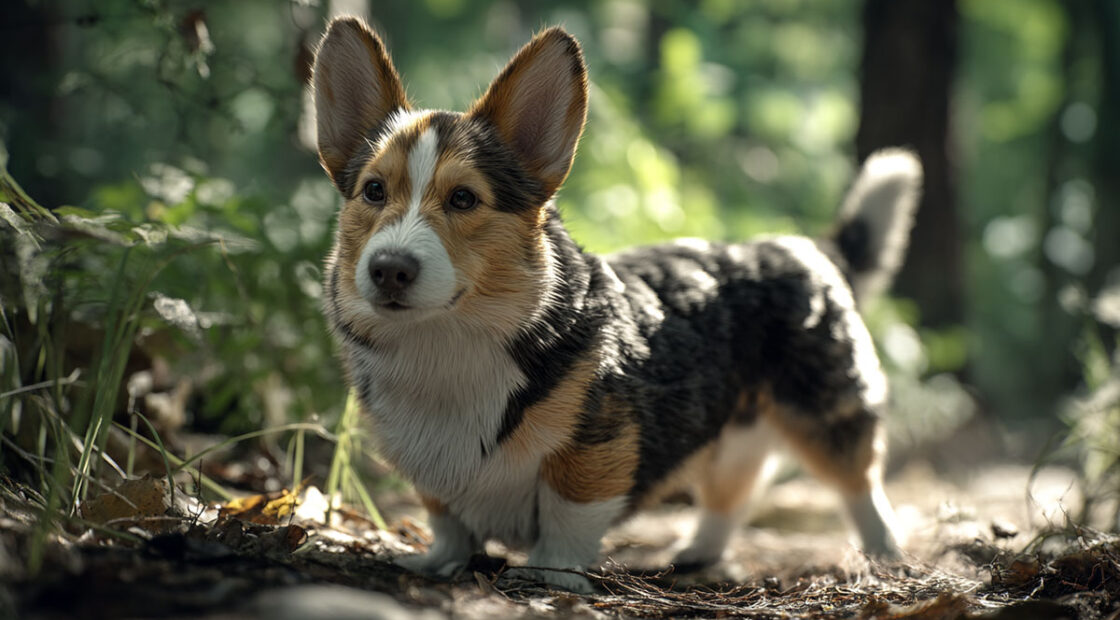
Pembroke Welsh Corgis come from Pembrokeshire in Wales, where farmers used them to drive cattle by nipping at their heels.
Both sexes stand 10 to 12 inches at the withers, and males weigh up to 30 pounds (AKC breed standard, 1993).
The long, low frame came out of that farm work, and it also explains the breed’s biggest health risk. Embark’s 2024 breed data show that only 3.7 percent of tested Pembrokes are clear of the FGF4 variant linked to intervertebral disc disease (IVDD).
What Is the Pembroke Welsh Corgi?
Nipping heels was the whole job. Pembrokeshire farmers bred the dogs to drive cattle that way, and the dogs stayed low-set.
The name comes from the Welsh words “cor” and “ci”, which most references translate as “dwarf dog.” The Mayflower Pembroke Welsh Corgi Club reads “cor” a second way, as “to watch over or gather.”
Registries agree on the job and split on the label. The AKC and the United Kennel Club both put the Pembroke in the Herding Group, while The Kennel Club in the UK files it under Pastoral. The Fédération Cynologique Internationale (FCI) uses Group 1, Sheepdogs and Cattledogs, standard no. 39. The Canadian Kennel Club has it in Group VII, Herding Dogs.
None of them judge it together with the Cardigan, the other breed that carries the Welsh Corgi name.
In the AKC’s 2025 rankings the Pembroke sits 16th among registered breeds. It first broke into the top 10 in the rankings reported in 2020 (Associated Press, 2020).
Where the Pembroke Welsh Corgi Comes From
Nobody can say when the breed began. It worked as a cattle drover and farm dog in Pembrokeshire, in southwest Wales, and no document records its first appearance.

The AKC archives put the breed’s recorded history in the 19th century, as a working dog. Everything before that is theory.
Origin theories
Some say Spitz-type herding dogs came over with the weavers Henry I settled in Pembrokeshire around 1107, and mixed with the local cattle dogs.
Others credit Norse settlers, whose dogs reached the British Isles in the 9th or 10th century and were crossed with Welsh herders (Hubbard’s theory, AKC archives). The Viking idea leans on the Swedish Vallhund, a short-legged Scandinavian herder of similar build.
The Westminster Kennel Club goes with Wales itself and traces Welsh ancestry back to at least the tenth century.
Hubbard’s version stacks the first two stories, with Norse stock arriving first and the weavers’ Spitz-type dogs added later.
Plenty of breed guides print 1107 as fact. The Mayflower Pembroke Welsh Corgi Club, a regional affiliate of the national parent club, calls the Scandinavian route the more commonly accepted theory instead.
Treat 1107 as a legend with a date attached, not a record.
Recognition timeline
The Kennel Club in London recognized the Pembroke and the Cardigan as separate breeds in 1934. The Pembroke Welsh Corgi Club of America followed in 1936, founded on February 12 at the Westminster Kennel Club show. The Canadian Kennel Club recognized the breed in 1938, and the United Kennel Club in 1959.
Dates come from the Pembroke Welsh Corgi Club of America’s brief history, the AKC archives, and each registry’s own standard.
Associated Press coverage in 2020 named Queen Elizabeth II the breed’s most famous fancier.
How Big Does a Pembroke Welsh Corgi Get?
Height is the easy part. A Pembroke stands 10 to 12 inches (25 to 30 cm) at the withers in the AKC standard and in The Kennel Club standard updated in April 2025.
Weight is where they part ways. The AKC allows no more than 30 pounds for dogs and 28 for bitches, with about 27 and 25 pounds preferred in show condition. The Kennel Club’s ideal is lower, at 10 to 12 kg (22 to 26 lb) for dogs and 9 to 11 kg (20 to 24 lb) for bitches.
Body length, withers to tail base, runs about 40 percent greater than the height at the withers (AKC standard).
So the two documents disagree by a few pounds. A 28-pound male sits inside the American limit and above the British ideal.
The Kennel Club adds that its numbers describe an ideal, and real dogs come out larger or smaller.
The AKC standard penalizes both ends of the scale. Oversized and undersized dogs both count as very serious faults, and it calls for severe penalties against diminutive, toy-like specimens.
Short legs are the breed’s signature, but the same standard warns that exaggerated lowness interferes with free movement.
Pembroke Welsh Corgi Coat, Colors, and Shedding
Expect a medium-length double coat that sheds, in red, sable, fawn, or black and tan, with or without white markings.
Coat structure
The AKC standard describes a short, thick, weather-resistant undercoat beneath a coarser, longer outer coat. A thicker ruff sits around the neck, chest, and shoulders.
The body coat lies flat. A little waviness is allowed. A wiry, tightly marcelled coat is very faulty, and so is one that is overly short, smooth, and thin.
White markings and colors that don’t belong
White is allowed on the legs, chest, neck, muzzle, and underparts, plus a narrow blaze on the head (AKC standard).
Merle and brindle belong to the Cardigan’s palette. The Pembroke Welsh Corgi Club of America’s 2023 judges’ education presentation covers what to do when one turns up in the ring.
Faults that cost points in the show ring
Breeders have nicknames for the four big ones. Fluffies carry an extremely long coat with heavy feathering on the ears, chest, legs, and feet, and trimming doesn’t fix it. Whitelies have a white body with red or dark markings.
Bluies show a distinct bluish or smoky cast, tied to pale eyes and liver or gray pigment. Mismarks put white on the back between withers and tail, on the sides, or on the ears.
The AKC standard lists all four as very serious faults.
That only matters for show quality. The Lakeshore Pembroke Welsh Corgi Club says a fluffy coat or a mismark doesn’t stop a dog from being a good companion.
Shedding and brushing
The AKC standard calls the Pembroke a shedding breed, and it tells judges not to punish a seasonal lack of undercoat too severely when the hair is glossy, healthy, and well groomed.
The Kennel Club rates grooming at more than once a week and lists the breed as a shedder. Brush on that schedule and you’ll still find loose hair on the furniture.
Pembroke vs Cardigan Welsh Corgi: How to Tell Them Apart
Check the tail first. The Pembroke’s is docked or naturally very short, and the Cardigan carries a long, fox-style brush.
| Feature | Pembroke Welsh Corgi | Cardigan Welsh Corgi |
|---|---|---|
| Tail | Docked short or natural bobtail (US standard) | Long, undocked fox brush |
| Ears | Erect, medium, tapering to a rounded point | Larger and rounder |
| Colors | Red, sable, fawn, black and tan | Wide range, including blue merle and brindle |
| Size | Smaller, shorter body | Taller, longer, heavier-boned |
| Home county | Pembrokeshire | Cardiganshire |
Table entries draw on the AKC’s Pembroke standard, Hill’s Pet Nutrition, and Showsight Magazine’s breed profiles.
Why the tail is not a perfect test
The Pembroke and the long-tailed Cardigan breed were interbred for roughly ten years before the 1934 split. That put the long-tail gene into the Pembroke population, according to the Pembroke Welsh Corgi Club of America’s brief history of the breed.
A Pembroke can therefore be born with a long tail. Petful’s comparison guide is blunt about it: a full-tailed Pembroke is still a Pembroke, and a Cardigan is not a Pembroke mix.
Temperament doesn’t settle it either. The same guide says individual temperament matters more than a label like “calmer.”
Why Many Pembroke Welsh Corgis Have No Tail
Mostly because breeders in the United States dock them. Only a few puppies are born with a natural bobtail.
Natural bobtail versus docked
A natural bobtail traces back to a mutation in the T gene, according to Embark, a canine DNA testing company. The AKC standard accepts a puppy born with a natural dock as long as it’s short enough.
Docking is a different process. The standard asks for the tail to be removed as short as possible without an indentation, and allows up to two inches.
The Pembroke Welsh Corgi Club of America (PWCCA) goes further than the standard. Its published policy calls docked or natural-bobtailed dogs an important part of the breed and recommends banding tails as soon after birth as possible.
Where docking is legal
- England banned it from 6 April 2007 under section 6 of the Animal Welfare Act 2006. Certified working dogs are exempt, but only hunt-point-retrieve breeds, spaniels, and terriers qualify.
- Wales followed on 28 March 2007, with a working-dog exemption that names specific spaniel, terrier, and gundog breeds.
- Scotland’s ban dates from 30 April 2007, according to the Royal College of Veterinary Surgeons.
- In the United States docking is legal and a personal choice, per the United Kennel Club, which also says no dog in its events is penalized for a full tail.
A corgi is not a spaniel, a terrier, or a hunt-point-retrieve breed, so docking a Pembroke puppy for looks has no exemption in England.
Did the ban shrink the UK breed?
Kennel Club registrations fell to 274 puppies in 2014. That put the Pembroke below the 300-registration line for Vulnerable Native Breeds for the first time.
The Daily Telegraph blamed the docking ban. The Kennel Club pointed to foreign breeds gaining popularity.
Then the breed recovered under the same law. By 2022 the Kennel Club reported the highest puppy registrations in 30 years, after Netflix’s The Crown renewed interest.
The ban was in force for the drop and for the rebound, so it clearly didn’t decide the breed’s numbers by itself.
Temperament, Training, and Exercise Needs of the Pembroke Welsh Corgi
Pembrokes are alert, people-focused working dogs, and they get bored without a job. They herd the household and announce visitors whether anyone asked or not.
Temperament
The PWCCA describes the typical temperament as outgoing, alert, active, and very people-oriented. The AKC adds that the breed is affectionate and companionable without being needy.
A Pembroke living with larger dogs tends to end up bossing them around. Small pets need careful introductions, because ratting is part of the breed’s farm work, per the club.
Sex makes little difference. The club says males are as good with children and other pets as females, as easy to housebreak, and no more aggressive.
Herding behavior and training

The herding instinct points at the household. Pembrokes will happily herd running children, and the breed club says parents have to correct nipping consistently from the start.
Correct heel nipping the same way every time, and once the dog has announced a visitor, teach a cue for quiet. Give it a task too, such as herding trials, agility, or tracking, before it invents one of its own.
The club puts it bluntly. This breed is bright and bossy, and a dog that senses nobody is in charge will take the job.
Exercise
The Kennel Club’s breed page puts daily exercise at up to 1 hour.
The PWCCA gives no number, only “a modicum,” and says short walks, long walks, jogging, herding, and agility all suit the dog. It advises avoiding extreme heat and cold and offering water afterward.
Mental work counts too. The club says Pembrokes do best with regular physical and mental stimulation, and Embark notes that exercise matters more for a breed that tends to overeat.
Which Health Problems Affect the Pembroke Welsh Corgi?

Breed health talk keeps circling back to intervertebral disc disease (IVDD), degenerative myelopathy, von Willebrand disease, hip dysplasia, and eye disease.
The PWCCA calls the breed relatively healthy with a few concerns, and describes it as a true dwarf (chondrodysplastic) breed.
Spine and joints
IVDD is the headline risk. In Type I IVDD a disc ruptures toward the spinal cord, and signs range from pain to a wobbly gait to paralysis (Embark, 2024).
The cause is an FGF4 retrogene variant tied to the short-legged body type. Embark’s data show nearly every tested Pembroke carries at least one copy, so the result can’t separate one breeding dog from another.
The Kennel Club’s Breed Watch lists the breed in Category 1, meaning no points of concern specific to the breed have been flagged for judges. That category covers show-ring conformation and not overall health, and the long back and short legs still make back problems more likely.
A lean body weight protects the spine. Teaching stairs one step at a time helps too, per the PWCCA, and so does skipping stair-climbing games, especially on open staircases.
Degenerative myelopathy
On genotype alone, 26 percent of Embark-tested Pembrokes are at risk for degenerative myelopathy (SOD1A), though the company notes its sample is a subset of dogs that opted into research.
Actual disease looks far rarer. Only 0.6 percent of Pembrokes were diagnosed in the one controlled study, a University of California, Davis analysis of the Veterinary Medical Database from 1990 to 1999, as cited by geneticist Dr Jerold Bell for the PWCCA.
The gap is genotype versus disease. Bell says only a small fraction of dogs with two copies become clinically affected, and his guidance for the club recommends against breeding decisions based on SOD1 alone.
The University of Missouri adds a Pembroke-specific SP110 modifier and says testing both mutations gives a better risk estimate.
Blood and eye conditions
A dog lacking von Willebrand factor can bleed excessively after an injury or surgery, which is why the result matters before any operation.
| Condition | What it affects | Screening |
|---|---|---|
| Von Willebrand disease type I | Blood clotting | DNA test (VWF) |
| Progressive retinal atrophy (rcd3) | Vision, night sight first | DNA test (PDE6A) |
| Hip dysplasia | Hip joint | OFA hip evaluation |
| Other eye disorders | Eyes | ACVO eye exam |
Embark classes retinal atrophy rcd3 as very rare in the breed.
How long do Pembroke Welsh Corgis live?
The median Pembroke survives to 13.2 years, according to a 2024 Dogs Trust-led study in Scientific Reports covering more than half a million UK dogs.
The breed club’s breeder estimates sit slightly below that, with healthy dogs reaching their teens.
Read 13.2 as a median for UK dogs under veterinary care. It isn’t a promise for any one puppy.
How to Find a Healthy Pembroke Welsh Corgi Puppy
Buy from a breeder who shows written hip and eye results for both parents, and verify them in the Orthopedic Foundation for Animals (OFA) database before paying a deposit.
What a puppy costs
No registry publishes a puppy price. The figures in circulation come from insurers and retailers, such as Sainsbury’s Bank Pet Insurance, which lists around 1,000 pounds in the UK.
Prices differ by country and breeder, so treat any single number as a rough guide. A long waiting list, which the breed club says most reputable breeders keep, tells you more than a low price does.
Which tests to ask for
- A hip dysplasia evaluation, which the OFA’s Canine Health Information Center program makes mandatory
- An ACVO eye exam (also mandatory)
- The von Willebrand disease DNA result
- Degenerative myelopathy and IVDD results, read against the clinical rates above
Steps to vet a breeder
- Pull referrals from the PWCCA breeder search or a regional club, and rule out pet stores, which the club says source from mass-production suppliers.
- Ask for OFA hip results rated fair, good, or excellent and an eye exam by a certified veterinary ophthalmologist, for both parents.
- Look the parents up in the OFA database instead of trusting a PDF.
- See the litter twice, and do not buy the first puppy that runs up to you.
- Refuse online-only deals. The club tells buyers to insist on live contact and a dated photo of the puppy.
- Read the contract for the sire and dam registration numbers, the health guarantee, and the return terms.
- Collect the puppy no earlier than 10 weeks. Many breeders wait until 12.
Rescue is a legitimate route. The PWCCA runs a Pembroke rescue network, and the AKC keeps a Rescue Network listing for recognized breeds.
UK buyers can use the Kennel Club’s Assured Breeder scheme and its breed health co-ordinators for the same checks.
Who Should Not Get a Pembroke Welsh Corgi?

Skip the Pembroke if nobody is home most of the day, or if you want a quiet dog.
The breed bores easily, and the breed club says it does poorly when confined to a yard with little human contact. These are alert watchdogs that announce anything unusual, and the club says quiet has to be taught.
Homes with small pets or running toddlers need supervision and consistent correction, because the herding and ratting instincts don’t switch off.
Weight is the other sticking point. Embark describes a tendency to overeat, which matters for a back already prone to disc disease, and the dog’s weight has to stay steady. The club also warns buyers about the time, energy, and money a long-lived dog demands, so anyone unready for a decade of expense should pass.
Space is rarely the limit. The Kennel Club’s breed page rates a small house with a small or medium garden as enough, in town or country.
A Pembroke is a reasonable bet when someone is home most of the day and you can keep the dog lean and control stair use. You also have to be fine with a dog that announces every visitor. If two of those fail, choose another breed.
Pembroke Welsh Corgi FAQ
Do Pembroke Welsh Corgis bark a lot?
Yes, they bark to announce anything out of the ordinary. The breed club calls them very alert watchdogs and says barking is far easier to prevent than to correct later.
Embark notes that the bark sounds like it belongs to a larger dog.
Are Pembroke Welsh Corgis hypoallergenic?
No. The Kennel Club lists the breed as a shedder, and the PWCCA says the undercoat comes out in large amounts in spring or summer.
A low-shedding coat is the usual basis for calling a breed hypoallergenic, and the Pembroke’s double coat is the opposite.
Can a Pembroke Welsh Corgi be left alone while I work?
Not for a full workday without help. The PWCCA tells working owners to bring a puppy home over a holiday weekend and to line up a friend or petsitter for a midday break.
Adults bore easily and do poorly with little human contact, so an empty house all day suits the breed badly.
How much should a Pembroke Welsh Corgi eat?
It depends on age, activity, and the calorie density of the food, so no single amount fits every dog.
Start with the breeder’s feeding instructions and raise quantities as a puppy grows, as the PWCCA advises. Embark adds that the breed tends to overeat, which makes measured portions the safer habit.
Do Pembroke Welsh Corgis get along with cats?
Yes, when introduced early. The PWCCA says many breeders keep cats that form close bonds with their corgis, and others socialize puppies to other species during early development.
Small cage pets are a different case. The club notes that ratting is part of the farm-dog job, so supervise any contact.
Planning Spine Care for a Pembroke Welsh Corgi
Spine care for a Pembroke Welsh Corgi starts in the first year, not at the first limp.
Nearly every tested dog carries the disc-disease variant, and the median dog lives past 13 years. The risk can’t be screened out, and the exposure lasts more than a decade.
Weight comes first. Keep the dog lean from the first year and set stair habits before the back is ever tested. Then get a treatment reserve or an insurance quote in place before any symptoms show up.
Weight and habits cost nothing and work every day, which is why they come before the fund that covers what they can’t.
The trade-off is a stricter routine in exchange for lower, not zero, risk.
This position was verified in October 2026 and changes if a validated test begins ranking disc risk among carriers.