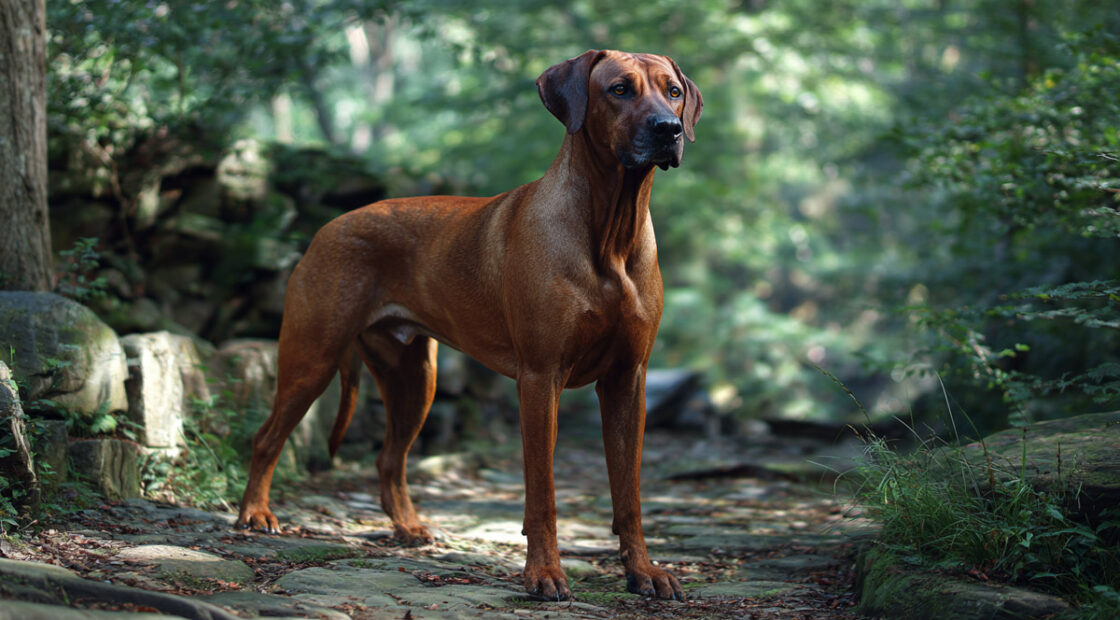
Rhodesian Ridgebacks come from southern Africa, where they were bred to track lions and keep them bailed up until the hunter caught up. The strip of hair running backward along the spine is where the name comes from.
These days it’s mostly a companion and sport dog. The AKC lists it in the Hound Group, and males stand 25-27 inches at the withers while females stand 24-26 inches.
That ridge comes from one dominant duplication covering the genes FGF3, FGF4, FGF19 and ORAOV1, according to Salmon Hillbertz and colleagues (Nature Genetics, 2007). The same variant predisposes dogs to dermoid sinus, a congenital skin defect that breeders check puppies for.
What Is a Rhodesian Ridgeback?
Hair that grows against the lie of the coat along the spine is the first thing anyone notices. Behind that ridge sits a large hound from southern Africa, developed to track big game, lions included, and hold it at bay until the hunter caught up.
It also goes by African Lion Hound, African Lion Dog or Van Rooyen’s Lion Dog, though owners mostly just say “Ridgie.”
The FCI nomenclature lists South Africa as the origin, and FCI standard No. 146 describes it as presently the only registered breed indigenous to southern Africa. Every major registry files it as a hound. Which hound group is another matter.
The Thai Ridgeback and the Phu Quoc Ridgeback, both from Southeast Asia, also carry a dorsal ridge, but they’re separate breeds. Salmon Hillbertz’s 2007 Uppsala thesis found the same ridge mutation in the Rhodesian and Thai dogs, which points to one shared origin.
Origin and History of the Rhodesian Ridgeback
Early pioneers in the Cape Colony crossed their own dogs with the semi-domesticated, ridged hunting dogs of the Khoikhoi, and the FCI standard traces the breed’s forebears to that cross. The first written standard came in 1922.

Ancestry modelling in Bergstrom and colleagues (Science, 2020) puts the pre-colonial share of the Ridgeback genome at roughly 4%. Small, but it means the breed is not a purely European recipe.
Breed histories name the Greyhound, Mastiff, Great Dane and Bloodhound as the likely European contributors (AKC history, as reproduced by Orvis).
Genomics backs up at least one of those. Parker and colleagues (Cell Reports, 2017) placed the Ridgeback in a subgroup of the European Mastiff clade shared with the Great Dane.
Cornelius van Rooyen, a big-game hunter, went on to breed Khoikhoi-type dogs for hunting and guarding. His line became known as Van Rooyen’s Lion Dog.
F.R. Barnes drafted the first standard at Bulawayo in 1922, and he leaned on the Dalmatian standard instead of writing from scratch.
- The South African Kennel Union approved the standard in 1926 (FCI), although Orvis’s breed history gives 1927 and ties the rename from Rhodesian Lion Dog to that year.
- Six dogs reached the United States for breeding in 1950.
- The AKC recognized the breed in 1955, and the FCI accepted it on a definitive basis that same year.
- The United Kennel Club came last, in 1980.
The 1922 text was looser than today’s.
Glenaholm Rhodesian Ridgebacks, a breeder archive of the original wording, lists brindles, fawns and sables as colors and a size of up to 28 inches. A 1931 amendment set 25-27 inches for dogs and 24-26 for bitches, and the current wheaten rule settled in the 1940s.
Honestly, the “lion dog” nickname oversells the job.
The FCI standard and the UKC history both say the dogs hunted in groups of two or three, tracked game and kept it at bay until the hunter arrived. The AKC adds that the breed earned its fame by baying lions, never killing them.
Size, Coat and Color Under the Breed Standards
Height is the easy part. All four registries put males at 25-27 inches (63-69 cm) and females at 24-26 inches (61-66 cm). Weight and hound group are where they split.
| Registry | Group | Height (male / female) | Weight (male / female) |
|---|---|---|---|
| AKC | Hound | 25-27 in / 24-26 in | 85 lb / 70 lb desirable |
| The Kennel Club (UK; now styled The Royal Kennel Club) | Hound | 63-69 cm / 61-66 cm | Not stated |
| FCI | Group 6, Section 3, related breeds of scenthounds | 63-69 cm / 61-66 cm | 36.5 kg / 32 kg |
| UKC | Sighthound and Pariah | 25-27 in / 24-26 in | About 80 lb / 70 lb |
Figures come from the AKC standard (effective July 1, 2025), The Kennel Club standard (updated 1 April 2025), FCI Standard No. 146 (current revision, 2025) and the UKC standard (revised December 1, 2014).
The FCI and UKC stop at 80 lb for males, five pounds under the AKC’s desirable 85 lb.
Their wording also adds an emphasis the others skip: agility, elegance and soundness, with no tendency towards massiveness. The Kennel Club warns puppy buyers that an individual dog can come out larger or smaller than its figures.
The coat is short, dense, sleek and glossy, never woolly or silky.
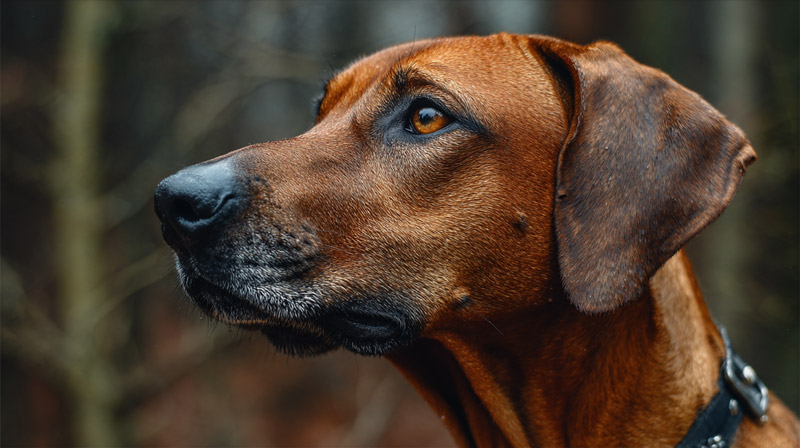
Color runs from light wheaten to red wheaten. A little white on the chest and toes is allowed, and more than that is undesirable. Noses and eyes go together, with a black nose and dark eyes or a brown (liver) nose and amber eyes.
The AKC disqualifies solid black, black and tan, and brown and tan on liver-nosed dogs. It treats clear-faced and masked dogs as equally correct. The Kennel Club goes the other way on color and calls anything outside the wheaten range unacceptable.
Shedding reports differ. Orvis calls the coat low-shedding, while PDSA says Ridgebacks shed all year with heavier spring and autumn coats.
Both land on the same routine: a weekly brush, an occasional bath and regular nail trims (AKC, PDSA).
How Does a Rhodesian Ridgeback Behave With Family, Strangers and Other Pets?
Expect a dog that’s devoted and even-tempered at home, reserved with strangers, and prey-driven enough that cats and small animals are a risk.
The AKC standard calls the temperament dignified and even tempered. The Kennel Club and the FCI describe a dog that is aloof with strangers and neither aggressive nor shy.
Aloofness is written into the standards. Aggression and shyness are written out: the FCI lists aggressive or overly shy dogs as disqualifying faults, and the UKC disqualifies viciousness or extreme shyness.
On children, the sources don’t agree. The AKC says the breed can be good with them given proper socialization and constant supervision, and Dogs NSW calls it particularly desirable for families with children. PDSA recommends older children, because a young Ridgeback can knock smaller ones over. Orvis says small children may not be a good fit and that rough handling will not be accepted.
The two sources that explain themselves, PDSA and Orvis, point to bounce and size rather than temper. Treat it as a question of child age, not of the dog’s character.
The AKC says Ridgebacks tend to get along well with other dogs. PDSA notes they can be unsure of unfamiliar dogs at first, and Orvis flags dominant behavior in homes with several males.
Cats are a different matter. PDSA rates the prey drive very high and advises against keeping the dog with smaller pets, though one raised alongside a cat may accept it.
Orvis advises against encouraging guard behavior. Without early and continued socialization, the dog can turn suspicious or fearful of new people, and that creates a bite risk.
Purina and the Westminster Kennel Club both describe a quiet breed that rarely barks without a reason. Think watchdog, not guard dog.
Exercise and Space Requirements for a Rhodesian Ridgeback
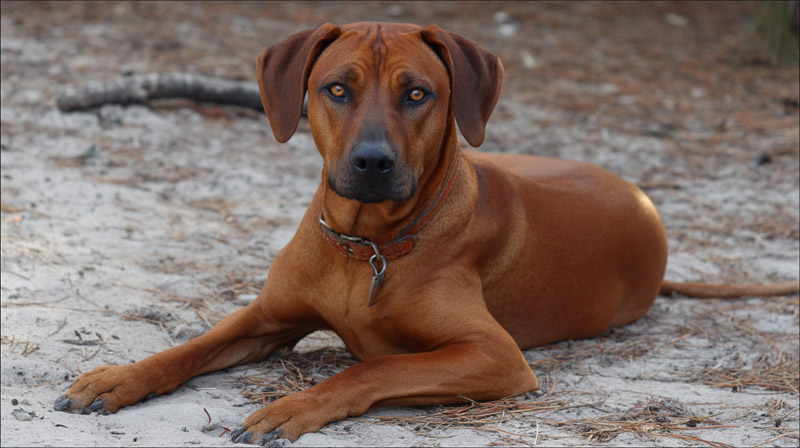
Nobody agrees on how much exercise a Ridgeback needs. Orvis says 30 minutes a day and PDSA says 2 hours, a fourfold spread for the same dog.
Orvis puts it at more than 30 minutes of brisk exercise, with 60 minutes ideal. The AKC says a moderate amount. Petfinder asks for a couple of hours, ideally free running, and PDSA wants at least 2 hours with off-lead time in a secure place.
Part of the gap is definition. Orvis frames its figure as the level that prevents destructive behavior, while PDSA frames its own as the baseline for a high-energy adult.
A workable plan sits between them: an hour of brisk activity as the floor, plus extra running or scent work on most days. Thirty minutes is where problems start, not a target.
Orvis suggests a well-conditioned adult can handle six to eight miles of running or a 10-mile hike. Lure coursing, tracking and agility all suit the breed (Orvis, AKC), and PDSA adds scent games, puzzle toys and training sessions for mental work.
Fencing matters more than floor space.
Orvis recommends a high-fenced yard because the breed is fast, has a high prey drive and is hard to catch once running. The AKC says off-leash time belongs in a safely enclosed area, and PDSA goes further and calls a large garden a must.
Apartments are the middle case. Orvis accepts them if the dog gets plenty of outdoor running and play, but says the breed is not an outdoor-only dog because it wants to be near its family.
Indoors, a well-exercised Ridgeback settles. Orvis says it prefers the couch to the yard during downtime, and a bored one turns destructive.
The Ridge: Structure, Genetics and Dermoid Sinus Risk
Hair on the ridge grows the wrong way because of a single dominant duplication in the DNA, and the same genetic region is linked to dermoid sinus, a congenital skin defect.
Ridge structure and the standard
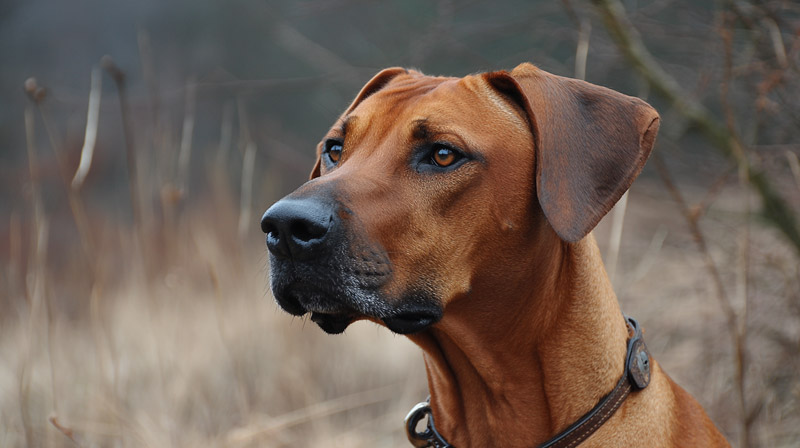
The AKC standard calls the ridge the hallmark of the breed and weights it more heavily than any other feature.
A correct ridge has two crowns, identical and directly opposite each other. It runs from just behind the shoulders to the hip bones, and the lower edge of the crowns should sit no further down than one third of the ridge.
Width averages about 2 inches (5 cm) according to the FCI, UKC and The Kennel Club. Under the AKC standard, one crown or more than two is a serious fault.
Ridgelessness is a disqualification at the AKC, the UKC and, since its 2025 revision, the FCI, alongside the AKC’s color disqualifications.
The most common faulty ridge is the three-crown ridge, according to Salmon Hillbertz’s 2007 Uppsala thesis. Faulty ridges often end a dog’s breeding career.
The duplication behind the ridge
One dominant mutation produces the ridge. A single copy is enough, and a dog with two copies looks identical to a dog with one (OMIA).
Salmon Hillbertz and colleagues (Nature Genetics, 2007) traced it to a duplicated stretch of DNA on chromosome 18 that carries several fibroblast growth factor genes, which steer skin and hair development.
A copy-number test now separates dogs with one copy (R/r) from dogs with two (R/R). A 2015 paper in Canine Genetics and Epidemiology describes the validation.
Breeders use the result to plan litters. Two R/r parents can produce ridgeless puppies, while R/R parents cannot.
GenoCan’s own panel data suggest R/R dogs carry a higher risk of dermoid sinus or faulty ridges, which is why it favors the R/r genotype.
The ridge rules also shrink the gene pool. The International Partnership for Dogs (IPFD, 2021) estimates that ridgeless and faulty-ridge dogs remove about one in five dogs from breeding in Finland and Sweden.
The same report notes that DNA testing could let breeders pair a ridgeless dog with an R/R mate and still get only ridged puppies. That would need wider international agreement among breed clubs.
Dermoid sinus: types and prevalence
In dermoid sinus, a congenital tube of skin lined with keratin and hair runs inward from the back near the ridge.
Surgery can remove it, and a dog that has needed surgery should never be bred (IPFD). Left alone, a sinus can abscess, and one that reaches the spinal cord can cause meningitis.
In the serious type IV form the tract reaches the dura mater around the spinal cord, as a 2022 case report in Frontiers in Veterinary Science documented in a Shiba Inu.
Prevalence figures disagree, and the gap is wide. Early Swedish studies by Salmon Hillbertz (2005-2006) put it at 5-6% and 8-10% of Rhodesian Ridgebacks, while a German study of 12,700 puppies born 2001 to 2019 found 2.53% overall (Distl, Veterinary Journal, 2022).
The German rate stays well below the early Swedish figures even in litters of ridged puppies only (2.81%), and it fell significantly across birth years.
The genetics are also less settled than the 2007 model suggested. A 2022 Animal Genetics study by Zhang and Distl concluded that the ridge duplication is not identical to the hypothesized dermoid sinus locus.
Distl’s prevalence study agrees that the ridge locus is unlikely to determine whether the sinus appears. Orvis calls it an open debate among breeders. Read the ridge as a predisposition, not a sentence.
A few figures are worth holding onto. The duplication that causes the ridge spans 133 kb (Nature Genetics, 2007), and the AKC scale gives the ridge 20 of 100 points, the largest single item. For dermoid sinus, set 8-10% of Swedish Ridgebacks in an early Swedish study (Salmon Hillbertz, 2005) next to 2.53% across 12,700 German puppies (Distl, 2022).
Health Problems, Screening Tests and Lifespan
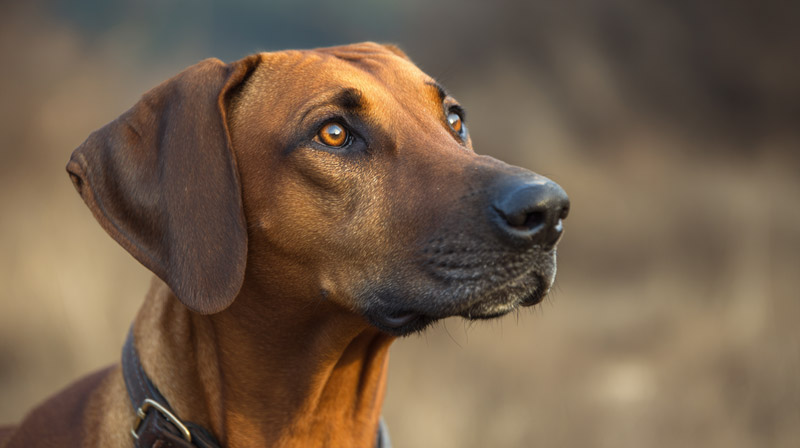
Responsible breeders screen hips, elbows, thyroid and eyes before mating, and those checks point at what owners should plan for: autoimmune thyroiditis, hip and elbow dysplasia, degenerative myelopathy and bloat.
Joint and thyroid conditions
Hip and elbow dysplasia are reported mostly in mild grades (IPFD, 2021). Finland requires screening of breeding dogs before a litter can be registered.
Thyroid disease is the bigger worry. Hypothyroidism, tested for as autoimmune thyroiditis, is the most frequently reported medical condition in the Rhodesian Ridgeback Club of the United States (RRCUS) health survey, at about 5 per 100 dogs. Only ridgelessness, at 10.6 per 100, ranks higher. The survey was first collected in 1996 and retabulated in 2001.
Weight gain on a normal diet, skin trouble and low energy are the warning signs (PDSA, IPFD).
The survey’s own authors warn that owner reporting contains errors, but call it the best tool the breed has.
OFA recommends thyroid re-exams at ages 2, 3, 4, 6 and 8 (the Ridgeback CHIC listing quoted by the IPFD also includes age 5), so a single clear result at breeding age does not close the question.
Neurological and hearing conditions
Degenerative myelopathy (DM) progresses through the spinal cord and traces to a mutation in the SOD1 gene. OFA offers the DNA test.
Whether to test is disputed. The Swedish and Finnish breed clubs do not generally recommend it because so few dogs fall ill, while US breeders test widely (IPFD, 2021).
OFA says carriers can be bred to tested-clear dogs and cautions against over-emphasizing the result. The Kennel Club approved an official DM scheme for the breed in December 2024, so results now appear on its Health Test Results Finder.
Juvenile myoclonic epilepsy (JME) shows up in dogs under 18 months, usually as muscle jerks at rest, and it is recessive (IPFD). Two carriers can produce affected puppies, so at least one parent should test clear (GenoCan).
Early onset adult deafness (EOAD) is recessive too, with hearing lost within roughly one to two years of age (GenoCan). BAER hearing tests are optional under the US CHIC program.
One test to treat with care is the inherited ventricular arrhythmia variant. GenoCan found it too common in its 400-dog panel to predict sudden death and concluded that routine testing is unlikely to help.
Bloat
Bloat (gastric dilatation volvulus, GDV) happens when the stomach fills with gas and twists, and it can be fatal (PDSA). Deep-chested dogs carry the highest risk.
WebMD lists the signs to treat as an emergency:
- Heaving with nothing coming up
- Restlessness
- A swollen abdomen
- Lying with the front legs down and the rear end raised
Orvis advises splitting daily food across at least two meals. PDSA adds a gap between eating and exercise, which it says is thought to lower the risk.
Screening tests breeders run
In the United States, RRCUS and the OFA CHIC program cover hips and elbows through OFA, OVC, GDC or PennHIP, thyroid through OFA or a board-certified endocrinologist or pathologist, and an eye exam. Cardiac and BAER tests are optional.
In the United Kingdom, The Kennel Club points to the BVA/Kennel Club hip and elbow schemes, the JME DNA test for Assured Breeders, and a breed club dermoid sinus check on puppies.
On the DNA side there are tests for JME, DM and EOAD, plus the ridge copy-number test for pairing decisions.
A CHIC number records that testing was done and disclosed, not that the dog passed (RRCUS). The club made its CHIC list stricter than its code of ethics to push owners toward testing for conditions whose prevalence is still unclear.
Lifespan
Finland’s breeding database puts average life expectancy at 9 years 7 months (Finnish Kennel Club data, 2011-2021, as reported by the IPFD).
Most breed profiles quote 10 to 12 years instead. The gap likely comes from method: profiles describe a typical healthy dog, while the Finnish average counts every recorded death, including young dogs lost to autoimmune disease or cancer.
Cancer leads causes of death in Finland. Swedish Agria insurance data (2011-2016) name lymphoma, leukemia, skeletal cancer and lung and liver tumors among the common tumor deaths before age ten, yet find the risk of dying before ten no higher than in dogs overall.
Plan around ten years, and treat 12 as a good outcome rather than the default.
How to Train and Socialize a Rhodesian Ridgeback
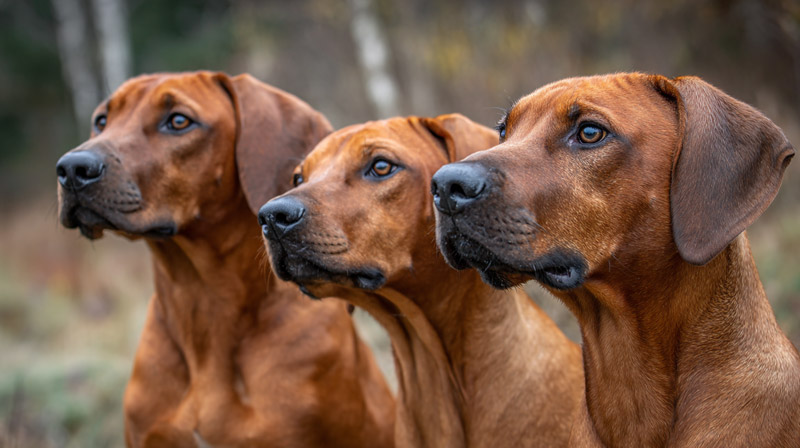
Socialization has to start before the puppy finishes its vaccinations. After that it’s short, reward-based training sessions, and recall stays a long project because the prey drive never switches off.
The American Veterinary Society of Animal Behavior calls the first three months the primary period and says puppies should be socialized before they finish vaccinations. The IPFD adds that Ridgebacks need heavy social and environmental training and advises planning for obedience classes through the first one to two years.
Orvis says the breed is sensitive to harsh correction and bored by long or repetitive sessions. The AKC recommends firm but fair guidance from puppyhood.
For recall, build it on a long line in unfenced places and proof it around distractions before trusting it near wildlife (Zoom Room).
Keep rewards small and count them toward the daily food allowance (PDSA). Orvis calls the breed prone to overeating, so healthy dog treats are the sensible reward.
Training goals give the work a point. The parent club runs an annual Canine Good Citizen award and lists agility, rally, obedience, scent work, tracking, racing and endurance trials as performance activities (RRCUS).
AKC lure coursing admits dogs a year or older and bars hounds with a breed disqualification. A ridgeless Ridgeback cannot enter.
When a Rhodesian Ridgeback Is the Wrong Dog
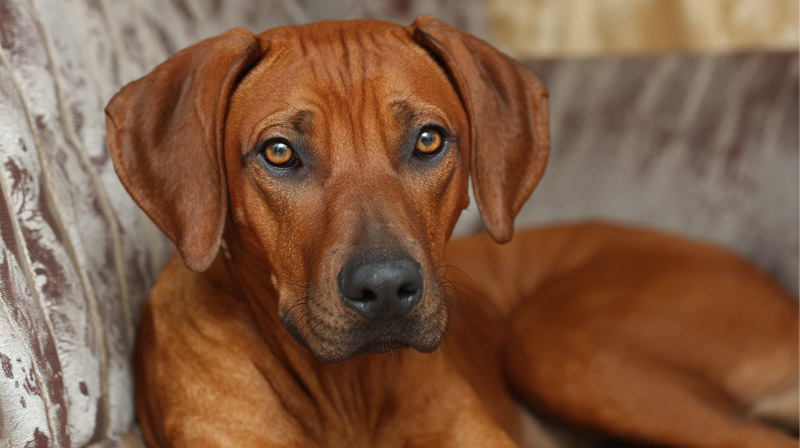
It’s a poor fit for first-time owners and for anyone who trains through correction rather than rewards, and a household that sits empty through the workday makes things worse.
- The AKC calls the breed somewhat challenging and not ideal for novices, PDSA does not recommend it as a first dog, and the IPFD says the owner needs experience with dogs.
- Harsh trainers get nowhere. Orvis says harsh methods are counterproductive with this sensitive breed.
- Long hours alone are rough on it. PDSA sets a four-hour ceiling and warns of separation anxiety, chewing and barking beyond it, while Orvis allows longer for a well-exercised dog and recommends crate training from an early age.
- Open kitchens are a bad idea, since the breed is prone to overeating, food guarding and counter surfing (Orvis).
- Bored Ridgebacks chew beds and dig cool holes in hot weather (Orvis), so tidy lawns and good bedding take a beating.
- The IPFD says a Ridgeback usually picks a favorite and should be indifferent to strangers, which won’t suit an owner who wants a dog that loves everyone.
Any one of these can be managed. Several at once is where the match breaks down.
How to Choose a Rhodesian Ridgeback Breeder
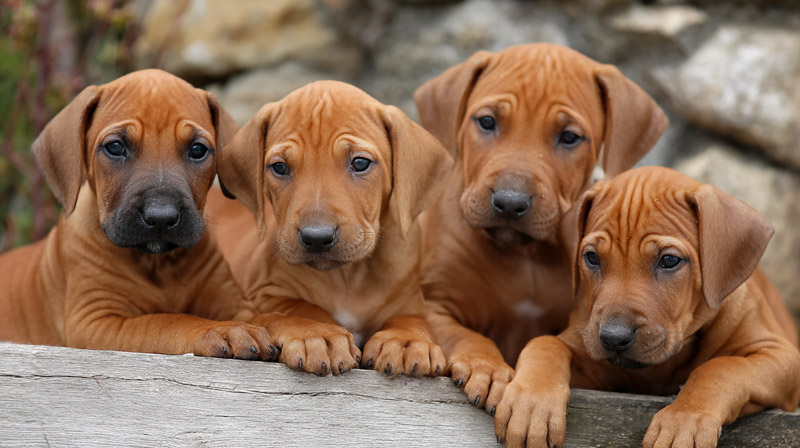
A good breeder can show you paperwork. That means public test records, DNA results where tests exist, a vet’s dermoid sinus exam of the litter, and a plain account of how the puppies are socialized.
- Look the parents up in the OFA database instead of accepting a verbal claim. Results appear once the owner agrees to disclosure, so a missing entry is itself an answer.
- Ask which DNA tests the parents have had. JME, DM and EOAD all have tests, and for recessive conditions at least one parent should test clear.
- Find out who examined the puppies for dermoid sinus, and when. PDSA says a vet should assess puppies before sale, and the IPFD notes many vets have never seen a sinus, so ask whether the examiner knew what to feel for.
- Ask about the ridge. Does the breeder know the parents’ ridge genotypes, and how does the pairing handle ridgeless and faulty-ridge risk?
- Meet the parents. Nordic breed clubs recommend a behavior assessment for breeding dogs and exclude aggressive or timid ones (IPFD).
- Check oversight through the RRCUS breeder directory and code of ethics in the US, or a Kennel Club Assured Breeder in the UK, which PDSA recommends for the extra health tests.
- Ask how the litter is being socialized before it leaves. PDSA tells buyers to raise this directly.
An unusually cheap litter is a red flag. PDSA warns these can come from puppy farms.
Rhodesian Ridgeback FAQ
How much does a Rhodesian Ridgeback cost to own?
PDSA puts the minimum at 105 pounds a month after purchase and set-up costs, and over 17,000 pounds across a lifetime.
It is a floor, so vet bills for conditions such as thyroid disease or bloat sit on top.
Can you adopt a Rhodesian Ridgeback from a rescue?
Yes. The Rhodesian Ridgeback Club of the United States runs Rhodesian Ridgeback Rescue, Inc. as its official rescue program, and it began in 1970 as the club’s adoption committee.
Ridgeback Rescue of the U.S. screens adopters with an application, a phone interview, reference checks and a home check.
Will a Rhodesian Ridgeback mix have a ridge?
Often, but not always. The ridge is dominant, so one inherited copy of the duplication is enough, and GenoCan estimates about 95% of purebred Ridgebacks with a single copy show a ridge.
A Ridgeback parent with two copies always passes one on.
What should you feed a Rhodesian Ridgeback puppy?
Pet Circle’s veterinary guide recommends a premium large-breed puppy formula until 12 to 18 months of age.
Portions follow the calories in the food, not a fixed number of cups, so weigh the puppy and check that you can feel its ribs.
When is a Rhodesian Ridgeback fully grown?
Sources disagree because they measure different things. Height settles around 14 months, while males keep adding muscle until about two years (Pawlicy).
Adult temperament typically settles between two and three years of age.
Is a ridgeless Rhodesian Ridgeback still a good pet?
Yes, as a pet. The AKC, UKC and FCI disqualify ridgeless dogs from the show ring, and Swedish breed clubs advise against breeding them (IPFD).
Finnish breeders often register such puppies as not for breeding and sell them as companions.
Keeping a Rhodesian Ridgeback Sound Through Adulthood
The breed’s recurring risks begin after the puppy stage ends, so a Ridgeback stays sound through adulthood on a fixed schedule of health checks and steady training.
Thyroid retests on the OFA schedule come first, then annual eye exams through age 9, then vet-led senior checks from age 8.
Thyroid retesting starts at age 2 and eye exams repeat every year. The senior checks pick up whatever neither schedule reaches.
The last OFA thyroid exam at age 8 falls about 19 months before Finland’s average life expectancy of 9 years 7 months, so the final stretch has no scheduled test.
The trade-off is a vet visit every year and repeat test fees, paid for earlier detection.