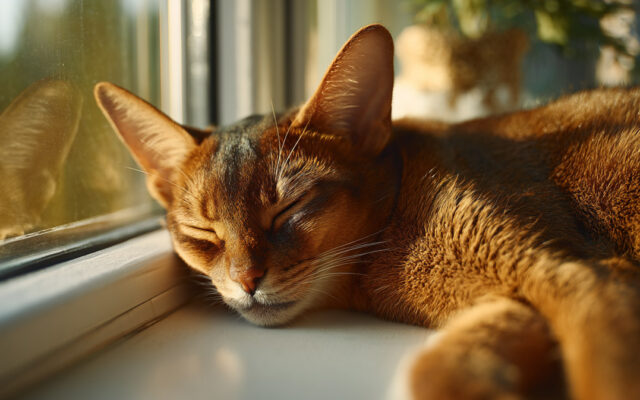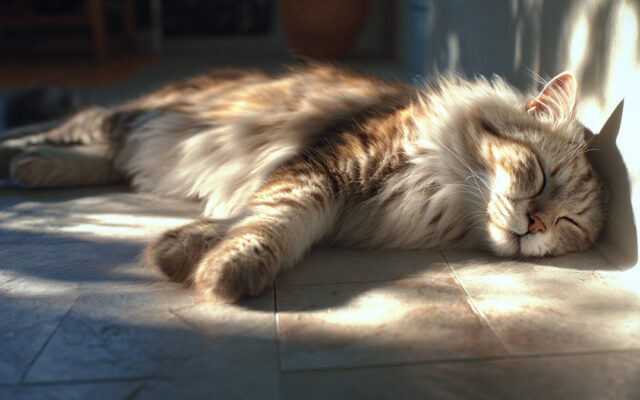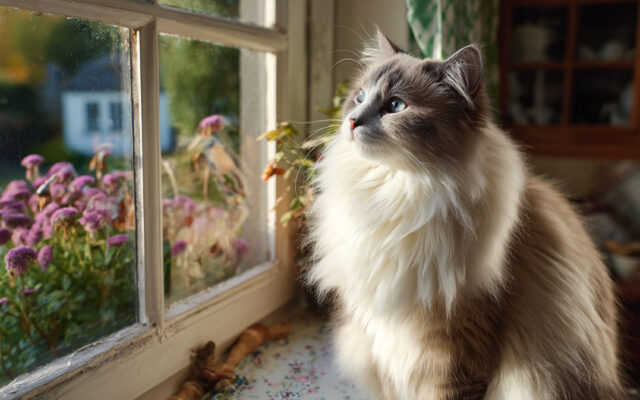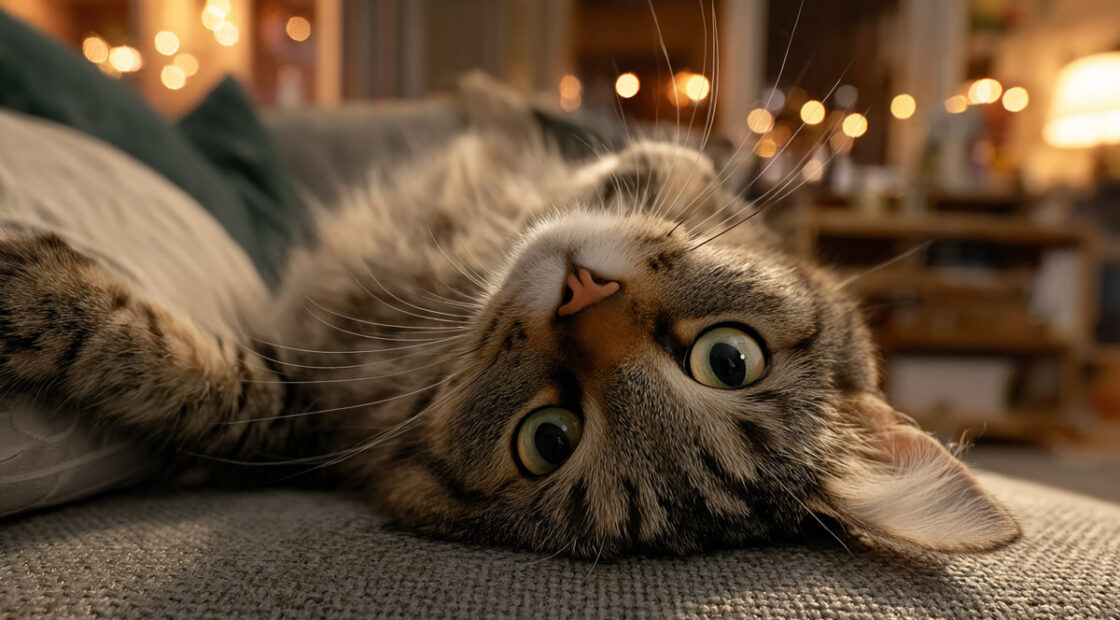
Pixiebobs are bred to look like bobcats. The short bobbed tail, the brown spotted tabby coat and the tufted ears all point that way, and the standard even permits extra toes.
Carol Ann Brewer started the line in Washington State in 1985. Despite the wild face, the cats are dog-like and easy with families.
Registries treat the breed as wholly domestic. The mid-1990s DNA test behind that status has no public method or data, per Wikipedia.
Commercial tests for bobcat and domestic cat hybrids did not exist as recently as October 2018 (Chiu et al., Forensic Science International: Genetics, 2019).
What is a Pixiebob?

Breeders in Washington State in the 1980s set out to make a domestic cat that looked like a bobcat. What came out has a short bobbed tail, a brown spotted tabby coat, tufted ears and, on some cats, extra toes.
Carol Ann Brewer built the line from spotted, short-tailed cats she collected in the Pacific Northwest.
Registries and vet sites spell the name Pixiebob, Pixie-bob and Pixie-Bob. All three mean the same cat.
PetMD states plainly that the breed has no wildcat ancestry. The CATZ Inc. standard, from a New Zealand registry, sets the goal as a domestic cat that resembles the North American bobcat, and it describes the cat’s true nature as loving and tractable.
The resemblance was bred for. The attitude is pure house cat.
Pixiebob appearance and breed standard

Medium to large and rangy, with heavy bone, a short tail, a hooded brow and an inverted pear-shaped head. That’s the standard in one breath.
Shoulder blades and hip bones stand out, which gives the cat a rolling gait. Ears sit low and back on the head, and lynx tips are desirable but not required.
The standard weights the head above everything else.
A few figures worth keeping handy:
- Adult males run about 12 to 17 lb and females about 8 to 12 lb (WebMD, 2024).
- The tail must be at least 2 inches and never past the hock (TICA standard, as summarized by Wisdom Panel).
- Up to 7 toes per foot are allowed (TICA standard, as reported by Petful).
- The head alone is worth 50 of 100 show points (CATZ Inc. Standard of Excellence).
Tail length and shape
The CATZ standard penalizes a tail that misses the minimum or runs past the maximum. TICA sets the minimum at 2 inches, and CATZ measures it from the prominent hip bone to the base of the tail. Nothing may go past the hock.
The shape is flexible, often kinked or knotted, carried low and following the curve of the back.
At least nine-tenths of the tail must carry bone, and a cat with no tail at all is withheld from every award.
Polydactyly and the 7-toe limit
Extra toes are allowed in the standard, not required, so plenty of Pixiebobs have a normal count. TICA permits up to 7 toes on a foot, while CATZ accepts 5 to 7 for championship exhibition.
Breed guides disagree on how unusual this is. Wisdom Panel and Royal Canin call the Pixiebob the only breed whose standard accepts extra toes, while a Petful kitten guide says it is one of two.
Whichever count is right, the written standard decides what a show cat can carry. Feet that turn inward or outward when the cat is stacked are disqualified, polydactyl or not.
Coat length and colors
Shorthairs have a soft, woolly coat that stands off the body and feels water-resistant.
The semi-longhair coat is silkier. It stays under 1.5 inches except on the face, back, belly and tail end, and it never forms a ruff around the neck.
Brown spotted tabby is the only recognized color in the CATZ standard, in lighter warm shades with heavy ticking that mutes the small spots. Eyes run gold to brown, gooseberry green is accepted, and copper or blue are not wanted.
Size and weight by sex

Males run about a third larger than females and carry more muscle (CATZ Inc.).
Don’t judge a Pixiebob’s size at one year, because the breed fills out slowly. A heavy coat and broad chest also make the cat look bigger than the scale says (Petful).
What is the Pixiebob temperament like?

Sociable, easygoing and dog-like. Pixiebobs follow their people from room to room, get along with children and other pets, and chirp where most cats meow.
Wisdom Panel calls them laid-back and not overly demanding, and the CATZ standard describes a domestic cat’s reliability paired with a dog’s attentiveness.
On the household side of things:
- Children bond with them easily, according to WebMD.
- Dogs and other cats are fine when introductions are handled properly (PetMD).
- A workday alone is manageable, but long stretches get lonely (WebMD).
- They chirp, chitter and trill instead of giving a standard meow.
The dog comparison holds up in behavior. Pixiebobs fetch, ride in the car without fuss and walk on a harness and leash, which PetMD ties to an adventurous streak.
Show lines screen for manners too. The CATZ standard withholds all awards for any sign of challenge, so a cat that squares up to the judge does not place.
Individual cats still vary. Early socialization and handling shape a Pixiebob as much as breed does, per PetMD.
Pixiebob health problems and lifespan

Pixiebobs are generally healthy and live 13 to 15 years, with only a handful of breed-linked conditions on record.
WebMD, PetMD, Wisdom Panel and Royal Canin all give 13 to 15 years. cats.com and Petful run to 16, and Wamiz gives 12 to 20 with an average near 14.
None of these profiles cites a lifespan survey of the breed, so the range is consensus, not measurement.
Documented conditions and screening
WebMD attributes the breed’s short problem list to its genetic diversity. Breeders have still reported a few things worth knowing about.
- Cryptorchidism, where one or both testicles fail to descend, has turned up in a few cases since the 1980s. Treatment is removal and neutering.
- A small percentage of females have difficult births (dystocia), and affected cats leave breeding programs.
- Unspayed females can develop uterine cysts that lead to infection, called cystic endometrial hyperplasia. Spaying treats it.
- Hypertrophic cardiomyopathy, a thickening of the heart walls, is rare in the breed.
Only a few HCM cases have turned up over the last few decades, and some were Pixiebobs mixed with Maine Coon or Bengal cats, both predisposed to the disease.
Embrace Pet Insurance and Catster also note that some Pixiebobs show vaccine sensitivity, so raise it at the first vet visit.
Ask any breeder for cardiac screening results and the Pawpeds health records on the parents.
Is the short tail a health risk?
Sources split on this one, and the genetics does not settle it.
PetMD and WebMD list no tail-linked disease, and some breed guides say the Pixiebob tail mutation differs from the one found in the Manx, whose tail gene is tied to spinal defects.
On the other side, zooplus, a German pet retailer, classes the Pixiebob as Qualzucht (breeding that causes suffering). It cites balance, communication with other cats and reduced neck-vertebra mobility.
Germany’s federal expert opinion on section 11b of its animal welfare act lists short or missing tails as an affected trait. web.de names the Manx, Cymric, Japanese Bobtail and Kurilian Bobtail as examples, not the Pixiebob.
The primary genetics cuts against a clean separation from the Manx. Buckingham and colleagues (Mammalian Genome, 2013) found one mutant T allele shared with American Bobtails and Pixiebobs.
A 2016 whole-genome paper on short-tailed Asian cats summarizes earlier work showing that T-box mutations in homozygous or compound heterozygous form cause embryonic lethality.
No source here measures spinal or mobility problems in Pixiebobs directly, so the welfare debate rests on inference from related breeds.
How to care for a Pixiebob

Weekly brushing, measured meals and two 15-minute play sessions a day cover most of it. The coat is dense but low-maintenance, so the real work is exercise and weight control.
| Task | Frequency | Source |
|---|---|---|
| Brushing, shorthair | Weekly | PetMD |
| Brushing, longhair | 2 to 3 times a week | PetMD |
| Nail trims | Monthly | Wisdom Panel |
| Tooth brushing | Daily | Wisdom Panel |
| Play sessions | Two 15-minute sessions daily | PetMD |
WebMD is stricter and says a few times a week for both coat lengths. Start weekly and add sessions during seasonal shedding, as Wisdom Panel suggests.
Adults do well on commercial food formulated for their life stage, split into two measured meals a day. Kittens can eat up to four times daily (PetMD).
Treats stay under 10 percent of daily calories, and a scale beats eyeballing a cat this fluffy.
Pixiebobs entertain themselves with climbing and exploring, but they still need people-led play on top of that. Cat trees, puzzle feeders, harness walks and a catio all help.
Polydactyl feet mean extra nails to trim, and long nails can grow into the paw pads. Baths are rarely needed.
Pixiebob history: from a Washington barn cat to TICA championship

It started in spring 1985, when Carol Ann Brewer bought a spotted, short-tailed, polydactyl male near Mount Baker in Washington State. Petfinder credits her Stoneisland Cattery with originating the breed.
- In 1986 Brewer rescued Keba, a bobbed-tail male so large he stood knee-high even while starving. He mated with a neighbor’s spotted female, and the April litter produced Pixie, the foundation cat and namesake.
- Brewer wrote the first breed standard in 1989, according to Embrace Pet Insurance and Petfinder.
- Over the next several years she added 23 cats from the Cascade range, believed to come from natural bobcat and domestic matings, and marketed them as Legend cats, a trademarked name.
- Other breeders with wild-looking barn cats joined in during the 1990s and widened the gene pool.
TICA’s dates are where the sources split.
Wisdom Panel and Omlet both date Brewer’s TICA application to 1993 but give acceptance as 1994 and 1995, which probably explains why other sources print 1993 as the exhibition year.
| Registry | Status | Year | Note |
|---|---|---|---|
| TICA | Exhibition | 1993, 1994 or 1995 | 1993 is likely the application date |
| TICA | New breed and color | 1996 | Wikipedia and cats.com agree |
| TICA | Championship | 1998 | Omlet gives 1997. Embrace Pet Insurance says it was granted in 1997 for the 1998 show season. |
| ACFA/CAA, CCA-AFC | Standard published | Not dated | Listed on Wikipedia |
| CFA, FIFe, GCCF | Not recognized | None | Per Sarah Hartwell |
TICA first filed the breed as a Native New Breed, a class for cats selected from a naturally occurring regional population, and now treats it as established.
Hartwell presumes the CFA, FIFe and GCCF holdouts reflect questions about the breed’s ancestry.
Wikipedia also lists a 1999 patent attempt on the breed by Frank Ditto, rejected by the US Patent and Trademark Office. Its footnotes point to a trademark application and a 2012 Federal Circuit case, so the filing type is unclear.
Do Pixiebobs have bobcat DNA?
No bobcat markers have been reported in Pixiebobs, and every source treats the breed as wholly domestic. The public evidence behind that result is thinner than the confidence around it.
The legend goes back to Brewer, who reported that Keba was bobcat-sired. Catster’s breed profile, updated in October 2026, still says breeders think genuine bobcat DNA is likely.
Sources date a negative test result to the mid-1990s, but Wikipedia notes that the method and primary data do not appear to be public.
The negative result still gets repeated in a few places.
- Wikipedia describes the breed as wholly domestic for ownership, registration, import and export.
- LOOF, the French registry, says on its breed sheet that DNA shows the Pixiebob never had lynx ancestors.
- One cat-products blog says the UC Davis Veterinary Genetics Laboratory settled the question, but it cites a Messybeast history page, not a lab report.
Commercial hybrid testing did not exist as recently as 2018. Colorado Parks and Wildlife seized a suspected bobcat that October, found no commercial test for bobcat and domestic cat hybrids, and screened for endogenous feline leukemia virus instead (Chiu et al., Forensic Science International: Genetics, 2019).
The animal lacked the virus, which showed it was not a domestic hybrid. A 1990s result that nobody has published is hard to verify, whichever way it points.
Registry history adds noise. Hartwell reports that during an early open-registry period after TICA recognition, some American Bobtails, Japanese Bobtails, Manx cats, jungle cats and Maine Coons may have been registered as Pixiebobs, and early breeders added Bengals.
Treat the Pixiebob as a domestic cat. A breeder who sells wild blood as a feature is a red flag, as Petful points out.
Pixiebob vs Maine Coon, American Bobtail and Savannah

The Maine Coon is bigger with a full tail, the American Bobtail is the closest match on tail and origin, and the Savannah is the only one of the four with wild ancestry.
| Breed | Origin | Wild ancestry | Best for |
|---|---|---|---|
| Pixiebob | Washington State, 1980s | None reported | Bobcat look, dog-like family cat |
| Maine Coon | Maine, natural breed | None | Large size and a full tail |
| American Bobtail | Arizona, late 1960s | None | Bobbed tail in any coat color |
| Savannah | Serval and domestic cat crosses | Serval, strongest in early generations | Exotic look, buyers who accept restrictions |
The Maine Coon shares the tufted ears and rugged build but runs far larger. TICA figures reported by Maine Coon Central put males at 18 to 22 lb, while Purina Canada lists 12 to 15 lb, so check the registry standard rather than a pet-food brand’s page.
The American Bobtail matches the Pixiebob on a short stubby tail and a dominant tail gene. Where it differs is color, since it comes in every coat color and pattern, and recognition, since CFA publishes a standard for it.
The Savannah is the odd one out. It is classed by filial generation (F1 has a serval parent), some places restrict the early ones, and price climbs steeply with serval share, according to National Geographic.
So the Pixiebob suits you if you want the bobcat face, a dog-like temperament and a domestic pedigree. Go Maine Coon for size and a full tail, or American Bobtail for a bobbed tail in any color with CFA recognition. The Savannah only makes sense if you accept serval ancestry, local rules and the price.
When a Pixiebob is the wrong fit

Allergy sufferers should look elsewhere, since WebMD lists the breed as not hypoallergenic.
Buyers on a short timeline will struggle too. PetMD says only a handful of US breeders exist, so expect a wait and a deposit, not a same-week pickup. Shelter finds are rare enough that Vetstreet calls them unlikely.
Anyone uneasy about short-tail breeding has a real option, which is to ask breeders about long-tailed kittens. They turn up in litters and sell for less (Petful, 2026). None of these sources says whether those kittens carry the same tail variant, so ask what the breeder’s genetic results show.
And if you want an actual wild cat, this isn’t it. The attitude is domestic, and buyers chasing a bobcat-hybrid story are shopping for the wrong cat.
If none of that applies, the breed fits.
How much does a Pixiebob cost, and how do you buy one?
A pet-quality Pixiebob kitten costs about $1,000 to $3,000 from a registered breeder, according to Petful’s July 2026 guide.
PetMD gives $800 to $4,000 once show-quality kittens are included.
Kitten price by trait

Tail and toes set most of the spread. Cascade Pixiebobs lists polydactyl bobtailed kittens at $2,300 to $4,000 and straight-toed long-tailed kittens at $1,200 to $2,300, as reported by Petful.
A short natural tail is the premium trait, since long-tailed kittens turn up in nearly every litter. Extra toes stack on top of that, and toe count varies from kitten to kitten within a litter.
Breeding rights or show lineage push the price well past the pet range.
Prices have climbed. The Seattle Times put pet-quality kittens at $400 to $1,000 in 1994, before any inflation adjustment.
After the purchase, Petful budgets roughly $700 to $1,500 a year, with gear, first vet visits and food adding to the first year.
How to find a reputable breeder
- Decide on a pet contract. Breeding rights inflate the price and most buyers never use them.
- Pick the traits you will pay for, and get the tail length and toe count of the actual kitten in writing.
- Shortlist breeders registered with TICA or ACFA so the pedigree can be verified.
- Ask for an itemized quote covering vaccinations, deworming, microchip, spay or neuter and any health guarantee.
- Add transport to every quote and compare totals, not sticker prices.
- Meet the parents in person or on video, and favor litters raised in the home and handled early.
- Read the contract before paying a deposit, including refund terms and what happens if you must rehome the cat.
Cullen Pixiebob Cattery publishes a typical pet-contract policy. It asks for a deposit and a signed contract, then releases the registration number once the buyer confirms spay or neuter.
Walk away from prices far below the market range, missing health records, or pressure to pay in full unseen. A cheap bobtailed kitten sold as a Pixiebob is usually unpapered, per Petful.
Pixiebob FAQ
Do male and female Pixiebobs have different personalities?
No, not in any way the sources document. PangoVet finds no real personality gap between the sexes and says each cat’s temperament is individual.
The difference that does show up is size, with males running larger.
Can two polydactyl Pixiebobs be bred together safely?
No study shows harm, and none shows safety. Wamiz says some sources advise against pairing two polydactyl parents over fears of paw deformities, then adds that no scientific study backs the concern.
Ask the breeder what the toe counts in their litters have looked like.
Is a Pixiebob legally a domestic cat?
Yes. Wikipedia describes the breed as wholly domestic for ownership, registration, import and export.
That differs from early-generation Savannahs, which some counties and cities restrict, according to Catster.
How can I tell if my cat is a Pixiebob?
Look for lynx-tipped ears, a spotted tabby pattern and a thick, slightly coarse coat, as PetMD describes. An at-home cat DNA test can help confirm it.
A pedigree from a TICA or ACFA registered breeder is the stronger proof.
How much does shipping a Pixiebob kitten cost?
Petful’s 2026 guide puts air transport at roughly $400 to $700, covering the health certificate, carrier and flight.
Driving to pick the kitten up costs only fuel and a day.
When does a Pixiebob reach full size?
Up to four years. Wikipedia says the breed keeps growing for up to four years instead of one, and Petful’s size guide gives a three to four year window.
Weight keeps climbing slowly after the kitten phase ends.
Planning the First Month With a Pixiebob

Start with the vet exam. Vetstreet advises a visit soon after adoption so a preventive regimen begins early, and the exam is also where problems surface.
Daily handling comes next, covering brushing, nail trims and teeth, because a kitten handled early accepts all of it (Vetstreet). The harness waits until the kitten has settled in.
Budget for the long run too. Petful’s 2026 yearly figure, multiplied across the 12 to 14 years left after year one of a 13 to 15 year life, gives $8,400 to $21,000, which exceeds the kitten’s price at either end of its range.
Checked in November 2026, no published spinal-health study of Pixiebobs appears in the sources reviewed. One would change the short-tail advice.