Your dog’s bowl deserves better than mystery ingredients and high-heat shortcuts.
The best air dried dog food sits in a category of its own, closer to raw feeding in nutrient profile but without the Salmonella risk or freezer requirements. More pet owners are making the switch, and the reasons go beyond marketing.
This guide covers what air drying actually does to protein bioavailability and amino acid retention, how to read a guaranteed analysis correctly, which brands hold up under scrutiny, and what feeding air dried food actually costs day to day.
No fluff. Just the information you need to make a confident decision for your dog.
What Is Air Dried Dog Food?
Air dried dog food is produced by slowly removing moisture from raw ingredients at low temperatures, typically between 60 and 70 degrees Celsius, over an extended drying period. The result is a shelf-stable product that sits nutritionally between raw feeding and conventional kibble, without the high-heat processing that changes ingredient structure.
Moisture content in finished air dried products typically falls between 10 and 15%. Compare that to raw food at 60 to 80% moisture and standard kibble at around 8 to 10%, and you start to understand why air dried food sits in its own category.
The format kills pathogens like Salmonella and E. coli through moisture removal rather than heat, which is the key practical difference from raw feeding. Dogs still get a nutrient profile close to raw, but without the refrigeration requirements or contamination risk.
How Air Drying Differs from Freeze-Drying and Dehydration
These 3 processes get lumped together constantly. They are not the same.
| Process | Temperature | Moisture Removal Method | Key Trade-off |
|---|---|---|---|
| Air drying | 60–70°C | Slow airflow over time | Longer process with good nutrient retention |
| Freeze-drying | Below freezing (-40 to -50°C) | Vacuum-pressure sublimation | Best nutrient retention but highest cost |
| Dehydration | 70–90°C | Higher-heat airflow | Faster process with some loss of heat-sensitive nutrients |
| Kibble extrusion | 150–200°C | High-heat, high-pressure cooking | Lowest cost but greatest nutrient degradation |
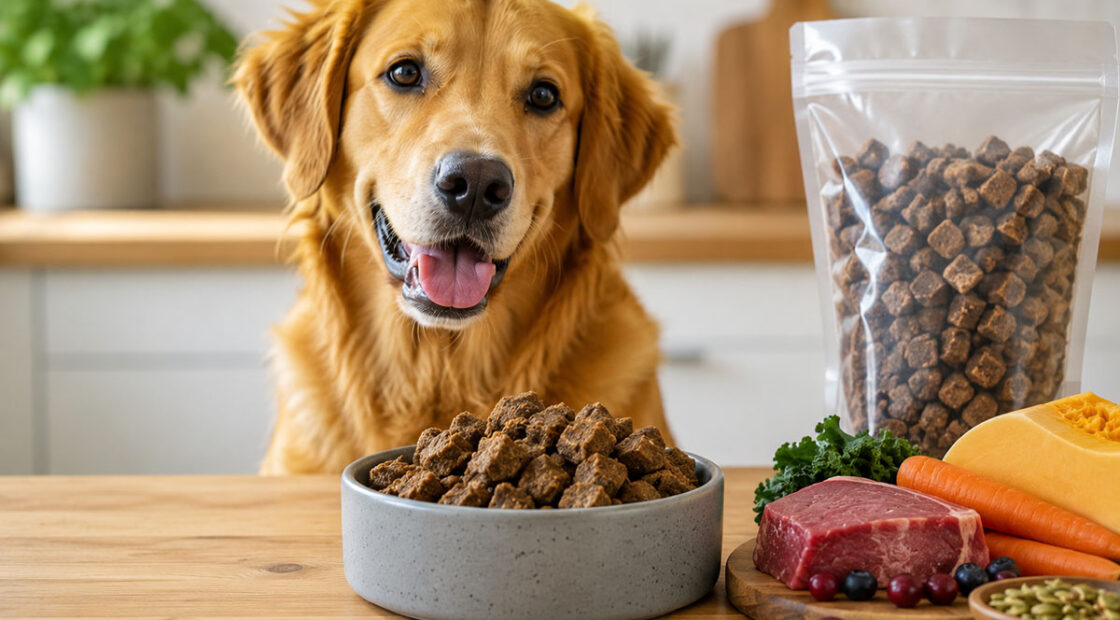
Air dried food comes in 3 main formats: shelf-stable blocks, crumbles, and patties. Ziwi Peak uses the block format. K9 Natural produces patties. Most brands now also offer crumble formats that double as meal toppers on kibble.
One thing worth knowing: air dried is not the same as dehydrated, even though some brands use the terms interchangeably on packaging. True air drying uses lower temperatures than dehydration. If a label says “dehydrated” and the protein source is listed as a meal rather than whole meat, that is a completely different product.
What Nutrients Are Preserved in Air Dried Dog Food?
Air drying preserves nutrients that high-heat processing destroys. A 2022 study published in Animals (Basel) found that fresh meat-based dry formulations retained significantly higher essential amino acid content compared to meat meal-based alternatives, with better in vitro digestibility scores across the board (Animals, 2022).
The reason comes down to temperature. Heat above 70 degrees Celsius starts denaturing proteins and degrading fat-soluble vitamins. Air drying stays below that threshold, which means the amino acid profiles in beef, lamb, and venison proteins arrive at your dog’s bowl largely intact.
Enzyme and Vitamin Retention
Digestive enzyme survival rate in air dried food is meaningfully higher than in kibble.
- Lipase and protease remain active at temperatures below 70 degrees C
- Fat-soluble vitamins A, D, E, and K are better preserved than in extruded processing
- Omega-3 and omega-6 fatty acids are less oxidized due to lower processing temperature
- Taurine, an amino acid dogs cannot produce in sufficient quantities on their own, is present in levels above minimum in most air dried formulas (Ziwi Peak Beef lists taurine at minimum 0.05%)
Freeze-dried raw foods showed amino acid digestibility values above 90% in a 2022 University of Illinois study. Air dried products, processed at slightly higher temperatures, come close to that range. Both formats significantly outperform extruded kibble on protein digestibility measures (University of Illinois Urbana-Champaign, 2022).
How to Read the Guaranteed Analysis on Air Dried Dog Food Labels
This trips up a lot of people, including me the first time I switched one of my dogs to air dried.
The guaranteed analysis on any dog food label is listed on an “as fed” basis, meaning it includes the moisture content of the food. Because air dried food contains only 10 to 14% moisture compared to wet food at 75 to 80%, the protein percentages look inflated relative to wet food but comparable to kibble.
Dry matter basis (DMB) is how you compare formulas fairly. The formula: take the reported nutrient percentage, divide by (100 minus the moisture percentage), then multiply by 100.
Example: Ziwi Peak Beef lists crude protein at 38% on an as-fed basis with 14% max moisture. On a dry matter basis, that calculates to roughly 44% protein. That is a high-protein diet by any standard. AAFCO requires a minimum of 18% protein (DM) for adult dogs and 22% for growth and reproduction (AAFCO, 2024).
What Are the AAFCO Standards for Air Dried Dog Food?
AAFCO does not regulate the manufacturing process. It sets nutritional minimums and label standards. A product being “air dried” says nothing about whether it qualifies as complete and balanced nutrition for your dog.
In July 2023, AAFCO approved the first major label modernization in over 40 years. The new regulations, effective from the 2024 Official Publication, require nutritional adequacy statements on the front panel of packaging and a redesigned Nutrition Facts Box closer to human food labeling standards (AAFCO, 2023). Brands have a six-year transition period to comply.
Complete and Balanced vs. Supplemental Feeding
“Complete and balanced” means the formula meets AAFCO’s minimum nutrient profile for at least one life stage.
“Intermittent or supplemental feeding only” means it does not. Some air dried toppers and mixers fall into this category. Feeding them as a sole diet creates nutritional gaps.
There are 2 ways a brand can substantiate a “complete and balanced” claim. First, laboratory nutrient analysis confirms the formula meets AAFCO profiles on paper. Second, an AAFCO feeding trial uses real dogs over a defined period to confirm the food actually sustains health. Feeding trial substantiation is harder to achieve and more meaningful. The label will say “Animal feeding tests using AAFCO procedures substantiate that [Product Name] provides complete and balanced nutrition” if a trial was conducted (Purina, 2024).
Life Stage Coverage in Air Dried Formulas
AAFCO recognizes 3 life stages for dogs: growth (puppy), adult maintenance, and all life stages.
- All life stages: Meets the highest nutritional bar, covering puppy growth requirements. Ziwi Peak Beef and most Ziwi recipes carry this designation with the exception of large breed puppies (over 70 lbs. as adults).
- Adult maintenance: Meets minimums for adult dogs only. Not sufficient for puppies.
- Growth: Formulated specifically for puppies and pregnant or nursing females.
The NRC (National Research Council) publishes minimum requirements for 37 essential nutrients in dogs. AAFCO profiles are based on NRC research and are updated periodically. When comparing air dried brands, check whether the AAFCO statement reflects formulation compliance or an actual feeding trial.
What Ingredients Separate the Best Air Dried Dog Foods from Average Ones?
You can learn most of what you need to know about an air dried dog food from the first 5 ingredients and the synthetic additive list. Everything else is detail.
The freeze-dried and air dried pet food segment grew 7.5% in the 52-week period ending June 2024, outperforming traditional kibble which declined 1.8% in the same period (NielsenIQ, 2024). That growth has attracted a lot of brands into the space, and ingredient quality varies widely.
Organ Meat Content: Why It Matters in Air Dried Formulas
Organ meat is not a filler. It is one of the most nutrient-dense ingredients in any dog food formula.
- Liver delivers preformed vitamin A, B vitamins, and iron in highly bioavailable forms
- Heart is one of the best natural sources of taurine and CoQ10
- Kidney provides B12, riboflavin, and selenium
- Spleen contains high levels of iron and vitamin C
Ziwi Peak’s beef recipe lists beef, beef tripe, beef lung, beef heart, beef liver, and beef kidney in the first 6 ingredients. That organ inclusion rate is why the formula hits 38% crude protein on an as-fed basis without relying on any plant-based protein sources.
Brands that use generic “meat meal” as a primary protein source are using a rendered ingredient, meaning it was processed at high heat before the air drying stage. The end product is not the same as a formula built on whole fresh meats and organs.
Synthetic Preservatives to Avoid
Finding BHA, BHT, or ethoxyquin in an air dried dog food is a red flag. These synthetic antioxidants are used to extend fat shelf life in lower-quality formulas.
BHA (Butylated Hydroxyanisole) and BHT (Butylated Hydroxytoluene) are petroleum-derived preservatives classified as possible carcinogens by the National Toxicology Program.
A well-formulated air dried product uses mixed tocopherols (natural vitamin E) and citric acid for preservation. Both Ziwi Peak and K9 Natural use this approach. The low moisture content of air dried food itself acts as a natural preservation mechanism. You do not need synthetic preservatives in a properly air dried formula. If you see them on the label, the formulation was compromised somewhere in the process.
Also watch for carbohydrate sources. Sweet potato and chickpeas are not harmful in small quantities, but some brands use them to bulk out formulas and reduce per-serving meat content. Tapioca starch adds calories with no nutritional value for a carnivore. Ziwi Peak keeps carbohydrate content to approximately 6.3% on a dry matter basis across its range. Most premium air dried brands stay under 10% DM carbohydrates.
What Are the Best Air Dried Dog Foods Available?
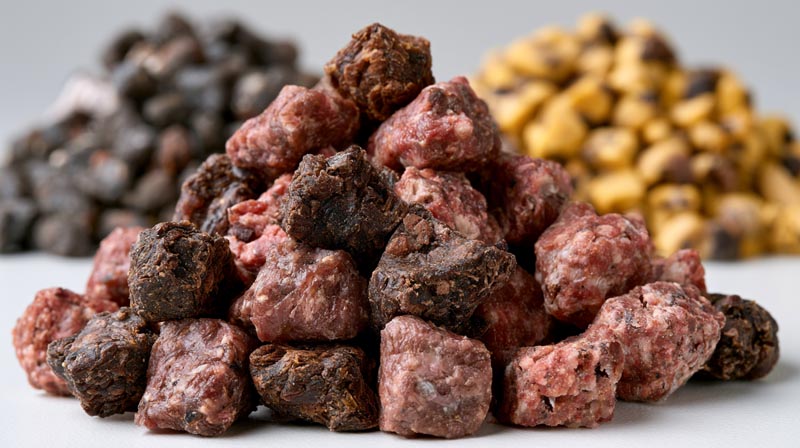
These rankings are based on 5 criteria: protein source quality, AAFCO life stage designation, ingredient integrity (organ meat inclusion, absence of synthetic preservatives), caloric density, and country of manufacture. Price per day is calculated for a 30 lb adult dog at maintenance feeding levels.
Best Air Dried Dog Food for Overall Quality
Ziwi Peak Air Dried consistently tops comparisons for ingredient quality. The beef recipe posts 38% crude protein and 30% crude fat on an as-fed basis, with a dry matter protein of approximately 44% (Dog Food Advisor, 2024). All recipes list organ meats in the first 6 ingredients.
- 96% meat, organs, seafood, and bone by formulation
- No grains, potatoes, rendered meals, or synthetic preservatives
- AAFCO all life stages (except large breed puppies)
- Manufactured in New Zealand, no FDA recalls on record
- Cost: approximately $3.00 to $4.50 per day for a 30 lb dog
Took me a while to get used to how little you feed. Because it is calorie-dense at around 4,900 kcal/kg for the beef recipe, the daily portion looks small compared to kibble. That is normal. Do not free-feed air dried food.
Best Air Dried Dog Food for Small Breeds
Small breed dogs have faster metabolisms and higher caloric needs per pound of body weight. They also tend to have more sensitive stomachs, which makes the limited ingredient profile of most air dried formulas a practical advantage.
K9 Natural Air Dried is a strong option here. The lamb formula carries an AAFCO all life stages designation and uses whole lamb, lamb green tripe, lamb heart, and lamb kidney as primary ingredients.
| Brand | Protein (as-fed) | AAFCO Statement | Best For | Price/day (30 lb dog) |
|---|---|---|---|---|
| Ziwi Peak | 38–44% | All life stages | Overall quality and sensitive stomachs | $3.00–$4.50 |
| K9 Natural | 35–40% | All life stages | Small breeds and single-protein diets | $2.50–$3.50 |
| Orijen | 38–42% | All life stages | High-activity dogs and multi-protein diets | $2.20–$3.20 |
| Stella & Chewy’s | 36–45% | All life stages | Budget-accessible premium option with wide availability | $1.80–$2.80 |
| Open Farm | 32–38% | Adult maintenance / all life stages | Transparency-focused buyers and ethical sourcing | $2.00–$3.00 |
Excludes large breed puppy growth (70+ lbs. adult weight)
Best Air Dried Dog Food for Large Breeds
Large breed dogs need controlled calcium-to-phosphorus ratios to support bone development and joint health. Most “all life stages” air dried formulas exclude large breed puppies specifically because of this.
Orijen Original Air Dried is a strong large breed option for adult dogs. Mars Petcare acquired Champion Petfoods (the parent company of Orijen) in February 2023, which raised some concerns among longtime fans about quality consistency. So far, formulations have remained unchanged and no recalls have been issued post-acquisition.
For large breed adults, look for formulas with naturally occurring glucosamine and chondroitin from joint-rich tissues. Ziwi Peak lists chondroitin sulfate at minimum 3,000 mg/kg and glucosamine at minimum 1,000 mg/kg in the lamb recipe. That comes from the inclusion of ground bone and cartilage, not synthetic supplementation.
Best Budget Air Dried Dog Food
If Ziwi Peak pricing is genuinely out of range, Stella and Chewy’s Freeze Dried Raw Dinner Patties and their air dried range offer comparable ingredient quality at lower price points. The brand has had a strong recall history record and carries AAFCO all life stages designations across most formulas.
Using air dried food as a high-value topper on a quality kibble base is a realistic middle ground. You get the palatability boost and partial nutrient upgrade without the full cost of air dried feeding.
How Does Air Dried Dog Food Compare to Raw and Kibble?
A 2024 University of Illinois Urbana-Champaign study found that extruded kibble had the lowest digestibility values across protein, fat, and dry matter compared to frozen raw and freeze-dried raw formats (Translational Animal Science, 2024). That research did not include air dried specifically, but the processing temperature profile of air dried food places it closer to freeze-dried than to kibble on the nutrient preservation scale.
Pathogen Risk Comparison: Air Dried vs. Raw
This is where air dried wins a clear practical argument over raw feeding.
Salmonella prevalence in raw pet foods has varied from 0 to 80% across 23 prevalence studies conducted between 2002 and 2023 (Wiley Comprehensive Reviews in Food Science, 2024). A study sampling 196 raw and kibbled diets found raw dog food contained significantly higher Salmonella contamination than kibble (7% vs. essentially 0% in commercial extruded products) (Nikki, pet nutrition research).
Air drying at 60 to 70 degrees Celsius kills Salmonella and E. coli through moisture reduction, making air dried food meaningfully safer than raw while retaining most of the nutritional advantages. The FDA’s position is that raw pet food carries inherent pathogen risk. Air dried is the format that sits closest to raw in nutrition without carrying that same risk profile.
Cost Per Day: Air Dried vs. Kibble vs. Freeze-Dried
Premium kibble is still the most cost-effective complete diet. But the cost gap is smaller than most people expect when you account for feeding volumes.
- Traditional kibble (premium): $0.60 to $1.20 per day for a 30 lb dog
- Air dried (budget tier, e.g., Stella and Chewy’s): $1.80 to $2.80 per day
- Air dried (premium tier, e.g., Ziwi Peak): $3.00 to $4.50 per day
- Freeze-dried (e.g., Primal, Stella and Chewy’s): $4.00 to $7.00+ per day
- Raw feeding (DIY or commercial): $2.50 to $6.00+ per day depending on protein source
NielsenIQ data from June 2024 shows freeze-dried dog food averages $35.23 per pound at retail versus $2.52 per pound for traditional kibble and $4.22 per pound for kibble-plus formats (NielsenIQ, 2024). Air dried sits between kibble-plus and freeze-dried on a cost-per-pound basis.
One important note: because air dried food is calorie-dense, you feed less volume per day than you would with kibble. A bag lasts longer than the per-pound price suggests at first glance.
What Are the Health Benefits of Air Dried Dog Food Backed by Research?
The research base for air dried dog food specifically is still developing. Most studies compare kibble to raw or freeze-dried, not air dried directly. But given the shared processing philosophy with freeze-dried formats, the relevant findings do apply in the same direction.
Gut Microbiome and Digestibility
A 2024 study from Oklahoma State University and the University of Florida published in Frontiers in Veterinary Science found that minimally processed, high-protein diets were associated with increased fecal IgA, IgG, and intestinal alkaline phosphatase (IAP) compared to kibble-fed dogs. IAP is a key marker of intestinal barrier function and gut health (Frontiers in Veterinary Science, 2024).
That matters practically. A well-functioning gut barrier means better nutrient absorption from every meal, which is why dogs transitioning from kibble to minimally processed diets often show improved stool consistency and coat quality within 4 to 8 weeks.
A separate study in Comparative Clinical Pathology* found that dehydrated natural dog food supported better fiber and mineral digestibility and stimulated antioxidant and immune system function compared to extruded dry kibble (PetfoodIndustry, 2024). Dehydrated and air dried share the same core low-temperature moisture-removal approach.
Skin, Coat, and Weight Management
Omega-3 and omega-6 fatty acid preservation is one of the clearest nutritional differences between air dried and extruded kibble.
High-heat extrusion oxidizes fats. Oxidized fats are less bioavailable and contribute to inflammatory processes over time. Air dried processing keeps fat oxidation low, which is why omega fatty acid content in a well-formulated air dried food is meaningfully closer to the source ingredient profile.
For coat health: The omega-3 content in Ziwi Peak’s lamb and mackerel recipe comes from whole mackerel and New Zealand green mussel, both minimally processed before drying. The taurine content from naturally occurring sources in heart muscle supports cardiac function as a secondary benefit.
On weight management: air dried food is calorie-dense, which means the satiety effect is strong at lower volumes. For dogs that overeat kibble due to low satiety, the high protein and fat content of most air dried formulas can reduce overall caloric intake through better meal satisfaction. This is your mileage may vary territory — it depends on the individual dog and how strict you are with portion control.
How Much Air Dried Dog Food Should You Feed Per Day?
Air dried dog food is calorie-dense. That is the first thing to understand before you calculate portion sizes.
Standard premium kibble runs roughly 3,000 to 3,500 kcal per kilogram. Ziwi Peak Beef runs 4,900 kcal/kg. That difference means your daily portion of air dried food will look noticeably smaller than what you were feeding in kibble, and that is correct.
Nearly 59% of dogs in the United States are classified as overweight or obese (Houndsy, 2024). Overfeeding air dried food is easy to do precisely because the bag looks barely touched compared to a kibble bag.
Daily Feeding Amounts by Dog Weight
These figures are based on an average adult dog at maintenance activity (2 meals per day, not highly active or working breed).
| Dog Weight | Approx. Daily Amount (air dried) | Approx. Daily Calories |
|---|---|---|
| 5 lbs | 28–35g | 140–170 kcal |
| 10 lbs | 45–55g | 220–270 kcal |
| 25 lbs | 85–100g | 415–490 kcal |
| 50 lbs | 140–165g | 685–810 kcal |
| 75 lbs | 190–225g | 930–1,100 kcal |
These are starting points, not fixed targets. Weigh your dog every 2 to 3 weeks during the first 2 months and adjust up or down based on body condition score.
Active working breeds, nursing females, and dogs recovering from illness all need more. Senior dogs with reduced activity typically need 10 to 20% less than the maintenance range above.
Transitioning from Kibble to Air Dried Dog Food
Never switch cold turkey. The high protein and fat content of most air dried formulas hits differently than kibble, and a sudden change causes digestive upset in most dogs.
A 7 to 10 day transition works for most dogs.
- Days 1-3: 25% air dried, 75% kibble
- Days 4-6: 50% each
- Days 7-9: 75% air dried, 25% kibble
- Day 10+: 100% air dried
Some dogs with sensitive stomachs need 14 days. If you see loose stools that persist beyond day 3 on a given ratio, hold at that ratio for an extra 2 days before moving forward.
Rehydrating air dried food with warm water is worth trying. It slows eating pace, aids digestion, and increases palatability for picky dogs. Add roughly 2 parts water to 1 part food by volume, let it sit for 3 to 5 minutes before serving.
Is Air Dried Dog Food Safe for Puppies and Senior Dogs?
Life stage matters significantly when choosing an air dried formula. Not every product covers every stage.
Air Dried Dog Food for Puppies
AAFCO requires a minimum of 22% protein (dry matter basis) for growth, which most premium air dried formulas well exceed. Ziwi Peak Beef sits at approximately 44% DM protein. That is not the concern.
The calcium-to-phosphorus ratio is. AAFCO sets acceptable Ca:P ratios at 1:1 to 2:1 for growth stage diets.
Large breed puppies (adult weight 70+ lbs) have stricter requirements. Research published in the Journal of the American Veterinary Medical Association found that calcium concentrations exceeded recommended limits in some “all life stages” maintenance foods, underscoring why large breed puppies need formulas specifically validated for their size (JAVMA, 2013).
Check the AAFCO statement carefully. A label reading “formulated for all life stages except growth of large size dogs” is not suitable as a sole diet for a large breed puppy. K9 Natural and Ziwi Peak both carry this exclusion on several recipes. For large breed puppies, contact the brand directly about calcium and phosphorus values before committing.
Air Dried Dog Food for Senior Dogs
Senior dogs do not have an AAFCO life stage category. There is no regulatory requirement for “senior” formulas. Any product labeled “adult maintenance” or “all life stages” technically qualifies for senior feeding.
The real concern for seniors is phosphorus. Dogs with chronic kidney disease (CKD) cannot filter phosphorus effectively. As phosphorus builds up in the blood, it accelerates kidney damage and pulls calcium from bones (AAHA, 2023).
Air dried diets are high in organ meat. Organ meat is high in phosphorus. For a healthy senior dog, this is fine. For a dog with diagnosed kidney disease, it is not. AAHA’s 2023 Senior Care Guidelines recommend phosphorus restriction beginning at IRIS Stage 2 kidney disease.
For seniors without diagnosed kidney or liver conditions:
- Air dried food is appropriate and often beneficial due to high protein retention
- Joint support from natural glucosamine and chondroitin in bone-inclusive formulas is a practical bonus
- Reduced portion size accounts for lower activity and slower metabolism
If your senior dog has any diagnosed organ condition, get a vet consult before switching to a high-protein air dried formula. That is not optional.
What Do Veterinary Nutritionists Say About Air Dried Dog Food?
The veterinary nutrition community is broadly supportive of minimally processed diets for healthy dogs. But there are specific concerns worth knowing.
The WSAVA Framework and Where Air Dried Brands Land
The WSAVA (World Small Animal Veterinary Association) publishes a framework of questions for evaluating pet food manufacturers, not a list of approved brands. The key questions concern whether a board-certified veterinary nutritionist (DACVN) formulates the recipes, whether AAFCO feeding trials substantiate the nutrition claims, and what quality control processes exist at the manufacturing level (WSAVA, 2024).
Most premium air dried brands, including Ziwi Peak and K9 Natural, do not publicly answer WSAVA’s manufacturer questions in a format comparable to Hill’s, Purina, or Royal Canin. That does not mean the food is nutritionally inadequate. It means the transparency layer differs.
Brands like Open Farm and The Farmer’s Dog have moved toward greater disclosure, with The Farmer’s Dog hiring 3 ACVN nutritionists in 2024 after pressure from veterinary groups (Dog Food Advisor, 2024).
Common Veterinary Concerns About Minimally Processed Diets
Dr. Martha G. Cline, DVM, DACVN, president of the American College of Veterinary Nutrition (ACVN), has stated that there is currently no evidence that raw meat diets are superior to traditional commercial foods for healthy adult dogs, and highlighted the infectious potential as the primary safety concern (Veterinary Practice News).
Air dried addresses that specific concern. But 3 other professional concerns remain relevant:
- Long-term feeding trial data: Most air dried brands use nutrient formulation compliance rather than AAFCO feeding trials. Real-world multi-year outcome data is limited.
- High fat and caloric density: Dogs predisposed to pancreatitis are at higher risk on high-fat formulas. Breeds like Miniature Schnauzers and Cocker Spaniels need closer monitoring.
- Protein load in compromised dogs: High protein does not cause kidney disease in healthy dogs. But it can worsen progression in dogs with existing kidney impairment (AAHA, 2023).
Well, here is the practical takeaway from all of this: if your dog is healthy, air dried is a well-supported choice. If your dog has a diagnosed condition affecting the liver, kidneys, or pancreas, get a board-certified veterinary nutritionist involved before switching.
Where to Buy Air Dried Dog Food and What It Costs
Availability has expanded significantly. Air dried dog food moved from specialty pet retailers into mainstream channels between 2022 and 2024, tracking the 7.5% growth in freeze-dried and air dried formats during the same period (NielsenIQ, 2024).
Retail and Online Availability
Chewy carries the widest online selection of air dried dog food in the US, including Ziwi Peak, Stella and Chewy’s, and K9 Natural with free shipping on orders over $49.
PetSmart and Petco both stock premium air dried brands in-store and online. Petco’s Autoship program offers 35% off a first repeat delivery order, with 5% off ongoing orders (Petco, 2024). That is the most practical way to reduce the ongoing cost of feeding air dried long-term.
Brand direct-to-consumer purchasing (Ziwi Peak US, Open Farm, K9 Natural) often includes subscription options with 10 to 15% discounts and sometimes free shipping above a spend threshold. Worth checking each brand’s site before defaulting to a marketplace.
Price Tiers and Real Cost Comparison
A few things to factor in that make the per-bag price less alarming than it looks at first.
Air dried food is nutrient-dense. A 2.2 lb bag of Ziwi Peak will last a 30 lb dog approximately 10 to 14 days when fed as a complete diet, depending on the recipe’s kcal/kg. That math is very different from how quickly a 2 lb bag of kibble disappears.
| Source | Selection | Subscription Option | Notes |
|---|---|---|---|
| Chewy | Widest online range | Yes (Autoship, 5–10% off) | Free shipping on orders over $49 |
| Petco | Strong in-store range | Yes (35% off first order, 5% ongoing) | Price matching available |
| PetSmart | Good mainstream selection | Yes (Autoship) | In-store pickup available |
| Brand direct | Full product line | Yes (10–15% subscription discount) | Best for loyal single-brand buyers |
For storage: once opened, air dried food stays fresh for 4 to 6 weeks in its original sealed bag stored at room temperature away from heat and light. Ziwi Peak’s own guidance recommends consuming within 8 weeks of opening. Freezing an opened bag extends shelf life but changes texture slightly.
Dogs with sensitive stomachs transitioning to air dried sometimes do better with a slow rollout over 14 days rather than the standard 7 to 10. The high fat content is typically the adjustment factor, not the protein. If you want to compare options across healthy dog treat categories while you transition, keeping treats low-fat during the switch helps the digestive adjustment.
And if you are figuring out what to feed a dog that does well on beef heart specifically, most premium air dried formulas already include it as a named ingredient. You get the nutritional benefit without sourcing it separately.
Breeds with known specific feeding requirements like the Bullmastiff, or large working breeds such as the Great Dane or Rottweiler, need portion calculations based on their maintenance energy requirements rather than the generic weight-based charts on packaging. These breeds’ higher adult body weights put them in a different caloric bracket than the averages suggest.
FAQ on Best Air Dried Dog Food
Is air dried dog food better than kibble?
For most healthy dogs, yes. Air drying preserves more amino acids, enzymes, and omega fatty acids than high-heat extrusion. Studies show minimally processed diets improve gut microbiome markers and digestibility compared to standard kibble (Frontiers in Veterinary Science, 2024).
What is the difference between air dried and freeze dried dog food?
Air drying uses low heat (60-70 degrees C) to remove moisture. Freeze drying uses sub-zero temperatures and vacuum pressure. Both preserve nutrients better than kibble. Freeze dried retains slightly more heat-sensitive compounds but costs significantly more per pound.
Can dogs eat air dried food every day?
Yes, provided the formula carries an AAFCO “complete and balanced” statement. Products labeled “intermittent or supplemental feeding only” are not suitable as a sole diet. Brands like Ziwi Peak and K9 Natural are formulated for daily complete feeding.
How much air dried dog food should I feed my dog?
Less than you expect. Air dried food is calorie-dense, typically 4,500 to 5,000 kcal/kg. A 30 lb adult dog needs roughly 85 to 100g per day. Always calculate from the food’s actual kcal/kg figure, not kibble portion habits.
Is air dried dog food safe for puppies?
It depends on the formula. Look for an AAFCO “all life stages” designation. Large breed puppies (adult weight 70+ lbs) need formulas specifically validated for large breed growth due to strict calcium-to-phosphorus ratio requirements.
Does air dried dog food need to be refrigerated?
No. The moisture removal process makes air dried food shelf-stable. Store in the original sealed bag at room temperature, away from heat and light. Once opened, use within 4 to 8 weeks depending on the brand’s guidance.
What are the best air dried dog food brands?
Ziwi Peak, K9 Natural, Orijen, Stella and Chewy’s, and Open Farm consistently rank highest on ingredient quality, AAFCO compliance, and recall history. Ziwi Peak leads on organ meat inclusion and protein density across its full product range.
Is air dried dog food good for dogs with sensitive stomachs?
Often yes. Limited ingredient profiles and single protein sources reduce common allergen exposure. The high digestibility of air dried protein also means less fermentation in the colon, which helps dogs prone to gas, loose stools, or food sensitivities.
Can senior dogs eat air dried dog food?
Healthy seniors do well on air dried food. Natural glucosamine and chondroitin from bone-inclusive formulas supports joint health. Dogs with diagnosed kidney disease need vet guidance first, as high organ meat content increases phosphorus intake significantly.
Why is air dried dog food so expensive?
Ingredient quality and processing time drive the cost. Whole named meats, organ meat inclusions, and slow low-temperature drying are more resource-intensive than kibble extrusion. Per-day cost is lower than the bag price suggests due to the high caloric density requiring smaller portions.
Conclusion
This conclusion is for an article presenting the case that air dried dog food is one of the most practical upgrades you can make to your dog’s diet without the complexity of raw feeding.
The low-temperature drying process retains protein bioavailability and amino acid integrity that high-heat kibble extrusion cannot match.
Brands like Ziwi Peak and K9 Natural deliver organ meat density, natural glucosamine and chondroitin, and AAFCO-compliant complete nutrition in a shelf-stable format.
Portion control matters. Caloric density is high, transitions take 7 to 10 days, and dogs with kidney or pancreatic conditions need veterinary nutritionist guidance before switching.
Get the guaranteed analysis right, verify the life stage designation, and choose a single-protein formula if your dog has sensitivities. The rest follows.